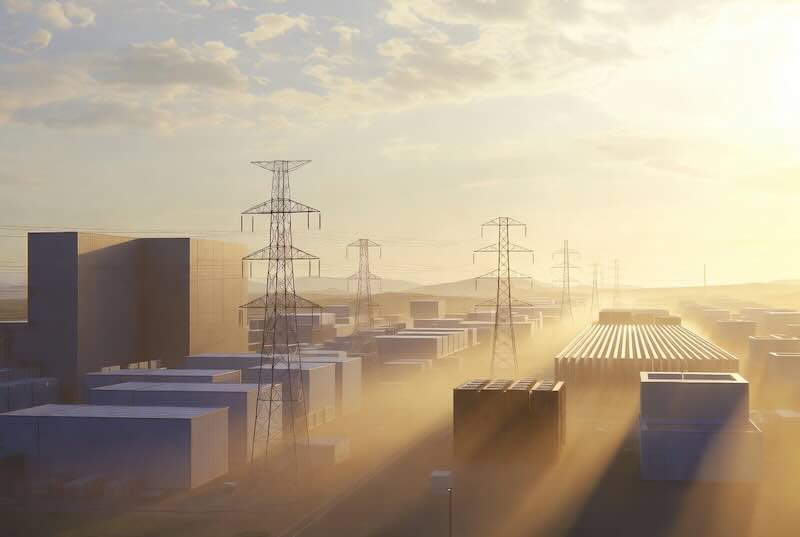
Big Tech is spending $650–700 billion on AI infrastructure in 2026 alone — a 60% jump from already historic 2025 levels. Meta just signed a deal to rent chips from Google. Amazon is headed for negative free cash flow. Nobody can afford to stop.
The four largest technology companies in the world — Alphabet, Amazon, Meta, and Microsoft — are on track to spend somewhere between $650 billion and $700 billion on AI infrastructure in 2026. Not over a decade. Not cumulatively. This year. For context: the entire US defence budget is around $886 billion. The AI infrastructure commitment from four private companies now approaches that level — and unlike the defence budget, it has no democratic sanction and no mandated oversight.
What Happened
The picture crystallised this week as Q4 earnings season closed out. Bridgewater Associates published an analysis showing the four hyperscalers collectively committed to more than $650 billion in AI-related capital expenditure for 2026 — a figure CNBC's analysis puts closer to $700 billion when infrastructure financing is included. The projected increase represents a 60%-plus jump from the already-record levels of 2025.
The individual commitments are staggering. Amazon expects to spend $200 billion this year — the most aggressive target of any single company. Alphabet has guided for up to $185 billion. Both companies are doing this while accepting that near-term free cash flow will take severe hits: Morgan Stanley projects Amazon will run a free cash flow deficit of $17 billion in 2026; Bank of America sees a $28 billion deficit. In November, Alphabet raised $25 billion in bonds to finance the build-out, quadrupling its long-term debt to $46.5 billion.
Meanwhile, Meta — a company that has invested heavily in building its own silicon independence through its MTIA custom chips — has quietly signed a multi-billion dollar deal to rent AI computing capacity from Google. The Information reported the arrangement last week, citing a person involved in the talks. The detail is significant: even the companies that planned to free themselves from chip dependency are renting capacity from rivals because demand has outrun their ability to supply themselves.
Why It Matters
There are two ways to read a $700 billion capital commitment with declining free cash flow and rising corporate debt. The first: the companies know something about near-term AI returns that has not yet shown up in public data, and they are front-running a productivity transformation that will justify the spend within a few years. The second: game-theory logic has trapped every hyperscaler in a race where any company that cuts capex risks permanent competitive disadvantage, regardless of near-term economics. Both can be true simultaneously, and that combination is the most dangerous scenario.
The Meta-Google chip deal is the most revealing single data point in the story. Meta has the resources, the engineering talent, and the stated strategic intent to build chip independence. It has invested billions in MTIA. And yet it is renting Google's TPU capacity. This suggests that the AI compute demand Meta is trying to satisfy — for training and inference across its product suite — is growing faster than any single company's ability to supply itself, regardless of vertical integration strategy. The bottleneck is real, the competition is acute, and the established hierarchy in AI infrastructure is becoming entrenched faster than challengers can overcome it.
Microsoft's stock performance adds another signal. Microsoft is down 17% year to date — the worst-performing hyperscaler. The market is pricing in uncertainty about whether the company's AI investment thesis, built around OpenAI integration and Copilot, will generate sufficient returns against the scale of its capital commitments. That is not a small concern: Microsoft has staked its next decade on AI returning the kind of operating leverage that its previous generation of cloud infrastructure delivered. The early signs are mixed.
Wider Context
The scale of the infrastructure commitment is reshaping every adjacent market. The AI boom is consuming the world's supply of high-bandwidth memory chips at a rate that is squeezing consumer device manufacturers — a dynamic covered in detail here last week. The energy implications are equally stark: major hyperscalers are now signing long-term nuclear power agreements to guarantee baseload supply for data centres. Google, Amazon, and Microsoft have all announced reactor deals in the past six months.
The financing structure is also worth examining. The companies spending at this scale are not doing it primarily from operational cash flow — they are borrowing. Alphabet's long-term debt quadrupled in a single year. Amazon has indicated it may need to raise additional equity and debt. These are not the financing patterns of companies confident about near-term payback periods; they are the patterns of companies that believe they are making bets whose returns are structurally certain but temporally uncertain. They might be right. The history of technology infrastructure investment suggests that the biggest bets — even the ones that look financially unsustainable in the short run — often deliver their returns, eventually. The question is always the same: how long is eventually?
The political dimension is increasingly relevant as well. The Pentagon's decision to sign an AI partnership with OpenAI — and the broader direction of US AI policy away from regulation and toward deployment — signals that the US government views this infrastructure race as a national security concern, not just a commercial competition. When states start treating private sector capital expenditure as strategic infrastructure, the risk profile of the investment changes. There is an implicit sovereign backstop being priced in.
The Singularity Soup Take
The game-theory framing is the honest one here, and it's the one that should worry observers of AI development who care about outcomes beyond market share. When the competitive logic demands that you keep spending regardless of near-term returns — when cutting back signals weakness and invites displacement — the decision calculus no longer reflects rational assessment of value creation. It reflects survival logic.
That is the condition the hyperscalers are in. And it means the infrastructure being built right now is not being built to optimally serve the uses that will emerge from it. It is being built to win a race whose rules are still being written. The companies that win the race will have enormous leverage over what those rules become. That is the real stake in a $700 billion annual commitment — not the immediate returns, but the structural position it purchases.
The Meta-Google chip rental is the most honest signal in the story. Meta is paying its competitor for the privilege of competing with it. When that logic is rational — and for now, it is — you know the infrastructure race has reached a phase where the normal rules of competitive behaviour no longer apply.
What to Watch
Q1 2026 earnings guidance will be the first real-time checkpoint: if any hyperscaler revises its capex commitment downward, it will either signal confidence that the build-out is ahead of schedule, or trigger a market reaction that tests how sensitive the race logic is to any sign of blinked competition. Watch also for ROI signals from enterprise AI deployments — the theoretical returns on this infrastructure are supposed to flow through productivity gains in corporate AI tools, and the evidence for those gains is still thin relative to the scale of the bet. The Meta-Google chip deal terms, when they eventually become public, will reveal something important about how Google is pricing its TPU advantage and whether it views chip rental as a competitive weapon as much as a revenue stream.