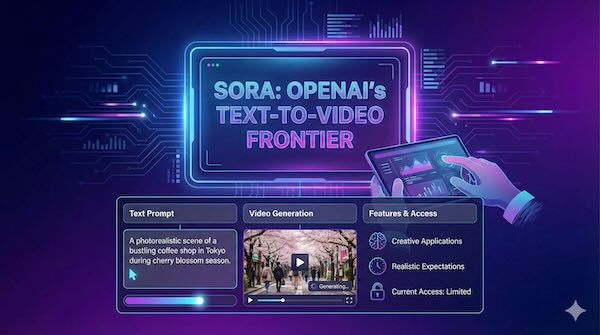
OpenAI's Sora represents one of the most significant advances in AI-generated video, enabling users to create short video clips from simple text descriptions. Since its public debut in December 2024 and the release of Sora 2 in September 2025, the technology has generated both excitement and controversy as it pushes the boundaries of what generative AI can accomplish.
What Sora Can Do
Sora transforms text prompts into video clips, generating scenes with multiple characters, specific camera movements, and detailed environments. The technology builds on OpenAI's DALL-E image generation model, extending those capabilities into the temporal dimension—understanding not just static images but how scenes unfold over time.
The original Sora could generate videos up to 20 seconds long at 1080p resolution. Sora 2, released in September 2025, introduced synchronized dialogue, sound effects, and music generation alongside the video. OpenAI describes Sora 2 as achieving the "GPT-3.5 moment for video"—capable of rendering complex actions like gymnastic routines and figure skating while more faithfully obeying physics than earlier models.
Key capabilities include:
- Text-to-video generation: Describe a scene in natural language and receive a video clip
- Image-to-video: Animate a still image into motion
- Video extension and remixing: Extend existing clips or blend multiple sources
- Storyboard tool: Specify individual frames by timestamp for precise control
- Character feature: Upload a reference video to insert yourself into AI-generated scenes
- Synchronized audio: Ambient sounds, effects, and dialogue generated automatically
How to Access Sora
Sora is available through ChatGPT Plus and ChatGPT Pro subscriptions. ChatGPT Plus costs $20 per month and provides basic access with 720p resolution and watermarked outputs. ChatGPT Pro at $200 per month unlocks Sora 2 Pro with 1080p video, longer clips up to 25 seconds, watermark-free downloads, and priority queue access.
The Sora app is currently available in select regions including the United States, Canada, Japan, South Korea, Mexico, and several other countries. The UK, Switzerland, and the European Economic Area are notably excluded. An iOS app launched alongside Sora 2, with Android support following in late 2025.
OpenAI has also released a Video API in preview, exposing Sora's capabilities to developers for the first time with endpoints for creating, monitoring, and downloading videos programmatically.
Creative Applications
Filmmakers and artists have embraced Sora as a rapid prototyping and ideation tool. Director Paul Trillo described working with Sora as feeling "unchained as a filmmaker—not restricted by time, money, or other people's permission."
The Toronto-based collective Shy Kids created "Air Head," a short film featuring a man with a balloon for a head, demonstrating how the tool can bring surreal concepts to life. The team noted that maintaining character consistency across shots remains challenging, which partly influenced their choice of a distinctive balloon-headed protagonist.
Practical creative applications include:
- Concept visualization: Quickly iterate on visual ideas before committing to traditional production
- Social media content: Generate short-form vertical videos for platforms
- Marketing materials: Create brand snippets and concept teasers
- Storyboarding: Develop animated pre-visualization for larger projects
- Artistic experimentation: Explore surreal or fantastical imagery that would be costly to produce traditionally
OpenAI launched Sora Selects, an artist program with $3 million in funding, featuring creators who showcase the tool's potential through short films.
Current Limitations
Despite impressive demonstrations, Sora has significant constraints that users should understand before diving in.
Physics simulation remains imperfect. Objects sometimes float when they should fall, liquids can pour upward, and basketballs may bounce without being touched or roll in impossible directions. While Sora 2 improved physics handling considerably, OpenAI acknowledges the model still makes mistakes.
Text rendering is unreliable. Generating readable text in videos—such as signs, logos, or written words—remains a critical limitation with very low accuracy. Content requiring legible text typically needs post-production fixes.
Hand anatomy and complex poses struggle. Users frequently encounter anatomical challenges including finger proportion issues, joint positioning variations, and occasional digit count inconsistencies.
Duration and consistency limits apply. ChatGPT Plus users are limited to 5-10 second clips, while Pro users can create videos up to 20-25 seconds. Maintaining consistent characters and environments across multiple generations remains difficult.
Beta testers from Shy Kids summarized the creative tension: "Control is difficult, which as creatives, you want control. That was our general feedback to the researchers."
Realistic Expectations
Sora works best when users approach it as a creative tool rather than a replacement for traditional video production. Filmmaker Don Allen Stevenson III noted that the tool takes prompts very literally—attempting to create a shot that "zoomed in on a helicopter" resulted in Sora mixing together a helicopter with a camera's zoom lens.
Successful workflows typically involve:
- Iterative prompting: Generating many variations and selecting the best results
- Post-production polish: Using traditional editing tools for colour correction, stabilisation, and fixes
- Hybrid approaches: Combining AI-generated footage with human-created elements like music, voice-over, and effects
- Accepting surprise: Some filmmakers embrace the unexpected outputs—"I like having less control. I like the chaos of it," said Stevenson.
Controversies and Concerns
Sora has attracted criticism on multiple fronts. By default, the generator uses copyrighted material in its videos unless copyright holders actively opt out. This prompted Japan's Content Overseas Distribution Association, representing companies like Studio Ghibli and Square Enix, to demand OpenAI stop using their copyrighted content.
The Walt Disney Company took a different approach, investing $1 billion in OpenAI to license more than 200 characters for use in Sora, including those from Disney Animation, Pixar, Marvel Studios, and Star Wars.
Watermarking has proven contentious. While all Sora-generated videos include a visible, moving digital watermark, third-party programs capable of removing it became prevalent within a week of Sora 2's release.
The social media aspects of the Sora app have drawn comparisons to TikTok, with some critics calling it "SlopTok"—a reference to concerns about AI-generated content flooding social feeds. Filmmaker Tyler Perry announced he would put a planned $800 million studio expansion on hold, citing concerns about Sora's potential impact on the film industry.
The Competitive Landscape
Sora operates in an increasingly crowded field. Competitors include Google's Veo 3, Runway's Gen-3 and Gen-4 models, and Pika Labs' offerings. Each has different strengths—some excel at longer clips, others at specific visual styles or editing controls.
For users evaluating options, the choice often comes down to access, pricing, and specific creative needs. Sora's integration with ChatGPT subscriptions makes it accessible to existing OpenAI users, while its synchronized audio generation distinguishes it from many competitors.
Getting Started
For those ready to experiment, the path forward is straightforward:
- Subscribe to ChatGPT Plus ($20/month) or Pro ($200/month)
- Access Sora through sora.com or the mobile app
- Start with simple, specific prompts describing scenes, camera movements, and visual details
- Generate multiple variations and iterate on successful results
- Plan for post-production work on any footage intended for professional use
The technology continues evolving rapidly. What seems like a limitation today may be resolved in months, while entirely new capabilities may emerge. For creators willing to work within current constraints and embrace experimentation, Sora offers a glimpse into a future where the gap between imagination and visual realisation continues to narrow.