How OpenAI's Text-to-Image Generator Handles Complex Prompts
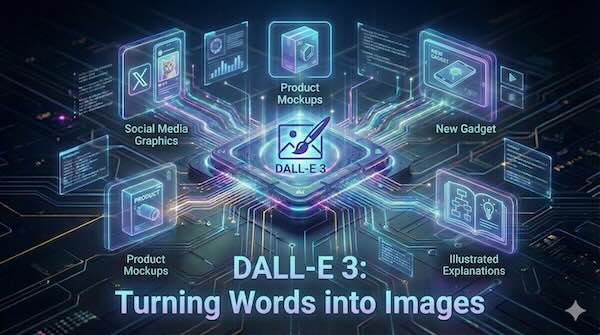
Released in October 2023, DALL-E 3 represents OpenAI's most significant leap forward in text-to-image generation. Built natively on ChatGPT, the system addresses one of the most persistent frustrations with earlier AI image generators: the tendency to ignore parts of a prompt or conflate different elements together. For marketers creating social media graphics, designers mocking up products, or educators building illustrated explanations, this improved prompt adherence opens up practical applications that were previously hit-or-miss.
The ChatGPT Integration Advantage
Unlike its predecessors, DALL-E 3 works directly within ChatGPT, creating a conversational approach to image generation. When a user submits an idea, ChatGPT automatically expands it into a detailed prompt optimised for image generation. A simple request like "a cat on a chair" becomes a richly specified scene with lighting conditions, artistic style, and compositional details.
This means users no longer need to master the arcane art of prompt engineering. Where DALL-E 2 required specific technical phrasing to produce quality results, DALL-E 3 interprets natural language and fills in the gaps intelligently. If the output isn't quite right, users can ask for adjustments conversationally: "make the lighting warmer" or "add more detail to the background" rather than rewriting the entire prompt from scratch.
Enhanced Prompt Understanding
DALL-E 3 demonstrates markedly better comprehension of spatial relationships, quantities, and specific arrangements. Ask for "three red apples on the left side of a wooden table with a blue vase on the right," and the system reliably places each element where specified. Earlier models would frequently muddle these instructions, producing images where objects drifted to unexpected positions or appeared in incorrect numbers.
The model also handles complex parameters that previously required expert-level prompting. Lighting conditions, camera angles, textures, artistic movements, and emotional atmosphere can all be specified in plain language. A prompt requesting "a moody film noir scene with harsh shadows and a 1940s aesthetic" produces results that actually capture that sensibility rather than delivering a generic dark image.
Text Rendering: Progress with Caveats
One of DALL-E 3's most talked-about improvements is its ability to render legible text within images. Where DALL-E 2 typically produced gibberish when asked to include words, DALL-E 3 can successfully generate short phrases, signs, and labels that are actually readable.
This capability works best with brief text: a shop sign reading "Open," a book spine with a three-word title, or a poster with a simple slogan. Common words that appear frequently in training data tend to render more reliably than unusual terms or longer phrases. When creating a vintage neon sign that reads "Open 24 Hours," the model generally succeeds. Asking it to spell out a company's full mission statement remains problematic.
The limitation matters for practical applications. Designers creating social media graphics or product mockups often find they can use DALL-E 3 for the visual composition, then overlay text manually in graphic design software for guaranteed accuracy. The model produces occasional spelling errors, inconsistent kerning, and garbled characters in longer text strings, making manual text overlay a common part of professional workflows.
Practical Applications
Social Media Graphics
Marketing teams use DALL-E 3 to rapidly prototype visual concepts for campaigns. Rather than briefing a designer on an abstract idea, a marketer can generate multiple directions in minutes. Prompts specifying brand colours, mood, and subject matter produce images that serve as starting points for refinement or, in some cases, final assets with minor touchups.
The model handles requests like "a minimalist Instagram post showing a coffee cup with morning light, warm neutral tones, clean modern aesthetic" with consistent quality. For accounts requiring high volumes of visual content, this capability significantly accelerates production timelines.
Product Mockups
Before investing in photography or detailed 3D renders, designers use DALL-E 3 to visualise product concepts in context. A prompt describing "a white sneaker with green accents displayed on a marble surface with soft studio lighting" generates realistic mockups useful for internal reviews and stakeholder presentations.
The model excels at blank mockup generation: business cards against textured backgrounds, posters on exterior walls, packaging on store shelves. These outputs serve as templates where designers can composite their actual artwork, saving the cost of physical photography while maintaining a professional presentation style.
Illustrated Explanations
Educational content creators find DALL-E 3 useful for generating custom illustrations that would otherwise require commissioning an artist or settling for generic stock imagery. A science educator can prompt for "a cross-section diagram of a plant cell in a watercolour textbook illustration style" and receive something tailored to their specific lesson rather than hunting through stock libraries for an imperfect match.
The model handles abstract concepts reasonably well when given clear visual metaphors. "A lightbulb made of interconnecting puzzle pieces representing collaborative innovation, vector illustration style" produces usable results where stock photography would fail entirely.
Working Within Limitations
DALL-E 3 maintains certain constraints that affect creative workflows. The system declines requests for images of real public figures by name and won't reproduce the style of living artists when explicitly requested. These safety measures occasionally block legitimate requests through overly broad filtering, requiring users to rephrase prompts to work around false positives.
Human anatomy remains challenging. Hands frequently appear with incorrect finger counts or impossible joint positions. Faces in crowded scenes may exhibit subtle uncanny qualities. Professional use cases requiring human subjects often require careful prompt crafting and selection from multiple generations to find acceptable results.
The model also lacks memory between sessions. Unlike working with a human designer who builds understanding of a brand over time, each DALL-E 3 interaction starts fresh. Maintaining visual consistency across a series of images requires users to develop template prompts they reuse, specifying the same style descriptors, colour palettes, and compositional preferences each time.
The Iterative Workflow
Effective use of DALL-E 3 typically involves iteration. Starting with a broad description, users review the initial output, identify what works and what needs adjustment, then refine their prompt for the next generation. This cycle might repeat several times before arriving at a satisfactory result.
The ChatGPT integration makes this process conversational rather than technical. Instead of rewriting complex prompts from scratch, users simply describe the changes they want: "keep the composition but make the colours more saturated" or "same scene but from a lower camera angle." ChatGPT translates these instructions into appropriate prompt modifications.
For professional workflows, maintaining libraries of proven prompt phrases accelerates this process. Terms that reliably produce desired outcomes for lighting, texture, style, and mood become reusable components that ensure consistency across projects.
Where It Fits
DALL-E 3 occupies a specific niche in the creative toolkit. It excels at rapid ideation, concept visualisation, and producing stylised illustrations. It's less suited to photorealistic human subjects, precise text-heavy designs, or applications requiring exact reproducibility across images.
For the marketing team needing twenty social media graphic concepts by end of day, DALL-E 3 delivers. For the photographer seeking to replace a studio shoot, the technology isn't there yet. Understanding these boundaries helps users apply the tool where it genuinely saves time and produces quality results, while avoiding frustrating attempts at tasks better suited to other methods.
The integration with ChatGPT represents a meaningful shift in accessibility. What once required specialised prompting knowledge now works through plain conversation. As users discover what the system does well and where it struggles, DALL-E 3 is finding its place not as a replacement for human creativity, but as an accelerant for it.