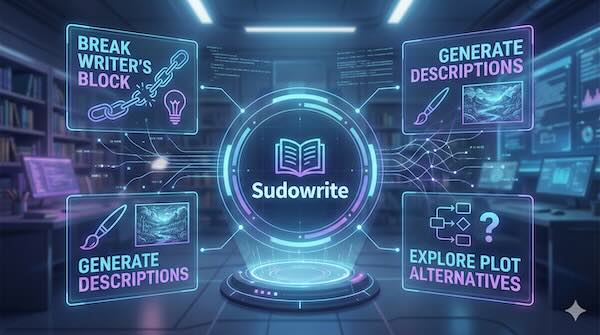
For novelists staring at a blank page or screenwriters wrestling with a stubborn second act, artificial intelligence is emerging as an unexpected creative partner. Sudowrite, launched in 2020, has positioned itself as one of the most focused AI writing tools for fiction creators, offering a suite of features designed specifically for the challenges of narrative craft.
What Makes Sudowrite Different
Unlike general-purpose AI writing assistants, Sudowrite was built from the ground up with storytellers in mind. The platform trains its models on published fiction and focuses on the particular needs of creative writers rather than business communications or academic work.
The tool integrates directly into the writing workflow, allowing authors to highlight passages and request specific types of assistance without breaking their creative momentum.
Core Features for Fiction Writers
Describe generates sensory-rich descriptions when writers need to flesh out a scene. Feed it a basic sentence about a character entering a room, and it returns options incorporating sight, sound, smell, and atmosphere.
Brainstorm helps writers explore possibilities when they feel stuck. It can suggest plot twists, character motivations, or alternative directions for a scene that has stalled.
Write continues prose in the style and voice the author has already established, useful for pushing through difficult passages or exploring where a scene might go.
Rewrite offers variations on existing text, allowing writers to see their sentences rendered in different tones or styles without losing the original.
Canvas provides a visual story planning tool where writers can map out plot structures, character arcs, and story beats before diving into prose.
Practical Applications
Writers report using Sudowrite most commonly for:
- Breaking through blocks by generating starter text that can be revised or discarded
- Testing dialogue variations to find the right voice for characters
- Expanding thin scenes with descriptive detail
- Exploring "what if" scenarios without committing to a direction
- Maintaining consistency across long manuscripts
The Creative Partnership Question
Sudowrite occupies interesting territory in ongoing debates about AI and creativity. The company positions its tools as collaborative rather than replacement technology, comparing them to how musicians use synthesizers or filmmakers use CGI.
Critics argue that over-reliance on such tools could homogenise fiction or atrophy a writer's own generative abilities. Supporters counter that the final creative decisions remain with the human author, who must still shape, edit, and refine whatever the AI suggests.
Pricing and Access
Sudowrite operates on a subscription model with tiered pricing based on usage. A free trial allows writers to test the features before committing. The platform works in-browser, requiring no software installation.
Who Benefits Most
The tool appears most useful for writers who already have a clear vision but struggle with execution, those working under deadline pressure, and authors looking to increase their output without sacrificing quality. Writers who find the blank page paralysing may discover that AI-generated starting points free them to do what they do best: revise, refine, and make the work their own.
For the fiction writing community, Sudowrite represents one answer to the question of how AI might serve creative work rather than simply automating it.