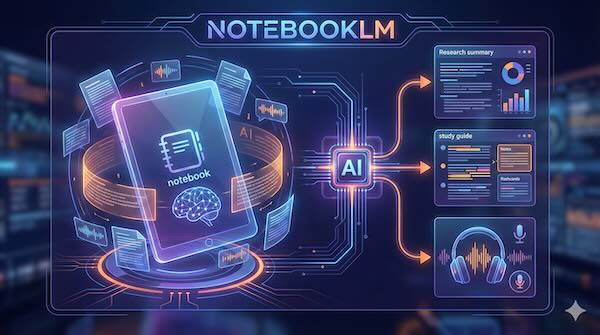
Google's NotebookLM represents a distinctive approach to AI assistance: rather than drawing on a vast general knowledge base, it creates a custom AI grounded entirely in documents you upload. This source-first design addresses one of the persistent challenges with large language models—the tendency to generate plausible-sounding but inaccurate information.
How NotebookLM Works
The tool accepts various document types including PDFs, Google Docs, web pages, and YouTube videos. Once uploaded, these sources become the foundation for an AI that can answer questions, summarise content, and identify connections across your materials. Crucially, the AI restricts its responses to information contained within your sources, reducing the hallucination problem that affects general-purpose chatbots.
Each response includes citations pointing back to specific passages in your documents, allowing you to verify claims and explore the original context. This transparency makes NotebookLM particularly useful for work where accuracy matters more than breadth.
Key Use Cases
Academic Research and Studying
Students and researchers can upload lecture notes, papers, and textbooks, then query the resulting knowledge base to test understanding, clarify concepts, or find connections between sources they might have missed. The citation feature helps trace ideas back to their origins.
Professional Research Synthesis
For analysts, journalists, or anyone synthesising information from multiple sources, NotebookLM can accelerate the process of identifying themes, contradictions, and gaps across a document collection. Rather than manually cross-referencing materials, users can ask targeted questions and receive sourced answers.
Content Creation
Writers and content creators can use the tool to organise research materials and generate outlines grounded in their sources, reducing the risk of factual drift that can occur when working from memory.
Audio Overview: The Podcast Feature
Perhaps NotebookLM's most unexpected capability is Audio Overview, which generates podcast-style discussions between two AI voices based on your uploaded sources. These synthetic conversations explain and debate the material in an accessible format, making dense documents easier to absorb.
The feature has found particular traction among learners who prefer audio formats and professionals who want to review materials during commutes or exercise. While the AI-generated hosts occasionally exhibit an enthusiasm that feels artificial, the educational value for passive learning is genuine.
Limitations to Consider
NotebookLM's strength—grounding responses in your sources—is also a constraint. It cannot draw on external knowledge, so questions requiring context beyond your documents will go unanswered. The tool works best when your source collection is comprehensive enough to address your likely questions.
Source limits also apply. While generous for most personal projects, large-scale research involving hundreds of documents may require careful curation of what to include.
Positioning in the AI Landscape
NotebookLM occupies an interesting niche between general AI assistants and specialised research tools. Where ChatGPT or Claude offer broad knowledge with the risk of fabrication, and traditional search requires manual synthesis, NotebookLM provides AI-powered analysis with built-in constraints that promote accuracy.
For users who need to deeply understand a defined body of material rather than explore open-ended questions, this trade-off often proves worthwhile.