Series: Beginner's Guide to AI #3
Read Time: 12 minutes
Level: Beginner
Prerequisites: Guide #1 - What Is AI?
Key Takeaways
- AI learns by finding patterns in massive amounts of data - the more examples it sees, the better it gets
- Neural networks mimic the human brain with layers of artificial "neurons" that process information
- Training is the key process where AI adjusts itself millions of times to improve its accuracy
- AI makes predictions, not decisions - it calculates probabilities based on what it learned from data
- Understanding how AI works helps you use it better and recognize its limitations
You know what AI is and how we got here. But how does it actually work? How can software look at a picture and tell you it's a cat? How does ChatGPT write essays? How does your phone predict the next word you'll type?
The answer involves some fascinating concepts that sound complex but are actually based on surprisingly simple ideas. Let's pull back the curtain and understand the mechanics of modern AI—no PhD required.
The Core Concept: Learning from Examples
At its heart, AI is about learning from examples rather than following explicit instructions. This is fundamentally different from traditional programming.
Traditional Programming vs. Machine Learning
Traditional Programming:
- Programmer writes specific rules: "If temperature > 80°F, turn on air conditioning"
- Computer follows these rules exactly, every single time
- Works great when rules are clear and unchanging
Machine Learning (AI):
- Give the system thousands of examples: rooms with different temperatures and whether people were comfortable
- The system figures out the patterns: people usually want AC when it's above 75°F, but less so when humidity is low
- The system can now make predictions for new situations it hasn't seen before
The Power of Patterns
Humans are excellent at recognizing patterns, but AI can find patterns in data at scales impossible for humans. An AI looking at millions of cat photos doesn't "know" what a cat is, but it learns statistical patterns: cats usually have pointed ears, whiskers, four legs, fur with certain textures, and specific face shapes.
When shown a new image, it calculates: "Based on all the patterns I learned, there's a 95% probability this is a cat."
Data: The Fuel That Powers AI
Before AI can learn anything, it needs data—lots of it.
Why AI Needs So Much Data
Think about how you learned to recognize dogs as a child. You probably saw dozens or hundreds of dogs before you could reliably identify them. AI needs similar repetition, but because it's starting from scratch with no prior knowledge, it needs vastly more examples.
Modern AI systems are trained on:
- Millions of images for visual recognition
- Billions of words for language understanding
- Thousands of hours of speech for voice recognition
- Years of data for prediction systems
Quality Matters Too
More data isn't always better. The data needs to be:
Accurate: Mislabeled examples teach AI the wrong patterns Representative: If you train AI on only golden retrievers, it won't recognize poodles Diverse: A face recognition system trained only on well-lit studio photos will fail in real-world conditions Relevant: Data about cats won't help AI recognize cars
This is why "garbage in, garbage out" is especially true for AI. Bad training data creates bad AI.
Neural Networks: Inspired by the Brain
The most powerful AI today uses "neural networks"—systems loosely inspired by how the human brain works.
The Biological Inspiration
Your brain contains about 86 billion neurons (nerve cells) connected in complex networks. When you learn something, your neurons strengthen certain connections and weaken others. This is how memories form and skills develop.
Artificial neural networks mimic this with mathematical models.
Artificial Neurons: The Building Blocks
An artificial neuron is actually quite simple:
- Receives inputs: Numbers representing information (like pixel brightness values)
- Multiplies each input by a "weight": Some inputs matter more than others
- Adds everything together: Combines all the weighted inputs
- Applies an activation function: Decides whether to "fire" (output a signal) based on the total
Simple Analogy:
Imagine deciding whether to go to the beach. You consider:
- Weather (very important, weight: 5)
- Distance (somewhat important, weight: 3)
- Crowds (less important, weight: 1)
If weather is great (9/10), distance is far (4/10), and crowds are moderate (6/10): (9×5) + (4×3) + (6×1) = 45 + 12 + 6 = 63
If your threshold is 60, you decide to go to the beach. That's essentially what one neuron does.
Layers Upon Layers
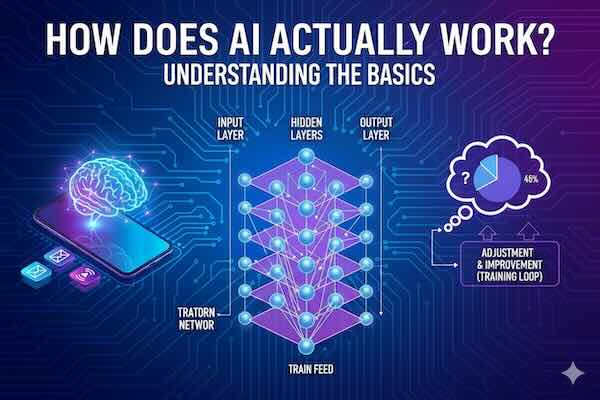
A single neuron isn't very smart, but neural networks connect thousands or millions of them in layers:
Input Layer: Receives the raw data (pixels, words, sounds) Hidden Layers: Multiple layers that process and transform the information Output Layer: Produces the final result (classification, prediction, generated text)
Each layer learns increasingly complex patterns:
- First layers: Detect simple features like edges and colors
- Middle layers: Recognize combinations like shapes and textures
- Deep layers: Identify complex concepts like "cat face" or "car wheel"
This is why they're called "deep" learning—the networks can be dozens or hundreds of layers deep.
Training: How AI Learns
Here's where the magic happens. Training is the process where an AI adjusts itself to become better at its task.
The Training Process Step-by-Step
Step 1: Initialize Randomly The neural network starts with completely random weights. It's essentially guessing blindly.
Step 2: Make a Prediction Show the network an example (like a photo of a cat) and ask it to classify it. With random weights, it will probably guess wrong.
Step 3: Calculate the Error Compare the AI's guess to the correct answer. If it said "dog" but the correct answer is "cat," calculate how wrong it was.
Step 4: Adjust the Weights This is the crucial part. The network adjusts its internal weights to reduce the error. It does this using sophisticated mathematics (backpropagation and gradient descent), but the concept is simple: change the weights in the direction that would have made the prediction more accurate.
Step 5: Repeat Millions of Times The network goes through thousands or millions of examples, adjusting itself slightly each time. Gradually, the random weights transform into patterns that recognize cats, dogs, cars, faces, or whatever it's learning.
The Learning Curve
Training isn't instant. Large AI models might train for:
- Days or weeks on powerful computers
- Millions or billions of training examples
- Countless iterations adjusting billions of parameters
This is why training costs can reach millions of dollars for cutting-edge models.
When Is Training Done?
The network is ready when it performs accurately on new data it hasn't seen before. This is tested using a "validation set"—examples kept separate from training.
Warning Sign: If AI performs perfectly on training data but poorly on new data, it has "overfit"—memorized the examples rather than learning general patterns. It's like a student who memorizes test questions but doesn't understand the subject.
How Different Types of AI Work
Now that you understand the basics, let's see how specific AI applications work.
Image Recognition
How it works:
- Image is converted to millions of numbers (pixel values)
- First neural network layers detect edges and colors
- Middle layers combine these into shapes and textures
- Deep layers recognize objects, faces, or scenes
- Output layer calculates probabilities: 85% cat, 10% dog, 5% other
Why it sometimes fails: Unusual angles, poor lighting, or objects it wasn't trained on can confuse the system. It's recognizing patterns, not truly "seeing."
Language Models (Like ChatGPT)
How it works:
- Trained on billions of sentences from books, websites, and articles
- Learns statistical patterns: which words typically follow which other words
- When you give it a prompt, it predicts the most likely next word
- Then predicts the word after that, and so on
- Uses "attention mechanisms" to keep track of context
Why it sounds human: It learned from human writing. But it's predicting patterns, not thinking. It doesn't "understand" meaning the way humans do.
Simple Example: If you write "The capital of France is ___", the model has seen this pattern thousands of times in training. "Paris" is the overwhelmingly most likely next word based on statistics, not because it "knows" geography.
Recommendation Systems
How it works:
- Collects data on what you've watched, liked, or bought
- Finds patterns: people who liked Item A often liked Item B
- Identifies users with similar preferences to you
- Recommends items that similar users enjoyed
- Constantly learns from whether you engage with recommendations
Why recommendations sometimes miss: If your preferences are unusual, or you share an account with others, the patterns become confused.
Speech Recognition
How it works:
- Audio is converted into a spectrogram (visual representation of sound)
- Neural network processes the patterns of frequencies over time
- Matches these patterns to phonemes (basic speech sounds)
- Combines phonemes into words based on language patterns
- Uses context to resolve ambiguities ("to," "two," "too")
Why it struggles: Accents, background noise, or unclear speech create patterns different from training data.
Self-Driving Cars
How it works (simplified):
- Multiple sensors (cameras, radar, lidar) collect environmental data
- Computer vision identifies lanes, signs, vehicles, pedestrians
- Prediction models forecast what other vehicles/pedestrians will do
- Planning algorithms decide the best path forward
- Control systems execute the driving actions
Why it's hard: Driving requires processing multiple types of information simultaneously, making split-second decisions, and handling extremely rare but critical situations (a ball rolling into the street might mean a child follows).
Understanding AI Limitations
Knowing how AI works reveals why it has specific limitations:
AI Can't Reason Like Humans
AI recognizes patterns and calculates probabilities. It doesn't "think through" problems using logic and common sense the way humans do.
Example: An AI might correctly identify a photo of a school bus but couldn't reason: "If school buses transport children, and this is rush hour, there are probably children inside."
AI Lacks True Understanding
Language models can write about quantum physics without "understanding" quantum physics in any meaningful sense. They're predicting word patterns based on statistical training.
AI Is Only As Good As Its Data
If training data contains biases, the AI learns those biases. If important scenarios are missing from training data, AI won't handle them well.
Real Example: Some facial recognition systems performed worse on darker skin tones because training datasets contained fewer examples of diverse faces.
AI Can't Explain Its Reasoning
Neural networks with billions of parameters are "black boxes." Even experts can't fully explain why the network made a specific decision. We can see what patterns it responds to, but not the complete chain of reasoning.
AI Lacks Common Sense
Humans have lifetime experience understanding how the world works. AI only knows patterns from its training data. It might generate grammatically perfect sentences that make no logical sense.
Example: An AI might write "I put the ice cream in the oven to keep it cold" because it learned word patterns without understanding physics.
How Training Data Shapes AI Behavior
The data AI trains on fundamentally determines what it can do:
What Data Teaches AI
Image Recognition: Millions of labeled photos teach: "This pattern of pixels = cat" Language Models: Billions of sentences teach: "After 'Once upon a time' usually comes a story" Recommendation Engines: User behavior teaches: "People who bought A often bought B" Game-Playing AI: Millions of games teach: "This move in this situation leads to winning"
The Bias Problem
If training data reflects societal biases, AI learns those biases as "patterns":
- Job screening AI trained on historical hires might favor candidates who look like past hires
- Language models trained on internet text might associate certain jobs with genders
- Facial recognition trained mainly on certain demographics might be less accurate on others
This isn't AI being prejudiced—it's AI being a mirror that reflects the patterns in its training data, including problematic ones.
The Role of Human Feedback
Modern AI increasingly uses human feedback to improve:
Reinforcement Learning from Human Feedback (RLHF)
- AI generates multiple outputs
- Humans rank which outputs are better
- AI adjusts to prefer patterns that humans rate highly
- Process repeats thousands of times
This is how ChatGPT learned to be helpful, harmless, and honest—human trainers provided feedback on which responses were better.
Continuous Improvement
Many AI systems keep learning after deployment:
- Search engines learn from which results people click
- Recommendation systems learn from what you watch or buy
- Voice assistants learn from corrections
This creates feedback loops: better AI leads to more usage, more usage provides more data, more data improves AI.
Putting It All Together
Let's trace what happens when you use AI:
Example: Asking ChatGPT a Question
- You type: "What causes rainbows?"
- Tokenization: Text is broken into pieces the model understands
- Encoding: Words become numbers that neural networks can process
- Processing: Billions of neural network weights (learned during training) activate in layers
- Context: Attention mechanisms identify which parts of your question matter most
- Prediction: Model predicts likely next word based on patterns learned from training
- Generation: Repeats prediction word-by-word to build complete response
- Output: Text is converted back to readable form and displayed
This entire process happens in seconds, but represents billions of mathematical calculations based on patterns learned from training on trillions of words.
Why Understanding This Matters
Knowing how AI works helps you:
Use AI More Effectively: Understanding that AI learns from examples helps you provide better prompts and context
Recognize Limitations: Knowing AI can't truly reason helps you verify important information
Interpret Mistakes: Understanding training data helps you predict where AI might struggle
Evaluate Claims: Knowing the technology helps you distinguish realistic expectations from hype
Participate in Discussions: Understanding basics lets you engage with debates about AI policy, ethics, and development
The Bottom Line
AI works through a beautifully simple concept—learning patterns from data—executed at massive scale. Neural networks with millions or billions of parameters learn to recognize patterns by adjusting themselves through repeated exposure to examples.
This process, while requiring sophisticated mathematics and enormous computing power, is conceptually similar to how humans learn: through experience and repetition. The key differences are scale (AI processes vastly more examples) and nature (AI finds statistical patterns while humans build understanding).
Understanding these basics demystifies AI. It's not magic, not conscious, not all-knowing. It's an incredibly powerful pattern-matching tool that has learned from human-generated data. Its capabilities and limitations flow directly from this fundamental nature.
Continue Your Learning Journey
Now that you understand how AI works, explore its practical applications:
- Guide #4: AI in Your Daily Life - Discover all the ways you're already interacting with AI
- Guide #5: Understanding ChatGPT and Large Language Models - Dive deeper into how conversational AI works
- Guide #1: What Is AI? - Review the fundamentals if needed
- View All Beginner Guides - See the complete learning path for AI beginners
This article is part of the SingularitySoup Beginner's Guide to AI series. Updated January 2026.