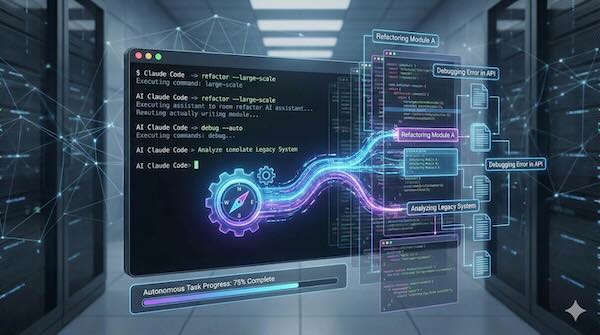
Software development is undergoing a significant transformation with the emergence of agentic coding tools—AI assistants that don't just suggest code snippets but can autonomously navigate, understand, and modify entire codebases. At the forefront of this shift is Claude Code, Anthropic's command-line tool that brings Claude's capabilities directly into the developer's terminal.
Unlike traditional autocomplete-style coding assistants, these agentic tools operate with a degree of independence. They can explore file structures, read documentation, run tests, and execute multi-step tasks without requiring constant guidance. This represents a meaningful evolution from asking an AI to complete a single line of code to delegating entire workflows.
What Makes Agentic Coding Tools Different
Traditional AI coding assistants work within narrow contexts—typically the file you're currently editing. Agentic tools take a fundamentally different approach. They can:
- Traverse entire repositories to understand project architecture and dependencies
- Execute commands to test changes, run builds, or check for errors
- Make coordinated edits across multiple files in a single operation
- Learn from context by reading README files, configuration, and existing code patterns
This broader awareness allows them to tackle tasks that would be tedious or error-prone for developers working manually, while maintaining consistency with existing project conventions.
Practical Applications
Large-Scale Refactoring
Renaming a function used in hundreds of files, updating an API across a codebase, or migrating from one framework to another—these tasks have traditionally required careful manual work or brittle find-and-replace operations. Agentic coding tools can understand the semantic meaning of changes, ensuring that refactors are applied correctly even when naming conventions vary or when context matters.
Debugging Complex Issues
When facing a bug that spans multiple components, developers often spend significant time simply locating the relevant code. An agentic assistant can trace execution paths, examine logs, and propose fixes while explaining its reasoning. This is particularly valuable for intermittent issues or problems in unfamiliar parts of a codebase.
Onboarding to Unfamiliar Projects
Joining a new team or working with legacy code often means weeks of orientation before becoming productive. Agentic tools can serve as knowledgeable guides, answering questions about architecture, explaining why certain patterns were chosen, and helping developers make their first contributions with confidence.
Automating Repetitive Tasks
Writing boilerplate code, adding tests for existing functions, updating documentation after changes—these necessary but repetitive tasks consume developer time that could be spent on more creative work. Delegating them to an AI assistant can free up significant capacity.
Working Effectively with Agentic Tools
Getting the most from these assistants requires some adjustment to typical workflows. Clear communication about goals matters more than precise instructions about implementation. Developers are finding success by describing what they want to achieve rather than how to achieve it, then reviewing the AI's proposed approach before execution.
Version control becomes even more important when AI is making changes. Working in branches, reviewing diffs carefully, and running comprehensive tests before merging are standard practices that take on new significance when changes may touch many files simultaneously.
Current Limitations and Considerations
Agentic coding tools are powerful but not infallible. They can make mistakes, misunderstand requirements, or propose changes that work in isolation but cause problems elsewhere. Human oversight remains essential, particularly for security-sensitive code or complex business logic.
Performance on very large codebases can also be a factor, as understanding millions of lines of code requires substantial context. Different tools handle this challenge in different ways, with various tradeoffs between comprehensiveness and speed.
Looking Ahead
The trajectory of agentic coding tools points toward increasingly sophisticated capabilities. Integration with development environments, better handling of ambiguous requirements, and improved reasoning about complex systems are all active areas of development.
For developers, these tools represent an opportunity to shift focus from mechanical tasks to higher-level problem-solving and design. For teams, they offer potential productivity gains and new approaches to managing technical debt. The technology is still maturing, but its impact on how software gets built is already becoming clear.