Series: Beginner's Guide to AI #7
Read Time: 14 minutes
Level: Beginner
Prerequisites: Guide #1 - What Is AI?
Key Takeaways
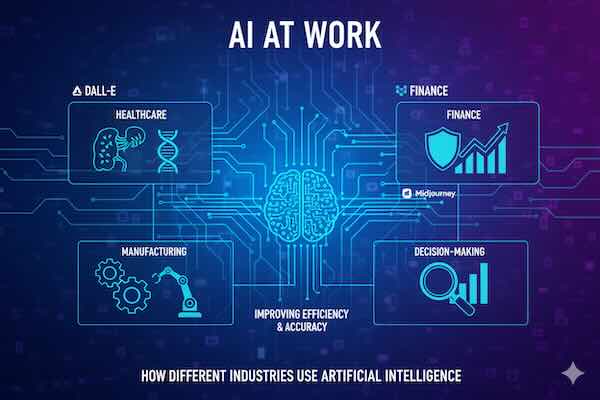
- Nearly every industry now uses AI to improve efficiency, accuracy, and decision-making
- Healthcare leads in transformative applications from diagnosis to drug discovery
- Finance pioneered AI adoption for fraud detection and algorithmic trading
- Manufacturing uses AI for quality control and predictive maintenance
- Understanding industry AI helps you recognize opportunities and prepare for changes in your field
AI isn't just powering your smartphone and social media—it's transforming how work gets done across virtually every industry. From diagnosing diseases to predicting equipment failures, from designing buildings to composing music, AI is reshaping professional landscapes in profound ways.
Whether you're a student planning your career, a professional adapting to change, or simply curious about how AI is reshaping the economy, understanding industry-specific applications reveals both the opportunities and challenges ahead.
Let's explore how different sectors are deploying AI and what it means for workers, businesses, and society.
Healthcare: Saving Lives with AI
Healthcare represents one of AI's most impactful application areas, with potential to improve outcomes while reducing costs.
Medical Diagnosis and Imaging
Radiology and Medical Imaging:
AI analyzes X-rays, MRIs, CT scans, and other medical images with remarkable accuracy:
- Cancer Detection: Identifies tumors in mammograms, often earlier than human radiologists
- Diabetic Retinopathy: Detects eye disease from retinal scans, preventing blindness
- Fracture Detection: Finds broken bones in X-rays, reducing missed diagnoses
- Brain Analysis: Identifies strokes, tumors, and neurological conditions from brain scans
Real Impact: AI doesn't replace radiologists but helps them work faster and catch subtle signs humans might miss.
Pathology:
- Analyzes tissue samples for cancer and disease
- Counts cells and identifies abnormalities
- Provides consistent, objective analysis
- Speeds up diagnosis significantly
Drug Discovery and Development
Accelerating Research:
Traditional drug development takes 10-15 years and costs billions. AI is changing this:
- Molecule Design: Generates new drug candidates by predicting molecular properties
- Clinical Trial Optimization: Identifies ideal patient populations and predicts outcomes
- Repurposing Existing Drugs: Finds new uses for approved medications
- Protein Folding: DeepMind's AlphaFold solved the protein structure problem, accelerating biological research
Example: During COVID-19, AI helped identify potential treatments in months instead of years.
Personalized Medicine
Tailoring Treatment:
AI analyzes patient data to customize care:
- Genetic Analysis: Predicts disease risk based on DNA
- Treatment Selection: Recommends therapies most likely to work for specific patients
- Dosage Optimization: Calculates ideal medication amounts based on individual factors
- Preventive Care: Identifies high-risk patients before symptoms appear
Hospital Operations
Behind the Scenes:
- Patient Flow: Optimizes scheduling and bed allocation
- Staff Scheduling: Predicts demand and allocates nurses and doctors efficiently
- Supply Chain: Manages inventory and reduces waste
- Administrative Tasks: Automates billing, coding, and documentation
Virtual Health Assistants
Patient Support:
- Symptom checkers (though not replacing doctors)
- Medication reminders
- Mental health support chatbots
- Post-surgery monitoring through wearables
Benefit: Extends healthcare access, especially in underserved areas.
Challenges in Healthcare AI
Important concerns:
- Data privacy and patient confidentiality
- Liability when AI makes mistakes
- Bias in training data affecting diagnosis accuracy
- Need for human oversight and judgment
- Regulatory approval processes
Finance: Money and Algorithms
Financial services were early adopters of AI, using it for everything from fraud detection to investment decisions.
Fraud Detection and Security
Real-Time Protection:
Banks use AI to analyze millions of transactions instantly:
- Pattern Recognition: Identifies unusual spending patterns
- Location Analysis: Flags transactions from unexpected places
- Behavioral Analysis: Learns your normal habits to detect anomalies
- Network Analysis: Identifies coordinated fraud rings
Why it works: AI processes far more data than humans could, catching fraud in real-time.
Algorithmic Trading
High-Speed Decision Making:
- Market Analysis: Processes news, social media, and data feeds instantly
- Pattern Recognition: Identifies trading opportunities from historical patterns
- Execution: Makes trades in milliseconds
- Risk Management: Continuously assesses and adjusts portfolio risk
Scale: Majority of stock trading now involves AI algorithms.
Credit Scoring and Lending
Smarter Risk Assessment:
Traditional credit scores use limited factors. AI considers:
- Thousands of data points beyond credit history
- Alternative data (rent payments, utility bills)
- Real-time financial behavior
- Predictive analytics for default risk
Benefits: Can extend credit to people with thin credit files.
Concerns: Potential for bias and lack of transparency in decisions.
Personal Finance
Consumer Applications:
- Robo-Advisors: Automated investment management (Betterment, Wealthfront)
- Budgeting Apps: Categorize spending and suggest savings
- Chatbots: Answer banking questions 24/7
- Financial Planning: Provide personalized recommendations
Insurance
Risk Assessment:
- Claims Processing: Automates routine claims, speeds up payments
- Fraud Detection: Identifies suspicious claims
- Underwriting: Assesses risk more accurately
- Pricing: Personalizes premiums based on individual risk factors
Usage-Based Insurance: Monitors driving behavior for auto insurance, activity for health insurance.
Regulatory Compliance
Managing Complexity:
- Anti-Money Laundering: Detects suspicious transactions
- Regulatory Reporting: Automates compliance documentation
- Risk Monitoring: Tracks exposure across portfolios
- Audit Support: Analyzes records for compliance
Manufacturing: Smart Factories
Manufacturing transformed from manual labor to automation, now adding AI for unprecedented efficiency.
Quality Control
Visual Inspection:
AI-powered cameras inspect products faster and more consistently than humans:
- Defect Detection: Identifies scratches, dents, misalignments
- Dimensional Accuracy: Measures precise specifications
- Assembly Verification: Confirms correct assembly
- Surface Quality: Detects material flaws
Advantage: Never gets tired, maintains consistent standards 24/7.
Predictive Maintenance
Preventing Breakdowns:
Sensors and AI predict equipment failures before they happen:
- Vibration Analysis: Detects bearing wear
- Temperature Monitoring: Identifies overheating
- Performance Degradation: Notices declining efficiency
- Optimal Maintenance Scheduling: Plans repairs during planned downtime
Impact: Reduces unplanned downtime by 30-50%, saves millions in repairs.
Supply Chain Optimization
End-to-End Intelligence:
- Demand Forecasting: Predicts product needs weeks or months ahead
- Inventory Management: Optimizes stock levels across locations
- Route Optimization: Finds most efficient shipping paths
- Supplier Selection: Identifies reliable, cost-effective suppliers
Result: Reduced waste, lower costs, faster delivery.
Robotics and Automation
Collaborative Robots (Cobots):
AI-powered robots work alongside humans:
- Assembly: Precise, repetitive tasks
- Material Handling: Moving heavy or dangerous items
- Packaging: Adapting to different product sizes
- Welding and Painting: Consistent quality in hazardous tasks
Key difference: Modern robots adapt to variations, learn from experience, work safely near humans.
Production Optimization
Continuous Improvement:
- Process Optimization: Finds most efficient production parameters
- Energy Management: Reduces power consumption
- Yield Improvement: Increases successful output
- Waste Reduction: Minimizes scrap and defects
Digital Twins
Virtual Factories:
AI-powered digital replicas of physical factories:
- Test changes virtually before implementing
- Optimize layouts and workflows
- Predict bottlenecks
- Train workers in virtual environment
Retail: Personalized Shopping
Retail rapidly adopted AI to understand customers and optimize operations.
Personalized Recommendations
Understanding Preferences:
- Product Suggestions: "Customers who bought X also bought Y"
- Personalized Search: Shows results tailored to your preferences
- Email Marketing: Customized promotions and content
- Dynamic Pricing: Adjusts prices based on demand and customer
Amazon's success: Largely built on recommendation algorithms.
Inventory Management
Smart Stock:
- Demand Forecasting: Predicts what will sell, when, and where
- Automated Reordering: Triggers restocking at optimal times
- Allocation: Distributes inventory to right locations
- Markdown Optimization: Determines when and how much to discount
Customer Service
24/7 Support:
- Chatbots: Handle common questions and issues
- Virtual Assistants: Guide shopping and answer queries
- Sentiment Analysis: Identifies unhappy customers for human intervention
- Voice Assistants: Enable voice shopping
In-Store Technology
Physical Retail Innovation:
- Cashierless Stores: Amazon Go eliminates checkout lines
- Smart Shelves: Track inventory in real-time
- Heat Mapping: Analyzes customer movement patterns
- Virtual Try-On: AR-powered clothing and makeup testing
Supply Chain and Logistics
Behind Retail:
- Warehouse Automation: Robots pick and pack orders
- Delivery Optimization: Routes drivers efficiently
- Last-Mile Delivery: Drones and autonomous vehicles (emerging)
- Returns Processing: Automates and speeds up returns
Transportation: Moving Toward Autonomy
Transportation is being revolutionized by AI, from logistics to autonomous vehicles.
Autonomous Vehicles
Self-Driving Technology:
Current Capabilities:
- Advanced Driver Assistance: Lane keeping, adaptive cruise control
- Partial Automation: Supervised self-driving (Tesla Autopilot)
- Limited Full Autonomy: Waymo robotaxis in select cities
- Commercial Trucking: Highway autonomous driving (developing)
How it works:
- Cameras, radar, lidar sensors collect data
- AI processes surroundings in real-time
- Predicts behavior of other vehicles, pedestrians
- Makes driving decisions milliseconds ahead
Challenges: Edge cases, weather conditions, ethical decisions, regulatory approval.
Logistics and Fleet Management
Optimizing Movement:
- Route Planning: Finds fastest, most fuel-efficient routes
- Load Optimization: Maximizes cargo efficiency
- Driver Scheduling: Balances hours and efficiency
- Predictive Maintenance: Prevents vehicle breakdowns
- Fuel Management: Optimizes consumption
Impact: UPS saves millions of gallons of fuel annually with AI-optimized routes.
Traffic Management
Smart Cities:
- Adaptive Traffic Lights: Adjust timing based on real-time traffic
- Congestion Prediction: Forecasts and prevents traffic jams
- Incident Detection: Identifies accidents quickly
- Public Transit Optimization: Improves scheduling and routing
Aviation
Safer Skies:
- Flight Planning: Optimizes routes for fuel efficiency
- Maintenance Prediction: Predicts component failures
- Air Traffic Control: Assists controllers with decision-making
- Turbulence Prediction: Improves passenger comfort
- Autopilot Systems: Handle routine flying tasks
Maritime and Rail
Other Transportation:
Shipping:
- Route optimization for cargo ships
- Port automation for loading/unloading
- Predictive maintenance for vessels
Railroads:
- Automated train operation
- Track inspection and maintenance
- Scheduling optimization
Agriculture: Farming Smarter
Agriculture adopts AI to increase yields while reducing environmental impact.
Precision Agriculture
Data-Driven Farming:
- Crop Monitoring: Drones and satellites assess crop health
- Soil Analysis: Determines optimal fertilizer needs
- Weather Prediction: Provides hyper-local forecasts
- Yield Prediction: Forecasts harvest quantities
- Pest Detection: Identifies diseases early
Result: Higher yields with less water, fertilizer, and pesticides.
Automated Equipment
Smart Machines:
- Autonomous Tractors: Self-driving farm equipment
- Robotic Harvesters: Pick fruit and vegetables
- Weeding Robots: Remove weeds without herbicides
- Drone Spraying: Precise pesticide application
Livestock Management
Animal Welfare:
- Health Monitoring: Wearables track vital signs
- Behavior Analysis: Detects illness or stress
- Feeding Optimization: Adjusts nutrition for each animal
- Breeding Selection: Identifies optimal genetics
Supply Chain
Farm to Table:
- Market Prediction: Forecasts crop prices
- Distribution Optimization: Gets produce to market efficiently
- Quality Assessment: Grades and sorts produce automatically
- Traceability: Tracks food from farm through supply chain
Education: Personalized Learning
Education slowly but increasingly integrates AI to customize learning experiences.
Adaptive Learning Platforms
Personalized Education:
- Skill Assessment: Identifies student strengths and weaknesses
- Customized Curriculum: Adjusts difficulty and pace
- Learning Path Optimization: Focuses on areas needing improvement
- Real-Time Feedback: Provides immediate corrections and explanations
Examples: Khan Academy, Duolingo, Coursera use adaptive learning.
Administrative Automation
Reducing Workload:
- Grading: Automated assessment of multiple-choice and short answers
- Plagiarism Detection: Identifies copied work
- Scheduling: Optimizes class schedules and room assignments
- Admissions: Assists with application review
Virtual Teaching Assistants
Supporting Learning:
- Answer common questions 24/7
- Provide additional explanations
- Recommend resources
- Track student progress
Accessibility
Inclusive Education:
- Speech-to-Text: Helps hearing-impaired students
- Text-to-Speech: Assists visually impaired learners
- Translation: Real-time language translation
- Learning Disabilities: Specialized tools for dyslexia, ADHD, etc.
Challenges in Educational AI
Important concerns:
- Over-reliance reducing critical thinking
- Privacy of student data
- Equity of access to technology
- Need for human mentorship and connection
Legal Services: AI in the Courtroom
Legal profession adopts AI for research, document review, and case prediction.
Document Review
Analyzing Masses of Text:
- Contract Analysis: Extracts key terms and identifies risks
- Discovery: Reviews millions of documents in litigation
- Due Diligence: Analyzes documents in mergers and acquisitions
- Compliance Checking: Ensures regulatory adherence
Impact: Tasks taking months now take days.
Legal Research
Finding Precedents:
- Case Law Search: Finds relevant precedents quickly
- Citation Analysis: Maps relationships between cases
- Predictive Analytics: Estimates case outcomes
- Legal Memo Generation: Drafts basic legal documents
Case Outcome Prediction
Data-Driven Strategy:
- Analyzes judge tendencies
- Predicts settlement values
- Assesses case strength
- Informs strategic decisions
Access to Justice
Democratizing Legal Help:
- Legal Chatbots: Provide basic legal information
- Document Automation: Generates standard legal forms
- Pro Se Assistance: Helps people represent themselves
- Translation: Makes legal resources available in multiple languages
Creative Industries: AI as Collaborator
Creative fields experiment with AI as both tool and creative partner.
Music Production
AI Musicians:
- Composition: Generates melodies, harmonies, arrangements
- Mixing and Mastering: Optimizes audio quality
- Sound Design: Creates new sounds and effects
- Personalized Playlists: Curates music based on preferences
Examples: AIVA composes soundtracks, Amper creates custom music.
Film and Video
Production Assistance:
- Scriptwriting: Generates ideas, dialogue, plot points
- Video Editing: Automates cuts, color correction
- Visual Effects: Creates CGI and enhancements
- Dubbing and Translation: Provides voices in multiple languages
Graphic Design
Design Support:
- Layout Suggestions: Proposes design arrangements
- Color Palettes: Generates harmonious color schemes
- Logo Generation: Creates initial concepts
- Image Enhancement: Upscales, colorizes, restores photos
Writing and Journalism
Content Creation:
- News Summarization: Condenses stories
- Data Journalism: Analyzes datasets and generates reports
- Translation: Makes content available globally
- Content Ideas: Suggests topics and angles
Important: AI assists but doesn't replace human creativity, judgment, and storytelling.
Energy and Utilities: Optimizing Resources
Energy sector uses AI for efficiency, sustainability, and grid management.
Smart Grids
Intelligent Power Distribution:
- Demand Prediction: Forecasts electricity needs
- Load Balancing: Distributes power efficiently
- Outage Detection: Identifies and responds to failures
- Integration: Manages renewable energy sources
Renewable Energy
Maximizing Green Power:
- Wind Turbine Optimization: Adjusts blade angles for maximum efficiency
- Solar Panel Management: Predicts output, optimizes placement
- Weather Forecasting: Predicts renewable energy availability
- Battery Management: Optimizes energy storage
Oil and Gas
Exploration and Production:
- Geological Analysis: Identifies promising drilling sites
- Production Optimization: Maximizes well output
- Pipeline Monitoring: Detects leaks and issues
- Refinery Efficiency: Optimizes processing
Energy Efficiency
Reducing Consumption:
- Building Management: Optimizes HVAC and lighting
- Industrial Process: Reduces energy waste in manufacturing
- Smart Homes: Learns preferences and saves energy
- Grid Efficiency: Reduces transmission losses
The Workforce Impact
AI's integration across industries has profound implications for workers.
Jobs Changing, Not Just Disappearing
Most likely scenario: Jobs transform rather than vanish entirely.
Roles being automated:
- Routine data entry
- Basic customer service
- Simple analysis and reporting
- Repetitive physical tasks
- Straightforward scheduling
Roles being augmented:
- Professionals using AI as tool
- Creative work with AI assistance
- Decision-making supported by AI insights
- Problem-solving with AI analysis
New roles created:
- AI trainers and supervisors
- AI ethicists and auditors
- Data scientists and engineers
- Human-AI interaction designers
Skills for the AI Era
What becomes more valuable:
- Critical thinking: Evaluating AI outputs
- Creativity: What AI can't replicate
- Emotional intelligence: Human connection and empathy
- Complex problem-solving: Beyond pattern recognition
- Adaptability: Learning new tools and approaches
- AI literacy: Understanding how to work with AI
The Bottom Line
AI is not just coming to the workplace—it's already here, transforming how work gets done across virtually every industry. From healthcare to agriculture, finance to creative fields, AI augments human capabilities, automates routine tasks, and enables new possibilities.
The key insight: AI is a tool, not a replacement. It excels at specific tasks—analyzing data, recognizing patterns, optimizing processes—but lacks human judgment, creativity, empathy, and contextual understanding.
Understanding how AI is used in various industries helps you:
- Recognize opportunities in your field
- Prepare for changes in your career
- Develop relevant skills for an AI-augmented workplace
- Make informed decisions about education and training
- Participate in discussions about AI's role in society
The future of work isn't humans versus AI—it's humans working with AI. Those who understand how to leverage AI while providing uniquely human value will thrive in the evolving economy.
Continue Your Learning Journey
Now that you understand industry applications, explore related topics:
- Guide #9: Career Opportunities in AI - Explore jobs in the AI field
- Guide #8: How AI Can Make Your Life Better - Personal applications of AI
- Guide #11: Understanding AI Risks - Explore potential dangers and challenges
- View All Beginner Guides - See the complete learning path for AI beginners
This article is part of the SingularitySoup Beginner's Guide to AI series. Updated January 2026.