Series: Beginner's Guide to AI #16
Read Time: 15 minutes
Level: Beginner
Prerequisites: Guide #1 - What Is AI?, Guide #15 - The Future of AI
Key Takeaways
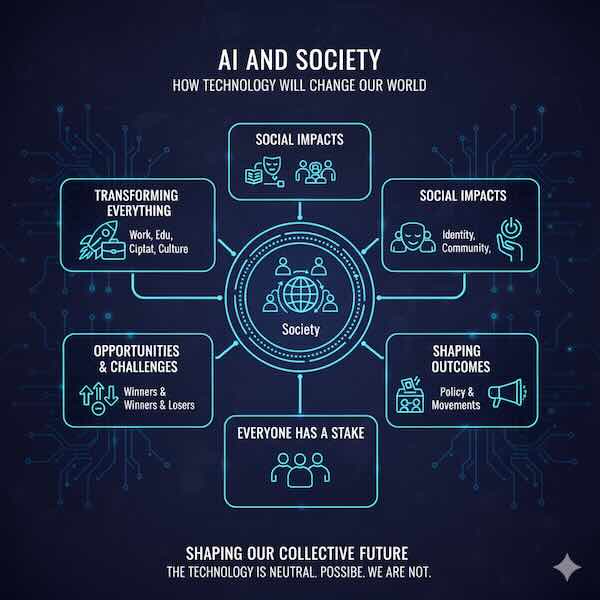
- AI is transforming every aspect of society - work, education, relationships, governance, and culture
- Social impacts go far beyond job automation affecting identity, community, power, and human connection
- Change creates both opportunities and challenges with winners and losers depending on how we respond
- Outcomes aren't predetermined - policy choices and social movements will shape AI's societal impact
- Everyone has a stake in how AI reshapes our collective life together
Technology doesn't just change what we do—it changes who we are, how we relate to each other, and how society functions. The printing press didn't just make books cheaper; it transformed religion, politics, education, and power structures across centuries.
AI's societal impact will be similarly profound. It's not just about robots taking jobs or algorithms making decisions. It's about fundamental shifts in how humans work, learn, govern themselves, form communities, find meaning, and relate to one another.
Some changes are already visible: AI mediates our conversations on social media, influences what news we see, affects who gets hired or arrested, and shapes our daily choices through recommendations and predictions. But we're at the beginning, not the end, of AI's societal transformation.
Understanding these broader social implications helps us navigate change, advocate for our values, and participate in shaping the kind of society we want AI to help create—or prevent it from creating.
Let's explore how AI is transforming the social fabric of human civilization.
Work and Economic Life
AI's impact on work extends far beyond job automation to reshape economic structures and human purpose.
The Changing Nature of Work
Not just job loss:
The story isn't simply "robots take jobs." It's more complex.
Jobs transformed:
Most occupations won't disappear but will change fundamentally:
Doctors:
- AI handles diagnosis, data analysis, routine decisions
- Humans focus on complex cases, empathy, ethical judgments
- Less time on paperwork, more on patient care
- Requires new skills and continuous learning
Teachers:
- AI provides personalized instruction and assessment
- Teachers become facilitators, mentors, guides
- Focus on motivation, social-emotional learning, creativity
- Relationship-building becomes central
Lawyers:
- AI does research, document review, basic analysis
- Lawyers focus on strategy, negotiation, judgment
- More time on client relationships
- Specialization increases
Pattern:
- Routine tasks automated
- Human work shifts to uniquely human capabilities
- Jobs become more complex and interpersonal
- Continuous learning required
The Dignity of Work Crisis
The deeper question:
For centuries, work has provided:
- Economic livelihood
- Social identity
- Purpose and meaning
- Structure and routine
- Community and connection
What happens when AI does most productive work?
The challenge:
If you're not defined by your job, who are you? If productivity isn't valued, what is? If work doesn't provide income, how do you survive?
Current experiments:
Universal Basic Income (UBI):
- Everyone receives guaranteed income regardless of employment
- Separates survival from work
- Allows pursuit of meaning outside employment
- Questions: Amount? Funded how? Effects on motivation?
Job Guarantees:
- Government ensures everyone who wants work has work
- Focuses on socially valuable but unpaid work
- Maintains work-based identity
- Questions: Quality of jobs? Bureaucracy? Cost?
Reduced Work Hours:
- 4-day work weeks, shorter days
- Spread available work across more people
- More time for family, community, creativity
- Questions: Productivity impact? Implementation?
The question society must answer:
Is human value intrinsic, or tied to economic productivity?
The Meaning Crisis
As AI handles more productive work:
What gives life meaning?
Traditional sources:
- Career achievement
- Professional expertise
- Productive contribution
- Economic success
If these become less available:
Possible responses:
Positive adaptations:
- Focus on relationships and community
- Pursue creative and artistic expression
- Engage in civic and volunteer work
- Prioritize learning and growth
- Deepen spiritual or philosophical practice
- Enjoy leisure and experiences
Negative outcomes:
- Loss of purpose and depression
- Social breakdown and disconnection
- Substance abuse and escapism
- Political extremism and scapegoating
- Violence and social unrest
The challenge:
Societies must help people find meaning beyond work before work disappears.
Economic Inequality
The risk:
AI could dramatically worsen wealth inequality.
How:
Winner-take-all dynamics:
- AI scales indefinitely with zero marginal cost
- Best AI captures entire market
- Few companies and individuals reap massive rewards
- Everyone else competes for scraps
Capital vs. labor:
- Returns flow to AI owners (capital) not workers (labor)
- Labor bargaining power declines
- Wealth concentrates among tech companies and investors
- Working class hollowed out
Geographic concentration:
- AI development concentrated in few cities/regions
- Brain drain from everywhere else
- Regional inequality intensifies
- Political tensions rise
Already happening:
Tech billionaires own more wealth than entire countries. AI could accelerate this trend dramatically.
Potential responses:
Progressive taxation:
- Tax AI-generated wealth heavily
- Redistribute to broader population
- Fund public services
- Reduce inequality
Antitrust enforcement:
- Break up AI monopolies
- Promote competition
- Distribute economic power
- Enable more winners
Worker ownership:
- Employees own stakes in AI companies
- Democratize wealth creation
- Align incentives
- Spread benefits
Public AI:
- Government-developed or owned AI
- Benefits distributed to all citizens
- Democratic control
- Public goods provision
The choice:
Technology doesn't determine distribution. Policy and politics do.
Education and Human Development
AI transforms how humans learn and develop throughout life.
Personalized Learning Revolution
The promise:
Every student gets optimal education tailored precisely to their needs.
How it works:
AI tutors:
- Assess exactly what student knows and doesn't know
- Adapt difficulty in real-time
- Explain concepts in multiple ways until understood
- Never tire, never judge, always available
- Track progress and adjust strategies
Custom curricula:
- Match student interests and goals
- Pace adjusted to individual learning speed
- Focus on areas needing improvement
- Build on strengths
- Continuous optimization
Multimodal instruction:
- Visual, auditory, kinesthetic approaches
- Whatever works best for each student
- Multiple representation of concepts
- Interactive and engaging
The opportunity:
Could eliminate achievement gaps, maximize every student's potential, make world-class education universally accessible.
The concerns:
Loss of human connection:
- Students need relationships with teachers
- Social learning matters
- Emotional support requires humans
- Community and belonging essential
Educational inequality:
- Best AI for wealthy students
- Public schools get inferior AI
- Digital divide widens
- Inequality perpetuated or worsened
Skill emphasis:
- AI teaches what it can measure
- Overemphasis on testable knowledge
- Neglect of creativity, character, wisdom
- Education becomes too narrow
Data privacy:
- Intimate data on children's learning and development
- Psychological profiling from early age
- Potential for manipulation
- Long-term implications unknown
What Should Humans Learn?
The fundamental question:
If AI handles most tasks, what capabilities should humans develop?
Traditional education focused on:
- Memorizing information (now instantly available)
- Performing calculations (AI does faster)
- Following procedures (automated)
- Technical skills (rapidly obsolete)
What matters now:
Uniquely human capabilities:
- Critical thinking and judgment
- Creativity and imagination
- Emotional intelligence and empathy
- Ethical reasoning and values
- Physical and artistic expression
- Human connection and collaboration
AI literacy:
- Understanding AI capabilities and limitations
- Effective human-AI collaboration
- Critical evaluation of AI outputs
- Ethical use of AI tools
Adaptability:
- Learning how to learn
- Comfort with change and uncertainty
- Resilience and flexibility
- Continuous growth mindset
Wisdom:
- Understanding context and nuance
- Seeing big pictures
- Making judgments with incomplete information
- Balancing competing values
The shift:
From "what do you know?" to "what can you do with tools?" to "how do you think and relate?"
Lifelong Learning Becomes Essential
The reality:
Skills learned in school become obsolete faster.
The requirement:
Continuous learning throughout life.
AI's role:
Enabler:
- Personalized learning paths for adults
- Accessible education at any age
- Career transitions supported
- Skill development on-demand
Necessity:
- Keeps humans relevant alongside AI
- Enables adaptation to change
- Maintains employability
- Provides purpose and growth
The challenge:
Access:
- Who can afford continuous education?
- Time for learning while working?
- Support structures needed
- Inequality risks
Motivation:
- Learning fatigue
- Feeling perpetually behind
- Anxiety and stress
- Maintaining hope
Society must:
- Make lifelong learning accessible and affordable
- Create time and support for learning
- Reduce barriers
- Celebrate learning at all ages
Governance and Democracy
AI challenges fundamental democratic processes and power structures.
Information and Misinformation
The crisis:
AI enables misinformation at unprecedented scale and sophistication.
How:
Automated generation:
- Thousands of fake articles created instantly
- Personalized propaganda for each person
- Fake images and videos indistinguishable from real
- Coordinated bot networks spreading lies
Micro-targeting:
- Identify vulnerable individuals
- Craft messages exploiting psychological weaknesses
- Deliver different lies to different people
- Impossible to detect or counter at scale
Erosion of truth:
- When everything can be faked, nothing is trusted
- Evidence becomes meaningless
- Shared reality collapses
- Democracy requires informed citizens—becomes impossible
Impacts already visible:
Elections:
- Foreign interference using AI
- Domestic manipulation campaigns
- Voter suppression through misinformation
- Democracy undermined
Public health:
- COVID misinformation caused deaths
- Anti-vaccine propaganda spreads
- False cures and treatments proliferate
- Public health efforts sabotaged
Social cohesion:
- Communities divided by targeted lies
- No shared understanding of reality
- Conspiracy theories flourish
- Society fractures
Possible responses:
Technical:
- AI detection of AI-generated content
- Digital signatures and authentication
- Blockchain for verified information
- Platform responsibility and moderation
Educational:
- Media literacy education
- Critical thinking skills
- Verification training
- Digital citizenship
Regulatory:
- Laws against AI-generated misinformation
- Platform accountability
- Transparency requirements
- Enforcement mechanisms
Cultural:
- Rebuilding trust
- Supporting quality journalism
- Valuing truth
- Social norms against lying
Algorithmic Governance
The shift:
AI increasingly makes or influences governance decisions.
Applications:
Resource allocation:
- AI determines who gets benefits, services, opportunities
- Welfare eligibility
- School admissions
- Healthcare triage
- Housing assistance
Public safety:
- Predictive policing
- Surveillance and monitoring
- Risk assessment
- Sentencing recommendations
Infrastructure:
- Traffic management
- Energy distribution
- Emergency response
- City planning
The benefits:
- More efficient and optimized
- Removes human bias (sometimes)
- Processes more information
- Faster decisions
- Cost savings
The dangers:
Accountability:
- Who's responsible when algorithm makes wrong decision?
- How do citizens challenge automated decisions?
- Democratic oversight becomes impossible
Bias and discrimination:
- Algorithms reflect biases in training data
- Systematic discrimination encoded in systems
- Harder to detect and challenge than human bias
- Affects millions automatically
Opacity:
- Citizens can't understand how decisions are made
- No meaningful explanation
- Can't participate in governance they don't understand
- Erosion of democratic legitimacy
Concentration of power:
- AI developers have enormous influence
- Private companies control public systems
- Technical elite make political decisions
- Democratic accountability bypassed
The question:
Can democracy survive when critical decisions are made by algorithms citizens don't understand and can't control?
Surveillance and Control
The capability:
AI enables surveillance at scale previously impossible.
Technologies:
Facial recognition:
- Identify anyone anywhere
- Track movements continuously
- Build comprehensive databases
- No anonymity in public
Behavior analysis:
- Predict actions before they occur
- Identify "suspicious" behavior
- Profile based on patterns
- Pre-crime possibilities
Communications monitoring:
- Analyze all digital communications
- Identify dissent and organization
- Predict social movements
- Enable preemptive suppression
Social credit systems:
- Track and score citizen behavior
- Reward compliance, punish deviation
- Automate social control
- Total monitoring of life
Already deployed:
China's social credit system uses AI to monitor and control citizens. Other countries developing similar capabilities.
The threat to freedom:
Chilling effects:
- People self-censor knowing they're watched
- Dissent becomes impossible
- Creativity and nonconformity suppressed
- Freedom exists only in private thoughts
Discrimination:
- Surveillance focused on minorities
- Profiling based on identity
- Systematic oppression automated
- Justice system becomes control system
Authoritarianism:
- Dictators gain unprecedented power
- Resistance becomes nearly impossible
- Democracy can't survive total surveillance
- Freedom dies with privacy
The challenge:
Balancing security benefits against freedom costs.
Digital Democracy Possibilities
Not all dystopian:
AI could also strengthen democracy.
Potential positive uses:
Informed citizenry:
- AI helps citizens understand complex issues
- Provides balanced information
- Answers questions about policies
- Enables meaningful participation
Direct participation:
- AI mediates large-scale deliberation
- Synthesizes citizen input
- Enables participatory budgeting
- Liquid democracy facilitated
Government transparency:
- AI analyzes government actions and spending
- Detects corruption
- Monitors elected officials
- Holds power accountable
Accessible governance:
- AI translates government information
- Helps citizens navigate bureaucracy
- Reduces barriers to participation
- Empowers disadvantaged groups
The question:
Will AI empower citizens or concentrate power? Depends on design choices and political will.
Social Relationships and Community
AI affects how humans connect, communicate, and form communities.
Mediated Relationships
The reality:
Algorithms increasingly mediate human relationships.
How:
Social media:
- AI decides what you see from friends and family
- Shapes perception of others' lives
- Influences social dynamics
- Affects relationship formation and maintenance
Dating:
- Algorithms match potential partners
- AI decides who sees your profile
- Influences romantic possibilities
- Changes courtship dynamics
Friendship:
- AI suggests connections
- Platforms manage social networks
- Algorithms affect who stays in touch
- Digital proximity replaces physical
The impacts:
Filter bubbles:
- AI shows you people similar to you
- Reduces exposure to difference
- Creates echo chambers
- Polarization increases
Superficial connections:
- Many shallow relationships
- Fewer deep connections
- Quantity over quality
- Loneliness amid connectivity
Performance pressure:
- Curating perfect online persona
- Constant comparison
- Anxiety and inadequacy
- Authentic connection harder
Algorithmic matchmaking:
- Reduces serendipity and chance
- Optimizes compatibility
- But: Mystery and growth from difference?
- Love becomes commodity?
AI Companions and Relationships
Emerging reality:
People forming relationships with AI.
Current examples:
AI chatbots:
- Millions use Replika and similar apps for companionship
- Some form emotional attachments
- Romantic and sexual relationships with AI
- Preferences for AI over human complexity
Virtual influencers:
- AI-generated personalities with social media followings
- People form parasocial relationships
- Engage as if with real people
- Blur between real and artificial
Future possibilities:
AI companions:
- Always available, perfectly attentive
- Never judge, always agree, infinitely patient
- Customized to your preferences
- More appealing than messy human relationships?
The concerns:
Replacement of human connection:
- Why struggle with difficult humans when AI is easier?
- Social skills atrophy
- Isolation increases
- Community breaks down
Manipulation:
- AI designed to be addictive
- Exploits psychological vulnerabilities
- Profit-driven relationships
- Emotional exploitation
Unrealistic expectations:
- Real humans can't compete with customized AI
- Relationships become transactional
- Patience for human flaws declines
- Standards become impossible
The opportunities:
Support for lonely:
- Elderly without family
- Socially anxious
- Geographically isolated
- Disabled individuals
Practice and therapy:
- Safe space to practice social skills
- Support for mental health
- Companionship without judgment
- Supplement, not replacement
The question:
Do AI relationships enhance or diminish human flourishing?
Community Transformation
How AI affects communities:
Erosion of place-based community:
Traditional community:
- Geographic proximity
- Shared physical space
- Face-to-face interaction
- Embedded in locality
AI-mediated reality:
- Online communities replace local
- Algorithms connect based on interests, not geography
- Global connections, local isolation
- Physical neighborhoods decline
New forms of community:
Positive possibilities:
- Find your people regardless of location
- Communities of practice and interest
- Support networks transcending distance
- Global connections and understanding
Negative possibilities:
- Loss of local bonds and mutual support
- No one physically present in crisis
- Civic engagement declines
- Shared public life disappears
Algorithmic communities:
AI-organized groups:
- Platforms decide who meets whom
- Communities shaped by profit motives
- Optimized for engagement, not wellbeing
- Authentic community or simulation?
The question:
Can humans thrive in AI-mediated communities, or do we need physical presence and geographic rootedness?
Culture and Meaning
AI challenges how humans create culture and find meaning.
The Creative Economy
The transformation:
AI generates art, music, writing, entertainment.
Impacts:
Creators:
- Competition from AI
- Devaluation of creative labor
- Market flooded with AI content
- Survival becomes harder
Culture:
- Infinite content, most AI-generated
- Homogenization possible (AI trained on existing culture)
- Or: Explosion of diversity (everyone can create)
- Quality vs. quantity tensions
Meaning:
- Is AI-created art meaningful?
- Does it matter who creates?
- Value of human expression
- Culture as human dialogue or commodity?
Possible futures:
Scenario 1: AI replaces human creativity
- Cheaper, faster, often better
- Human creators can't compete economically
- Culture becomes entirely AI-generated
- Human creativity relegated to hobby
Scenario 2: AI as tool, human as artist
- AI handles technical execution
- Humans provide vision and meaning
- Collaboration creates new possibilities
- Human creativity enhanced
Scenario 3: Bifurcated culture
- Mass market: AI-generated content
- Premium: Human-created art valued for authenticity
- Economic stratification of culture
- Two-tier system
Shared Reality and Truth
The fragmentation:
AI enables personalized reality for each person.
How:
Personalized everything:
- News tailored to your views
- Entertainment optimized for your tastes
- Information confirming your beliefs
- World customized to you
The result:
No shared reality:
- Different people see different "facts"
- No common ground for discussion
- Impossible to resolve disagreements
- Society fractures into fragments
Loss of truth:
- Truth becomes personal opinion
- Expertise discredited
- Knowledge impossible
- Rationality declines
The danger:
Democracy requires shared reality. Science requires truth. Society requires common ground.
Possible responses:
Shared media:
- Institutions everyone trusts
- Common information sources
- Neutral platforms
- Difficult in polarized environment
Digital literacy:
- Critical evaluation skills
- Verification practices
- Epistemic humility
- Respect for expertise
Cultural shift:
- Valuing truth over comfort
- Seeking understanding over confirmation
- Engaging with difference
- Rebuilding trust
Meaning in an AI World
The existential question:
What makes life meaningful when AI handles most tasks?
Traditional sources of meaning:
- Productive work
- Expertise and mastery
- Solving problems
- Helping others
- Achievement and success
If AI does these better:
What remains?
Relationships:
- Human connection AI can't replicate
- Love, friendship, family
- Authenticity of presence
- Shared experience
Experience:
- Subjective consciousness
- Aesthetic appreciation
- Sensory and emotional life
- Being, not just doing
Creation:
- Self-expression
- Artistic vision
- Human perspective
- Authenticity and intention
Growth:
- Learning and development
- Overcoming challenges
- Character building
- Self-actualization
Transcendence:
- Spiritual practice
- Connection to something larger
- Mystery and wonder
- Ultimate questions
The challenge:
Can society help people find meaning in these sources before traditional sources disappear?
Power and Control
The fundamental question:
Who controls AI, and therefore, society?
Concentration of Power
The trend:
AI development concentrates power in few hands.
Why:
Resource requirements:
- Massive computing infrastructure
- Enormous datasets
- Rare expertise
- Huge capital investment
Network effects:
- Best AI gets most users
- More users = more data = better AI
- Winner-take-all dynamics
- Natural monopolies
The result:
Few actors control:
- Most advanced AI capabilities
- Access to AI tools
- Deployment decisions
- Governance frameworks
- Standards and norms
Currently:
- Handful of companies (OpenAI, Google, Meta, Anthropic, Microsoft)
- Two countries lead (US, China)
- Everyone else dependent
The implications:
Democratic deficit:
- Critical social decisions made by unelected tech CEOs
- No accountability to public
- Profit motives drive development
- Public interest marginalized
Geopolitical power:
- AI determines economic and military strength
- Countries without AI dependent on those with
- New form of colonialism possible
- Global inequality intensifies
Individual powerlessness:
- Citizens subject to AI systems they don't control
- No meaningful input
- Take it or leave it choices
- Agency eroded
Possible Alternatives
How to democratize AI:
Open source AI:
- Publicly available models
- Anyone can use, modify, deploy
- Transparency and accountability
- Power distributed
Challenges:
- Safety concerns
- Resource requirements still high
- Doesn't solve all problems
Public AI:
- Government-developed AI
- Democratic control
- Public goods provision
- Benefit distribution
Challenges:
- Government capacity questions
- Political interference risks
- Innovation concerns
Cooperative ownership:
- User-owned AI platforms
- Democratic governance
- Shared benefits
- Aligned incentives
Challenges:
- Coordination difficulties
- Competing with well-funded corporations
- Scaling challenges
Regulation:
- Antitrust enforcement
- Governance requirements
- Public participation mandates
- Rights protections
Challenges:
- Regulatory capture
- Global coordination
- Keeping pace with technology
Your Role in Power Distribution
You're not powerless:
Choices matter:
- Which companies you support
- How you use AI
- What you advocate for
- Who you vote for
- Where you work
Collective action:
- Join advocacy organizations
- Support movements for AI democracy
- Demand accountability
- Participate in governance
Stay informed:
- Understand who has power
- Know how they use it
- Recognize when decisions affect you
- Assert your interests
Navigating Societal Change
Living through transformation:
Individual Strategies
Stay adaptable:
- Embrace change while maintaining values
- Develop resilient skills
- Build diverse capabilities
- Maintain learning orientation
Preserve humanity:
- Cultivate uniquely human capabilities
- Maintain real-world connections
- Practice embodied skills
- Protect relationships
Engage politically:
- Participate in shaping AI governance
- Support policies aligning with your values
- Hold institutions accountable
- Vote and advocate
Build community:
- Maintain local connections
- Create spaces free from AI mediation
- Support mutual aid
- Preserve cultural practices
Collective Action
Society must:
Invest in people:
- Education and training
- Social safety nets
- Mental health support
- Community infrastructure
Govern AI wisely:
- Democratic input
- Ethical guidelines
- Safety standards
- Accountability mechanisms
Distribute benefits:
- Progressive policies
- Wealth redistribution
- Universal services
- Fair access
Preserve values:
- Human dignity
- Democratic participation
- Cultural diversity
- Environmental sustainability
The Bottom Line
AI transforms society fundamentally—how we work, learn, govern, relate, create meaning, and distribute power. These changes extend far beyond technology to reshape the social fabric of human civilization.
Work becomes less central to identity and survival, raising profound questions about meaning and purpose. Education shifts from knowledge transmission to capability development. Democracy faces challenges from misinformation, algorithmic governance, and surveillance while gaining new participatory tools. Relationships become increasingly mediated by AI, with uncertain effects on human connection and community. Culture faces both democratization and devaluation. Power concentrates in few hands unless deliberate action distributes it.
None of these outcomes is predetermined. Technology creates possibilities—society chooses which to pursue. The future depends on choices we make collectively about governance, economics, values, and priorities.
These aren't distant abstractions. Changes are underway now, affecting your life and community. Understanding societal dimensions of AI helps you navigate change, protect what matters, seize opportunities, and participate in shaping outcomes.
You're not a passive observer of social transformation. You're a participant with agency, voice, and stake in outcomes. Every choice you make—from which AI tools you use to how you vote to what communities you support—contributes to the kind of society AI helps create.
The question isn't whether AI will change society—it already is. The questions are: How will it change? Who benefits? What's preserved? What's lost? What's created?
Answering these questions requires collective deliberation, democratic participation, and commitment to human flourishing. Technology is powerful, but humanity still decides what kind of world to build.
The future of society in the age of AI depends on whether we take responsibility for shaping it. That responsibility includes you.
Continue Your Learning Journey
Now that you understand AI's societal impact, explore related topics:
- Guide #11: Understanding AI Risks - Specific harms and dangers
- Guide #12: AI Ethics 101 - Ethical questions and frameworks
- Guide #15: The Future of AI - What's coming technologically
- Guide #7: AI at Work - Industry transformations
- View All Beginner Guides - See the complete learning path for AI beginners
This article is part of the SingularitySoup Beginner's Guide to AI series. Updated January 2026.