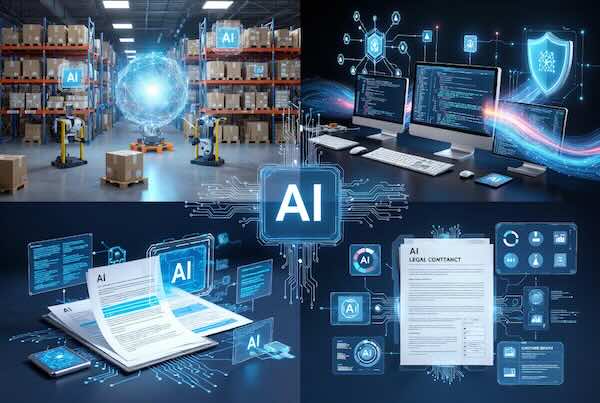
The age of AI agents has arrived—not as a distant promise, but as a practical reality transforming how businesses operate today. Unlike traditional AI tools that simply provide information or suggestions, these agentic systems can perceive their environment, make decisions, and take action to accomplish complex goals with minimal human intervention.
Across industries, organizations are deploying AI agents that deliver measurable results, from reducing operational costs to accelerating workflows that once took days down to minutes. Here's where agentic AI is making the biggest impact right now.
Retail: Intelligent Inventory Management
Walmart has emerged as a pioneer in deploying what it calls "super agents" for inventory management. These AI systems don't just track stock levels—they autonomously coordinate with suppliers, predict demand fluctuations, optimize warehouse logistics, and even adjust ordering patterns based on local events and weather conditions.
The result? Reduced waste from overstocking, fewer out-of-stock situations that frustrate customers, and significant cost savings across Walmart's massive supply chain. These agents work 24/7, processing millions of data points to make decisions that would overwhelm human teams.
Software Development: AI Pair Programmers
The coding landscape has been revolutionized by autonomous development tools like Cursor and Claude Code. These aren't simple autocomplete features—they're capable coding partners that can understand project context, write substantial blocks of code, debug errors, refactor existing codebases, and even implement entire features from natural language descriptions.
Developers report productivity gains of 30-50% on certain tasks, with AI agents handling boilerplate code, documentation, and routine bug fixes while humans focus on architecture and creative problem-solving. Claude Code, for instance, operates directly from the command line, allowing developers to delegate entire coding tasks and review the results, fundamentally changing the relationship between programmers and their tools.
Healthcare: Streamlining Claims Processing
Healthcare administrators know that claims processing is often a bureaucratic nightmare—but AI agents are bringing order to the chaos. These systems can review medical claims, cross-reference them with policy details, identify discrepancies, request additional documentation, and approve or flag claims for human review.
What once took healthcare organizations weeks can now happen in days or even hours. More importantly, these agents reduce errors that lead to claim rejections and help ensure that patients and providers get paid correctly and promptly. The consistency of AI review also helps identify patterns of fraud or billing errors that human reviewers might miss.
Legal: Document Analysis at Scale
Law firms are deploying AI agents like Harvey and Luminance to tackle document-heavy work that traditionally consumed thousands of billable hours. These systems can review contracts, conduct due diligence for mergers and acquisitions, identify relevant case law, and flag potential legal issues across massive document sets.
Luminance, for example, can analyze legal documents to spot unusual clauses, compare contracts against standard templates, and even suggest negotiation points. Harvey goes further, drafting legal documents and providing research assistance. Lawyers report that these tools don't replace their expertise—instead, they free attorneys from tedious review work to focus on strategy and client relationships.
Cybersecurity: Real-Time Threat Response
When cyberattacks happen, speed is everything. Platforms like Darktrace deploy AI agents that don't just detect threats—they respond to them autonomously. These agents can identify unusual network behavior, isolate compromised systems, block malicious traffic, and begin remediation processes before a human analyst even receives an alert.
In an era where ransomware can encrypt an entire network in minutes, having AI agents that respond in seconds can mean the difference between a minor incident and a catastrophic breach. These systems learn the normal patterns of each organization they protect, allowing them to spot subtle anomalies that traditional rule-based security tools would miss.
Customer Service: From Answering to Resolving
The latest generation of customer service agents represents a quantum leap beyond the frustrating chatbots of the past. Companies are deploying AI agents that don't just answer questions—they resolve issues end-to-end.
These agents can access multiple backend systems, process refunds, update account information, troubleshoot technical problems, and escalate complex issues to human agents with full context. They understand nuance, handle frustrated customers with empathy, and can juggle multiple conversation threads without losing track.
The business impact is substantial: reduced wait times, 24/7 availability, consistent service quality, and dramatic cost savings. More importantly, human customer service representatives can focus on complex cases that truly require human judgment and creativity.
The Common Thread
What unites all these use cases is a shift from AI as a passive tool to AI as an active participant in workflows. These agents don't wait for instructions—they pursue goals, adapt to changing circumstances, and coordinate with other systems and humans to get work done.
The technology isn't perfect. AI agents still make mistakes, occasionally require human oversight, and work best when given well-defined parameters. But the trajectory is clear: agentic AI is moving from experimental deployments to core business infrastructure across virtually every industry.
For organizations watching from the sidelines, the question is no longer whether to deploy AI agents, but where to start and how to do it responsibly. The early adopters are already seeing the results—and the competitive advantage that comes with them.