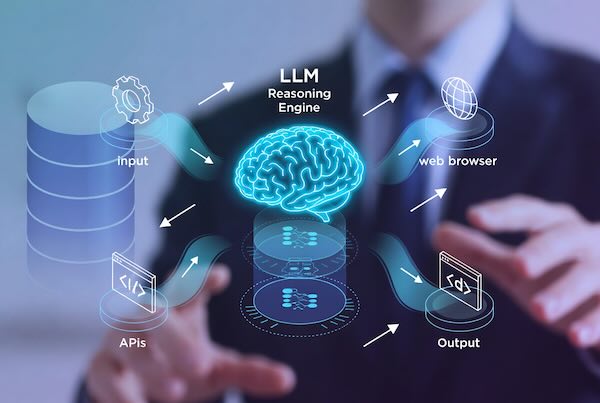
If you've noticed AI getting more capable lately—booking appointments, writing and running code, or pulling real-time data from across the web—you're witnessing the rise of AI agents. These systems don't just respond to prompts anymore; they can plan multi-step tasks, use tools, and work more autonomously than ever before.
But what's actually happening under the hood? Let's break down the architecture that makes modern AI agents tick.
The Core: Large Language Models as Reasoning Engines
At the heart of every AI agent is a large language model (LLM)—systems like GPT-4, Claude, or Gemini. Think of the LLM as the agent's brain, but not in the way you might expect. It's not storing facts like a database or following hardcoded instructions like traditional software. Instead, it acts as a reasoning engine.
When given a task like "find the cheapest flight to Tokyo next month," the LLM doesn't know flight prices. But it can reason about what steps would be needed: search for flights, compare options, check dates, consider alternatives. It generates a plan based on patterns it learned during training, then executes that plan using the tools at its disposal.
This shift—from static response generator to dynamic reasoner—is what separates today's agents from earlier chatbots.
Tool Calling: Connecting AI to the Real World
Raw language models are isolated systems. They can't browse the web, check your calendar, or execute Python code—at least not without help. That's where tool calling comes in.
Tool calling lets LLMs interact with external systems through well-defined interfaces (APIs). When an agent needs to check the weather, it doesn't guess. Instead, it recognizes it needs external data, calls a weather API with the right parameters (location, date), receives structured data back, and incorporates that into its response.
Modern agents have access to three primary categories of tools:
APIs and Web Services: Direct connections to databases, weather services, calendar systems, payment processors, or any other web-based service with a programmatic interface.
Web Browsing: Some agents can navigate websites like a human would—clicking links, filling forms, reading content—to gather information not available through APIs.
Code Execution: Perhaps most powerful, many agents can write and run code in real-time. Need to analyze a dataset, manipulate an image, or perform complex calculations? The agent writes Python (or another language), executes it in a sandboxed environment, sees the output, and continues from there.
The breakthrough came when AI companies figured out how to make this reliable. Early attempts at tool use were clunky—models would call the wrong APIs or pass malformed parameters. Today's systems like Claude 4.5, GPT-4, and Gemini have been specifically trained to excel at tool calling, dramatically improving success rates.
Memory: The Context That Persists
Traditional chatbots started fresh with every conversation. Modern agents need memory—both short-term and long-term.
Short-term memory is the conversation history: what you just asked, what the agent just did, what data it retrieved. This lives in the model's context window, which has expanded dramatically (some models now handle over 200,000 tokens, equivalent to a short novel).
Long-term memory is trickier. Some agents maintain user profiles, preferences learned over time, or summaries of past interactions stored in external databases. When you return to the conversation, the agent retrieves relevant memories and incorporates them into its reasoning.
This persistent context is what allows an agent to pick up where you left off, remember your preferences, or reference something from weeks ago.
Planning and Orchestration: The Executive Function
Having reasoning, tools, and memory isn't enough. Agents need an orchestration layer—essentially an executive function that manages the workflow.
When you give an agent a complex task, it needs to:
- Break the request into subtasks
- Determine which tools to use and in what order
- Handle failures gracefully (what if an API is down?)
- Iterate on its approach if the first attempt doesn't work
- Synthesize information from multiple sources into a coherent response
This is where planning frameworks come in. Some agents use explicit planning algorithms (like chain-of-thought reasoning or tree search). Others use implicit planning, where the LLM itself figures out the sequence on the fly.
MCP and the New Infrastructure Layer
One of 2025's most significant developments is the emergence of standardized protocols for connecting LLMs to tools. Anthropic's Model Context Protocol (MCP) is a leading example—an open standard that defines how agents discover available tools, understand their capabilities, and invoke them reliably.
Think of MCP as USB-C for AI agents. Just as USB-C standardized how devices connect and communicate, MCP standardizes how AI models connect to data sources, applications, and services. Instead of every company building custom integrations for every model, MCP provides a universal connector.
This matters because it dramatically lowers the barrier to building agents. A developer can expose their application through MCP, and any compatible agent can immediately use it—no custom integration required.
Why 2025 Changed Everything
Several factors converged to make practical AI agents viable this year:
Model improvements: Current-generation LLMs are significantly better at multi-step reasoning, error recovery, and maintaining coherence over long tasks.
Expanded context windows: With more "working memory," agents can handle complex tasks without losing track of details.
Reliable tool calling: Success rates for API calls and code execution have gone from 60-70% to over 90% in many cases, crossing the reliability threshold for production use.
Infrastructure maturity: Cloud providers like AWS, along with AI companies like Anthropic, OpenAI, and Google, have built robust platforms specifically designed for agent workloads—handling execution sandboxing, rate limiting, monitoring, and security.
Standardization: Protocols like MCP mean agents don't need bespoke integrations for every tool, accelerating ecosystem growth.
The Stack in Action
Let's walk through what happens when you ask an agent to "analyze sales data and email a summary to the team":
- The LLM receives your request and reasons about the necessary steps
- It recognizes it needs to access a file, so it calls a file retrieval tool
- Once it has the data, it writes and executes Python code to perform the analysis
- It generates visualizations and summary statistics from the code output
- It formulates an email using the analysis results
- It calls an email API to send the message
- It confirms completion with you
At each step, the LLM is making decisions, the orchestration layer is managing execution, tools are being invoked through standardized protocols, and the conversation context is being maintained. It's not magic—it's a carefully designed stack of technologies working in concert.
What This Means for You
You don't need to understand every technical detail to benefit from agentic AI. But knowing the basics helps you understand both the possibilities and the limitations.
AI agents are powerful because they can reason, use tools, and persist over time. But they're not omniscient or infallible. They depend on the quality of available tools, the clarity of your instructions, and the robustness of the underlying infrastructure.
As these systems continue to improve, the line between "asking an AI a question" and "delegating work to an AI assistant" will keep blurring. The architecture we've outlined here—reasoning engines, tool calling, memory, and orchestration—is the foundation making that future possible.