Series: Beginner's Guide to AI #15
Read Time: 16 minutes
Level: Beginner
Prerequisites: Guide #1 - What Is AI?, Guide #2 - A Brief History of AI
Key Takeaways
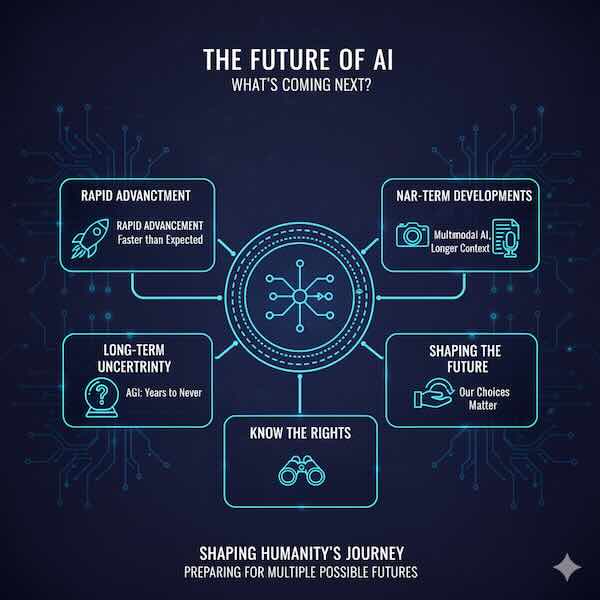
- AI capabilities are advancing faster than most experts predicted with major breakthroughs occurring annually
- Near-term developments are fairly predictable - better multimodal AI, longer context, faster processing
- Long-term future is deeply uncertain - timelines for AGI range from years to never
- Technological progress doesn't determine outcomes - choices we make shape how AI affects society
- Preparing for multiple possible futures is wiser than betting on one prediction
In 2020, AI couldn't reliably write a coherent paragraph. In 2022, ChatGPT passed the bar exam. In 2023, AI could generate photorealistic videos. In 2024, AI systems began conducting scientific research autonomously. What's next?
Predicting AI's future is notoriously difficult. Experts have been consistently wrong—sometimes too pessimistic, often too optimistic, frequently surprised by what actually happened. Yet understanding likely trajectories, emerging capabilities, and possible scenarios helps us prepare for change.
This isn't science fiction speculation. We'll focus on developments already underway, capabilities on the horizon, and plausible long-term trajectories based on current trends. We'll also explore why the future isn't predetermined—human choices will shape what AI becomes and how it affects our lives.
Let's explore what's coming next in AI, from next year to next decade and beyond.
Near-Term Future (2026-2028)
These developments are already underway or highly likely based on current progress.
Multimodal AI Becomes Standard
What it means:
AI that seamlessly understands and generates text, images, audio, and video together—not as separate capabilities but as integrated understanding.
Current state:
Models like GPT-4V and Gemini can process text and images together. But integration is still limited.
What's coming:
Unified Understanding:
- Describe a scene in words, AI generates video matching description with accurate sound
- Show AI a video, ask questions about it, get detailed analysis
- Real-time video conversation with AI understanding visual context
- Seamless switching between modalities
Practical applications:
Education:
- AI tutor that sees your work, hears your questions, explains visually
- Learns from your expressions and confusion
- Adapts teaching style in real-time
Accessibility:
- Real-time scene description for visually impaired
- Sign language translation
- Context-aware assistance for disabilities
Creative work:
- "Show me this scene, but make it feel like a Miyazaki film"
- Automatic video editing understanding intent
- Music that matches video mood automatically
Timeline: Already beginning, mainstream within 2-3 years.
Longer Context Windows
The limitation now:
Current AI has limited "memory" within conversations. ChatGPT can track maybe 10,000-25,000 words. For complex tasks, this is restrictive.
What's coming:
Million-word context:
- Feed AI entire books and discuss them
- Provide comprehensive project documentation
- Maintain context across days or weeks
- Process massive datasets in conversation
Practical implications:
Research:
- "Here are 50 research papers, synthesize findings"
- Compare entire bodies of work
- Find patterns across large corpora
Business:
- Upload all company documents, ask strategic questions
- Comprehensive analysis of large projects
- Institutional knowledge accessible instantly
Personal:
- Life logging with AI remembering everything
- Coherent long-term projects
- True personal AI assistant with full context
Timeline: Rapid progress, significant improvements within 1-2 years.
Personalized AI
Current limitation:
AI treats everyone the same, starts fresh each time.
What's coming:
AI that knows you:
- Learns your communication style
- Remembers your preferences and context
- Adapts to your knowledge level
- Builds on previous interactions
How it works:
Personal models:
- Fine-tuned on your data (with your permission)
- Remembers conversations across sessions
- Understands your goals and values
- Recognizes your patterns and needs
Examples:
Personal writing assistant:
- Knows your voice and style
- Aware of your projects and commitments
- Suggests based on your actual situation
- Improves through ongoing interaction
Personal tutor:
- Tracks what you know and don't know
- Identifies your learning style
- Adjusts difficulty appropriately
- Builds on previous lessons
Personal health advisor:
- Understands your health history (you share)
- Tracks your habits and patterns
- Provides personalized recommendations
- Coordinates with healthcare providers
Privacy considerations:
This requires trusting AI companies with intimate data, or running personalized AI locally (emerging option).
Timeline: Early versions exist, significant adoption within 2-3 years.
AI Agents That Take Action
Current limitation:
AI generates text or images but can't actually do things in the world.
What's coming:
AI that acts autonomously:
- Manages email and calendar
- Books travel and makes reservations
- Orders products and services
- Handles routine tasks end-to-end
How it works:
Integration with tools:
- Access to APIs and services
- Permission to act on your behalf
- Ability to navigate websites and apps
- Execution of multi-step tasks
Examples:
Personal assistant:
- "Plan a vacation to Japan for three weeks from now"
- AI researches options, books flights and hotels, creates itinerary
- Handles changes and problems
- Keeps you informed
Work automation:
- "Schedule meetings with these five people"
- AI coordinates calendars, sends invites, handles rescheduling
- Prepares agendas
- Follows up afterward
Research assistant:
- "Find and summarize recent papers on this topic"
- AI searches databases, evaluates relevance, synthesizes findings
- Generates annotated bibliography
- Tracks citations
The challenge: Trust and control. Giving AI authority to act requires confidence it will do what you want.
Timeline: Basic versions emerging now, sophisticated agents within 2-4 years.
Dramatic Cost Reduction
Current state:
Running advanced AI is expensive. Costs declining rapidly.
What's coming:
AI becomes essentially free:
- Processing costs drop 10-100x
- Running sophisticated AI on smartphones
- Free tiers become very generous
- AI embedded in everything
Implications:
Universal access:
- World-class AI tutor for every student
- Expert medical advice everywhere
- Professional tools accessible to all
- Democratization of capabilities
Ubiquity:
- AI in every device and appliance
- Constant access to intelligence
- Offline AI becomes standard
- Privacy through local processing
Economic disruption:
- AI services commoditized
- Business models shift
- New economic structures emerge
Timeline: Ongoing, accelerating over next 2-5 years.
Specialized Superhuman Capabilities
Pattern:
AI already surpasses humans in specific domains. This expands.
Near-term superhuman AI:
Scientific research:
- Drug discovery faster than human researchers
- Materials science breakthroughs
- Theorem proving in mathematics
- Climate modeling beyond human capacity
Creative domains:
- Music composition rivaling great composers
- Artistic styles humans can't replicate
- Novel designs and architectures
- New forms of expression
Analysis:
- Pattern recognition in massive datasets
- Predictions humans can't make
- Optimization beyond human intuition
- Real-time processing of complex systems
The key:
Superhuman in specific tasks, not general intelligence. But the list of tasks grows.
Timeline: Continuous expansion, major breakthroughs annually.
Medium-Term Future (2028-2035)
More speculative but plausible based on current trajectories.
Embodied AI and Robotics
Current state:
Robots exist but are limited, expensive, and clumsy. AI is largely digital.
What's coming:
Physical AI in the real world:
Humanoid robots:
- Walking, balancing, manipulating objects
- Operating in human environments
- Performing physical tasks
- Working alongside humans
Specialized robots:
- Surgical robots with superhuman precision
- Construction robots building homes
- Agricultural robots harvesting crops
- Delivery robots navigating cities
Key developments:
Dexterity:
- Fine motor control rivaling human hands
- Ability to handle delicate objects
- Adaptability to unexpected situations
- Learning from demonstration
Navigation:
- Understanding 3D environments
- Adapting to dynamic situations
- Safe operation around humans
- Efficient movement
Integration:
- AI "brains" controlling robot "bodies"
- Real-time decision-making
- Learning from physical interaction
- Coordination between multiple robots
Implications:
Economic:
- Physical labor increasingly automated
- Manufacturing completely transformed
- Service jobs affected
- New industries emerge
Social:
- Robots in homes and workplaces
- Elderly care and assistance
- Dangerous work eliminated
- Human role redefined
Timeline: Rapid progress, significant deployment by early 2030s.
AI in Scientific Discovery
Vision:
AI as autonomous scientist, not just tool.
Capabilities:
Hypothesis Generation:
- Analyzing existing research
- Identifying gaps and questions
- Proposing novel experiments
- Creative scientific thinking
Experimentation:
- Designing experiments
- Controlling lab equipment remotely
- Running simulations
- Collecting and analyzing data
Discovery:
- Identifying patterns humans miss
- Making unexpected connections
- Solving long-standing problems
- Accelerating progress dramatically
Real progress already:
AlphaFold:
- Solved 50-year protein folding problem
- Predicted structures of millions of proteins
- Accelerating drug discovery
- Earned Nobel Prize consideration
Materials science:
- AI discovering new materials
- Optimizing properties
- Predicting behaviors
- Accelerating development cycles from years to months
What's next:
Autonomous labs:
- AI runs experiments 24/7
- Tests thousands of hypotheses
- Optimizes in real-time
- Makes discoveries without human intervention
Scientific acceleration:
- Decades of progress in years
- Breakthroughs in medicine, energy, materials
- Solutions to climate change
- Fundamental physics discoveries
Timeline: Advancing rapidly, transformative by early 2030s.
Hyper-Personalized Everything
The trend:
Everything becomes individually customized by AI.
Applications:
Education:
- Curriculum adapted to each student in real-time
- Learning style perfectly matched
- Pace individualized
- Every student has optimal education
Medicine:
- Treatment plans customized to individual genetics, lifestyle, environment
- Continuous monitoring and adjustment
- Preventive care personalized
- Healthcare optimized for each person
Entertainment:
- Movies, games, music generated for your preferences
- News and information curated precisely
- Stories that adapt to your reactions
- Infinite personalized content
Work:
- Tasks matched to your skills and interests
- Tools adapted to your workflow
- Training customized to your needs
- Career paths optimized for you
The concern:
Hyper-personalization could:
- Create echo chambers
- Eliminate shared experiences
- Make manipulation easier
- Increase social fragmentation
The opportunity:
Could also:
- Maximize human potential
- Reduce waste and inefficiency
- Increase satisfaction and wellbeing
- Enable truly customized lives
Timeline: Increasing personalization throughout 2030s.
AI Governance and Regulation
Current state:
Minimal regulation, voluntary industry standards.
What's coming:
Comprehensive frameworks:
Safety standards:
- Mandatory testing before deployment
- Certification requirements
- Liability frameworks
- Ongoing monitoring
Transparency requirements:
- Disclosure of AI use
- Explainability standards
- Audit rights
- Public reporting
Ethical guidelines:
- Bias testing and mitigation
- Privacy protections
- Human oversight requirements
- Rights and appeals processes
International coordination:
Global treaties:
- Shared safety standards
- Data governance agreements
- AI arms control
- Development guidelines
Challenges:
- Balancing innovation and safety
- Keeping pace with technology
- International cooperation
- Enforcement mechanisms
Timeline: Accelerating regulation through late 2020s and 2030s.
Economic Transformation
The shift:
AI fundamentally restructures economy.
Changes:
Labor markets:
- Massive job displacement and creation
- Skills requirements change rapidly
- Value of human work redefined
- Income structures transform
Productivity explosion:
- Economic output increases dramatically
- Costs of goods and services plummet
- Abundance in many areas
- Distribution challenges intensify
New economic models:
Possible developments:
- Universal Basic Income
- Shorter work weeks
- Job guarantees
- Wealth redistribution
- New definitions of work and value
Industries transformed:
Everything from:
- Healthcare (personalized, predictive, AI-assisted)
- Education (individualized, AI-tutored)
- Transportation (autonomous, optimized)
- Manufacturing (fully automated)
- Services (AI-augmented or replaced)
The question:
Will benefits be widely shared or concentrated? This depends on policy choices, not technology alone.
Timeline: Continuous transformation through 2030s, major restructuring by mid-decade.
Long-Term Future (2035+)
Highly speculative. Multiple possible trajectories.
Scenario 1: Artificial General Intelligence (AGI)
What it is:
AI that matches or exceeds human intelligence across all domains—reasoning, creativity, social intelligence, common sense.
When:
Predictions range from 2030s to never. No consensus.
If it happens:
Capabilities:
- Learns any task humans can learn
- Thinks creatively and abstractly
- Understands context and nuance
- Generalizes across domains
- Potentially self-improves
Implications:
Optimistic scenario:
- Solves humanity's greatest challenges
- Abundance and prosperity for all
- Extended healthspan and lifespan
- Space exploration accelerates
- Human potential unlocked
Pessimistic scenario:
- Alignment failures cause catastrophe
- Loss of human purpose and agency
- Existential risks
- Irreversible mistakes
- Concentration of power
Realistic scenario:
- Both opportunities and challenges
- Requires careful management
- Outcomes depend on choices we make
- Mixed results across different areas
The debate:
Experts disagree on:
- Whether AGI is possible
- When it might arrive
- Whether it's desirable
- How to ensure safety
- What it means for humanity
Scenario 2: Specialized Superintelligence
Alternative path:
Instead of general intelligence, we get AI that's superhuman in many specific domains but lacks general understanding.
Characteristics:
- Extraordinary capabilities in narrow areas
- No common sense or general reasoning
- Powerful but limited
- Tool-like, not agent-like
This might mean:
Scientific superintelligence:
- Solves scientific problems beyond human comprehension
- But can't navigate human social situations
- Accelerates progress in specific fields
Economic superintelligence:
- Optimizes economic systems
- But doesn't understand human values
- Creates efficiency, maybe not happiness
Creative superintelligence:
- Produces art, music, literature beyond human capability
- But lacks human emotional depth
- Technically perfect, perhaps soulless
Implications:
- Powerful tools without existential risk
- Humans remain in control
- Selective automation
- Complement rather than replace humans
Scenario 3: AI Plateau
The possibility:
AI progress slows or stops before reaching human-level general intelligence.
Why it might happen:
Technical barriers:
- Fundamental limits to current approaches
- Diminishing returns from scaling
- Unsolved theoretical problems
- Resource constraints
Economic factors:
- Returns don't justify investment
- Market saturation
- Alternative technologies emerge
- Priorities shift
Social/political:
- Regulation slows development
- Public backlash
- Ethical concerns limit research
- International restrictions
What this looks like:
- AI capabilities stabilize
- Incremental rather than revolutionary progress
- Focus shifts to deployment and refinement
- Other technologies become more important
Not necessarily bad:
Could mean:
- Time to adapt to existing AI
- Focus on beneficial deployment
- Addressing ethical issues
- Sustainable integration
Scenario 4: Unpredictable Breakthroughs
The wild card:
Something unexpected changes everything.
Possibilities:
New architectures:
- Radically different approaches to AI
- Capabilities we can't currently imagine
- Paradigm shifts like transformers were
Brain-computer interfaces:
- Direct neural connection to AI
- Human-AI hybrid intelligence
- Merging biological and artificial
- Enhanced human capabilities
Quantum computing:
- AI running on quantum computers
- Entirely new capabilities
- Solving currently impossible problems
- Unpredictable emergent properties
Biological AI:
- Artificial neurons and biological computing
- Wetware instead of hardware
- Living AI systems
- Hybrid organic-digital intelligence
The challenge:
Can't predict what we can't imagine. History shows unexpected developments often matter most.
What Determines the Future?
Technology doesn't develop in a vacuum. Human choices shape outcomes.
Research Priorities
What gets developed:
Depends on what's researched and funded.
Current focus:
- Capability improvement (making AI more powerful)
- Commercial applications (making money)
- Safety research (ensuring beneficial AI)
The balance matters:
Too much capability focus = powerful but potentially dangerous AI
Too much safety focus = slow progress, falling behind
Balance needed but difficult to achieve.
Your influence:
- Support safety research
- Advocate for funding priorities
- Choose which companies to support
- Participate in shaping priorities
Regulatory Choices
How AI is governed:
Shapes what's possible and permissible.
Regulatory approaches:
Light touch:
- Maximum innovation
- Risk of harms
- Market determines outcomes
Heavy regulation:
- Minimum risk
- Slower progress
- Potential to stifle innovation
Adaptive regulation:
- Evolves with technology
- Risk-based approach
- Balance innovation and safety
Global coordination:
Critical for:
- Setting standards
- Preventing races to bottom
- Addressing global risks
- Ensuring fair access
Democratic participation:
Regulations should reflect public values, not just industry or government preferences.
Economic Structures
How benefits are distributed:
Determines whether AI creates widespread prosperity or concentrated wealth.
Possible models:
Market-driven:
- AI benefits flow to owners
- Wealth concentration
- Innovation maximized
- Inequality risks
Social safety net:
- Basic income or services
- Education and retraining
- Safety nets for displaced
- Shared prosperity
Public ownership:
- AI as public utility
- Democratic control
- Broad benefit distribution
- Innovation concerns
Mixed approaches:
Likely outcome combines elements, but specific mix matters enormously.
Cultural Adaptation
How society responds:
Shapes AI's impact on human life.
Questions:
Work and purpose:
- How do we find meaning when AI does most work?
- What's valuable about human contribution?
- How do we structure society?
Education:
- What should humans learn?
- How do we prepare for uncertain future?
- What capabilities remain uniquely human?
Relationships:
- How do we maintain human connection?
- What role for AI in social life?
- How do we preserve what makes us human?
Values:
- What do we want to preserve?
- What are we willing to change?
- What matters most?
Cultural choices determine whether AI enhances or diminishes human flourishing.
Preparing for Multiple Futures
Since the future is uncertain, prepare for various possibilities.
Build Adaptive Skills
Focus on:
Uniquely human capabilities:
- Emotional intelligence
- Creative thinking
- Strategic reasoning
- Ethical judgment
- Human connection
Rapid learning:
- Ability to learn new skills quickly
- Comfort with change
- Continuous adaptation
- Intellectual flexibility
AI literacy:
- Understanding AI capabilities and limits
- Effective AI collaboration
- Critical evaluation of AI
- Ethical AI use
Domain expertise:
- Deep knowledge in specific areas
- Combining expertise with AI
- Judgment and contextual understanding
Stay Informed
Follow developments:
- AI research and breakthroughs
- Policy and regulation
- Industry trends
- Social implications
Diverse sources:
- Technical papers
- News and analysis
- Multiple perspectives
- Critical voices
Think critically:
- Question hype and fear
- Evaluate claims carefully
- Distinguish speculation from reality
- Form independent views
Participate in Shaping the Future
Your voice matters:
Democratize AI:
- Advocate for public input
- Support inclusive development
- Demand accountability
- Participate in governance
Support responsible development:
- Choose ethical companies
- Demand transparency
- Advocate for safety
- Hold institutions accountable
Educate others:
- Share knowledge
- Discuss implications
- Build understanding
- Foster informed debate
Engage politically:
- Vote for representatives who take AI seriously
- Participate in consultations
- Support wise policies
- Advocate for your values
Maintain Perspective
Remember:
Humans adapt:
- We've navigated major transitions before
- Society adjusts to change
- Resilience is possible
- Future isn't predetermined
Technology serves humans:
- We choose how to use it
- We set priorities
- We define success
- We maintain control
Uncertainty isn't all bad:
- Opens possibilities
- Allows for agency
- Creates room for hope
- Means we can shape outcomes
Balance optimism and caution:
- Hope for benefits
- Prepare for challenges
- Act wisely
- Stay engaged
The Bottom Line
AI's future is both predictable and surprising. Near-term developments are clear: better multimodal AI, longer context, personalization, AI agents, lower costs, specialized superhuman capabilities. These will arrive within years.
Medium-term changes are likely: embodied AI in robotics, AI-driven scientific discovery, hyper-personalization, comprehensive regulation, economic transformation. These will reshape society through the 2030s.
Long-term possibilities are uncertain: AGI might arrive or might not. We might hit plateaus or see breakthroughs. Outcomes range from utopian to catastrophic, with realistic scenarios somewhere between.
But the future isn't predetermined. It depends on choices we make—about research priorities, regulation, economic structures, and cultural adaptation. Technology creates possibilities; humans choose which to pursue.
The most important insight: You're not a passive observer. Your choices, voice, and participation matter. The future of AI will be shaped by countless decisions by countless people—researchers, policymakers, business leaders, and citizens.
Understanding what's coming prepares you to navigate change, seize opportunities, avoid pitfalls, and participate in shaping outcomes. The future is uncertain, but it's not beyond our influence.
What happens next with AI depends partly on technology, largely on humanity. And humanity includes you.
The question isn't just "What's coming next?" but "What do we want to come next?" and "What will we do to shape it?"
The future of AI is being written now. This guide helps you read what's being written—and perhaps write some of it yourself.
Continue Your Learning Journey
You've completed the Beginner's Guide to AI series! Here's what you've learned:
- Guide #1: What Is AI? - Foundational understanding
- Guide #2: A Brief History of AI - How we got here
- Guide #3: How Does AI Actually Work? - Technical basics
- Guide #4: AI in Your Daily Life - Everyday applications
- Guide #5: Understanding ChatGPT and LLMs - Language models
- Guide #6: Image AI Explained - Image generation
- Guide #7: AI at Work in Industries - Industry applications
- Guide #8: How AI Can Make Your Life Better - Practical benefits
- Guide #9: Career Opportunities in AI - Job prospects
- Guide #10: Getting Started with AI Tools - Hands-on guide
- Guide #11: Understanding AI Risks - Dangers and challenges
- Guide #12: AI Ethics 101 - Ethical questions
- Guide #13: AI Safety and Alignment - Making AI safe
- Guide #14: Your AI Privacy Guide - Protecting yourself
- Guide #15: The Future of AI - What's coming next
Where to go from here:
- Explore specific topics in depth
- Try advanced AI applications
- Participate in AI discussions
- Share your knowledge with others
- Stay engaged with developments
- Help shape AI's future
Thank you for learning with SingularitySoup!
This article is part of the SingularitySoup Beginner's Guide to AI series. Updated January 2026.