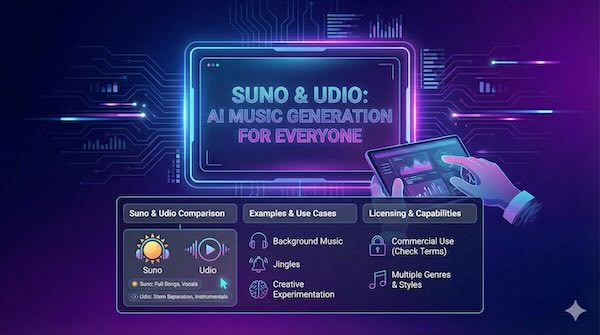
The dream of creating music without years of training or expensive equipment has become reality. Two platforms—Suno and Udio—have emerged as the leading AI music generators, enabling anyone to produce complete songs from simple text descriptions. But as these tools mature, understanding their capabilities, differences, and legal complexities has become essential for creators considering them.
How AI Music Generation Works
Both Suno and Udio transform text prompts into fully produced tracks, complete with vocals, instrumentation, and arrangements. Describe a mood, genre, or theme—"upbeat indie rock about chasing dreams" or "melancholic piano ballad about lost love"—and the AI generates a complete song in under a minute.
The underlying technology analyses patterns learned from vast musical datasets, enabling these tools to produce coherent compositions across genres. Users can provide their own lyrics, let the AI generate them, or create purely instrumental pieces.
Suno: The Market Leader
Suno has established itself as the dominant platform, claiming over one million subscribers and recently securing $250 million in Series C funding. The platform's latest version (v4.5) delivers studio-quality 44.1kHz audio supporting over 1,200 genres, with tracks extending up to eight minutes.
Key features include:
- Suno Studio — A browser-based digital audio workstation allowing multitrack editing, stem separation (up to 12 tracks), and professional-level arrangement tools
- Add Vocals/Add Instrumentals — Upload your own audio and have the AI generate complementary elements
- Personas — Save and reuse specific vocal styles and musical characteristics
- ReMi lyrics model — AI-powered lyric generation with natural phrasing
- Remaster feature — Upgrade older creations to match current audio quality standards
Suno operates on a credit system. The free tier provides 50 daily credits (roughly 10 songs), while the Pro plan ($10/month) offers 2,500 monthly credits with commercial use rights. The Premier plan ($30/month) includes 10,000 credits and full Studio access.
Udio: The Quality-Focused Alternative
Founded by former Google DeepMind researchers, Udio launched in April 2024 and quickly gained a reputation for exceptional audio fidelity and vocal realism. Professional producers often favour its output quality, particularly for complex arrangements.
Notable capabilities:
- Sessions — A visual timeline editor resembling traditional DAW interfaces, allowing users to drag, arrange, and restructure compositions
- Extend and Remix — Build songs iteratively by adding sections and regenerating parts until satisfied
- Inpainting — Surgically edit specific portions of a track without affecting the whole
- Multilingual support — Generate vocals in multiple languages with natural pronunciation
Udio's free tier provides 10 daily credits plus 100 monthly credits. The Standard plan ($10/month) delivers 1,200 credits with WAV and stem downloads, while Pro ($30/month) offers 4,800 credits and bulk download capabilities.
Comparing the Platforms
Audio quality — Both produce impressive results, though Udio often edges ahead in vocal realism and mix polish. Suno excels in diverse genre coverage and accessibility.
Workflow — Suno Studio offers more comprehensive editing within the platform. Udio's Sessions provide a cleaner visual interface for arranging sections.
Speed — Suno generates faster, typically completing tracks in 30-45 seconds. Udio takes slightly longer but may require fewer iterations.
Learning curve — Suno is more beginner-friendly with intuitive prompting. Udio rewards users who craft detailed, specific prompts.
Practical Applications
Background music for content — Both platforms excel at generating royalty-free tracks for YouTube videos, podcasts, and social media content. A simple prompt like "upbeat corporate background music, 90 BPM, synthesizers" delivers usable results in seconds.
Jingles and brand audio — Create consistent audio branding by saving successful styles and regenerating variations. Particularly useful for small businesses without production budgets.
Creative experimentation — Musicians use these tools for rapid prototyping, generating demo versions of ideas before investing in full production. The stems export feature allows further refinement in professional DAWs.
Educational content — Generate custom background tracks for tutorials, e-learning modules, or presentations without licensing concerns.
The Licensing Landscape: Critical Considerations
The legal situation surrounding AI music has shifted dramatically. In June 2024, the Recording Industry Association of America filed landmark copyright infringement lawsuits against both Suno and Udio, alleging they trained their models on copyrighted recordings without permission. The lawsuits sought up to $150,000 per infringed work.
Both companies acknowledged training on copyrighted material but argued this constituted fair use—learning from music rather than copying it. That defence faced significant challenges.
Recent settlements have transformed both platforms:
Udio reached licensing agreements with Universal Music Group and Warner Music Group in late 2025. Under these deals, the platform operates as a "walled garden"—users can create and stream music within the platform but face significant restrictions on downloading and external distribution. The companies plan to launch a new jointly-operated service in 2026 trained exclusively on licensed content.
Suno settled with Warner Music Group in November 2025 for $500 million, with Warner taking ownership and oversight of AI likeness, music, audio, software, and copyrights. The settlement has prompted notable changes to Suno's terms of service.
Understanding Current Usage Rights
For Suno:
- Free tier songs are restricted to non-commercial, personal use only—subscribing later does not grant retroactive commercial rights
- Paid subscribers (Pro/Premier) receive commercial use rights for songs created during their subscription
- However, Suno now clarifies that users "generally are not considered the owner of the songs, since the output was generated by Suno"
- Remixes created using Suno's features are classified as joint works restricted to non-commercial use regardless of subscription tier
- Users grant Suno a perpetual, irrevocable licence to use submitted content for model training and promotion
For Udio:
- Following the UMG settlement, downloads are currently disabled or severely restricted
- Songs created before the agreements that were downloaded during a brief grace period retain their original terms, including commercial use rights
- The future platform launching in 2026 will operate under new licensing frameworks with different user rights
- Free tier users must attribute "Created with Udio" when sharing content
Copyright and Ownership Complexities
A fundamental issue persists across both platforms: AI-generated music may not qualify for copyright protection under current law. In the United States, copyright protects works created by humans. Music generated entirely through AI prompts likely lacks the human authorship required for protection.
If you write your own lyrics, you own those lyrics and may be able to register them with copyright offices. Some jurisdictions may recognise you as the song's creator with the AI serving as an instrument. This area of law remains unsettled and varies by region.
Streaming platforms have also adapted. Deezer now tags albums containing AI-generated tracks and has implemented fraud detection, estimating that up to 70% of streams on fully AI-generated uploads are fraudulent. Distributors increasingly require disclosure of AI involvement.
Recommendations by Use Case
Content creators needing background music — Suno's Pro plan offers the best value, with clear commercial rights for content monetisation. Generate tracks, export, and use freely in videos.
Professional producers seeking inspiration — Udio's superior audio quality makes it valuable for reference tracks and ideation, though current download restrictions limit practical application until 2026.
Hobbyists exploring creativity — Both free tiers provide sufficient access for experimentation. Suno's higher daily allowance makes it more generous for casual users.
Commercial releases and streaming distribution — Proceed with extreme caution. The legal landscape remains volatile, AI-generated tracks may face platform restrictions, and revenue shares may be affected. Consult an intellectual property lawyer before any serious commercial release.
The Road Ahead
AI music generation has matured remarkably fast. What seemed like a novelty in 2023 now produces content that most listeners cannot distinguish from human-made music. An AI-generated artist signed a $3 million record deal in 2025, and several AI creators have charted on Billboard.
Yet the technology sits at a crossroads. The major label settlements signal a shift from litigation to licensed collaboration, potentially establishing frameworks for ethical AI music creation with proper artist compensation. Both Suno and Udio have committed to retiring their current models and launching new versions trained exclusively on licensed content.
For creators, the practical advice is straightforward: understand exactly what rights your subscription tier grants, document everything (prompts, dates, account status), and treat AI-generated music as a powerful creative tool rather than a shortcut to commercial success. The technology democratises music creation, but navigating its legal and ethical complexities requires the same diligence as any professional creative endeavour.