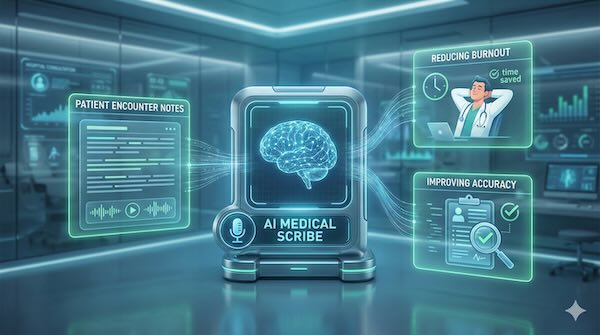
The administrative burden of clinical documentation has long been one of medicine's most persistent pain points. Physicians spend an average of 5.8 hours per eight-hour clinical day on documentation duties, with significant portions completed after hours during what's grimly known as "pajama time." This burden has contributed to a burnout crisis that, while improving, still affects over 43% of physicians according to 2024 AMA data.
AI-powered medical scribes represent one of the most promising solutions to emerge in recent years. These tools passively capture patient-clinician conversations and automatically generate structured clinical notes, promising to return precious time to direct patient care.
How Ambient AI Scribes Work
Unlike traditional dictation software, modern AI scribes use ambient listening technology to capture entire clinical encounters in the background. The physician simply begins a patient visit, and the system records and transcribes the conversation, then uses large language models to structure the content into a clinical note format that integrates directly with electronic health records.
The technology has matured significantly. Current systems can recognise medical terminology across more than 50 specialties, support multiple languages, and deliver draft notes within minutes of a visit's conclusion. The best platforms offer "linked evidence" features that map AI-generated content back to source audio, allowing clinicians to verify specific claims in the documentation.
Leading Platforms in the Market
Nuance DAX Copilot (now part of Microsoft) pioneered the ambient scribe category and remains the dominant choice for large enterprise deployments. The platform offers the deepest integration with Epic workflows, with notes appearing automatically in the correct fields without provider action. DAX is known for requiring minimal editing for routine encounters, though its premium pricing (estimated at $600-700 per month per provider) and enterprise-focused implementation make it best suited for large health systems.
Abridge has emerged as a major competitor, particularly notable for its Epic integration through the "Partners and Pals" programme. The company has been deployed across more than 200 health systems, including major institutions like Kaiser Permanente, Mayo Clinic, Johns Hopkins, and Duke Health. Abridge supports 28 languages and claims providers save an average of two hours per day on documentation. The platform recently expanded beyond outpatient care into emergency medicine and inpatient settings, with features that transform bedside conversations into structured notes for hospitalists.
Other notable platforms include DeepScribe, which offers both AI-only and hybrid human-AI scribe services; Suki, which provides voice-powered documentation with smart commands; and newer entrants like Freed and Nabla targeting smaller practices with more accessible pricing.
Clinical Impact and Evidence
The evidence for time savings is compelling, though researchers note measurement inconsistencies across studies. In quality improvement research, ambient AI scribes have reduced documentation time by a median of 2.6 minutes per appointment and cut after-hours EHR work by nearly 30%. Some health systems report providers saving one to two hours daily, enabling them to see additional patients or reclaim time for work-life balance.
The burnout reduction appears meaningful. Mass General Brigham reported a 21.2% reduction in clinician burnout with ambient documentation tools, while Emory saw documentation-related wellbeing improve by over 30%. These findings align with broader physician wellbeing trends—the AMA reports burnout rates fell to 43.2% in 2024, down from 53% in 2022, with documentation burden relief cited as a contributing factor.
Beyond efficiency, the technology appears to improve documentation completeness. A Texas Oncology study found that ambient scribes increased documented diagnoses from 3.0 to 4.1 per encounter. Northwestern Medicine clinicians using DAX billed more high-level evaluation and management visits on average.
Safety Concerns and Limitations
The rapid adoption of AI scribes has outpaced validation and regulatory oversight, raising concerns among patient safety researchers. A 2025 study evaluating two commercial AI scribe products found errors in 70% of draft notes, averaging 2.9 errors per note. Omission errors—where information discussed during the encounter fails to appear in the documentation—were most common and potentially most dangerous, as they require clinicians to recall details from memory to identify missing content.
Hallucinations present another concern. While rates are reported at 1-3%, even small percentages can have serious implications in healthcare. Physical exams appear particularly prone to fabrication, with systems documented as generating entire examinations that never occurred. The assessment and plan sections, which require clinical reasoning rather than simple transcription, are also vulnerable to AI approximations that may not reflect actual clinical thinking.
Equity concerns have emerged as well. Research has documented significant disparities in automatic speech recognition performance, with AI systems showing reduced accuracy when transcribing speech from Black patients compared to white patients. This suggests patients with non-standard accents, limited English proficiency, or those from marginalised communities may receive inadequate documentation of their concerns.
Currently, most AI scribes operate without specific FDA oversight, classified as administrative tools rather than medical devices. This creates a regulatory gap where liability largely falls on clinicians and healthcare organisations, while vendors remain protected.
Best Practices for Implementation
Healthcare organisations deploying AI scribes should establish robust validation processes. This includes pulling diverse sample charts to compare AI-generated notes against actual encounter content, tracking accuracy by patient demographics, and creating systems for clinicians to flag errors and identify patterns.
Clinicians are advised to plan to review every AI-generated note carefully rather than assuming accuracy. Particular attention should be paid to physical examination documentation, medication changes, and the assessment and plan sections. Patient consent processes should be established, with clear communication about AI involvement in documentation.
Organisations should also be cautious about raising patient volume expectations based on projected efficiency gains. Some research suggests AI scribes reduce clinicians' perceived burden without dramatically cutting actual time—valuable for wellbeing but not necessarily translating to productivity increases.
The Road Ahead
AI medical scribes represent a genuine advance in addressing healthcare's documentation crisis, but the technology requires thoughtful implementation and ongoing oversight. The tools show clear promise for reducing burnout and freeing clinicians to focus on patient care, yet the rush to adoption has created gaps in validation, transparency, and regulation that must be addressed.
As one researcher noted, the key question is not whether to adopt these tools but how to do so responsibly—ensuring they enhance care without eroding trust or introducing new risks to patient safety. For healthcare organisations, this means balancing enthusiasm for the technology's benefits against the need for rigorous quality assurance and attention to equity in implementation.