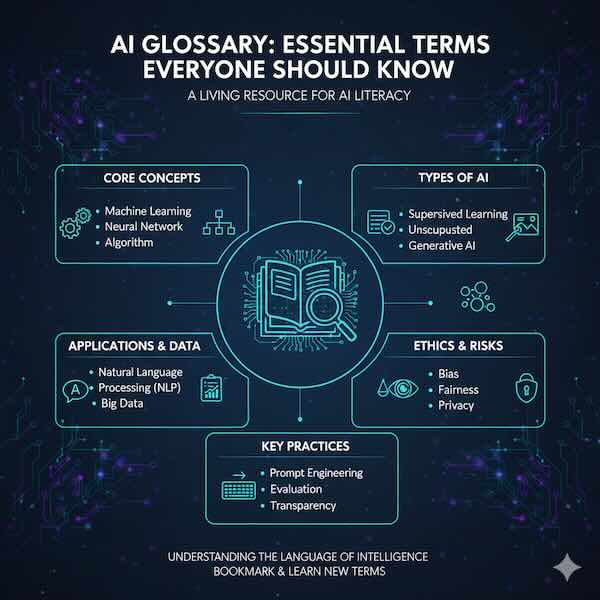
Series: Beginner's Guide to AI #20
Read Time: 12 minutes
Level: Beginner
Prerequisites: None - designed as a reference resource
Key Takeaways
- Understanding AI vocabulary helps you participate in conversations and make informed decisions
- Terms are organized by topic for easier learning and reference
- Plain language explanations make concepts accessible without technical background
- Real-world examples connect abstract terms to familiar experiences
- This is a living resource - bookmark and return as you encounter new terms
AI conversations are filled with jargon—algorithms, neural networks, transformers, hallucinations, alignment. It can feel like learning a foreign language.
But you don't need a PhD to understand the essential terms. This glossary provides clear, jargon-free explanations of the AI vocabulary you'll encounter in news articles, conversations, and everyday life.
Terms are organized by topic rather than alphabetically, making it easier to understand related concepts together. Each definition includes a plain English explanation, why it matters, and real-world examples.
Bookmark this page and return whenever you encounter an unfamiliar term. Think of it as your AI dictionary—practical, accessible, and always available.
Let's demystify AI terminology together.
Core AI Concepts
These are the foundational terms you'll encounter most frequently.
Artificial Intelligence (AI)
What it means: Software that can perform tasks normally requiring human intelligence—like recognizing images, understanding language, making decisions, or solving problems—by learning from data rather than following rigid pre-programmed rules.
Plain English: Computer programs that can learn and adapt, not just follow instructions.
Why it matters: AI is the umbrella term for everything in this guide. Understanding this helps you recognize AI in daily life.
Example: Your email spam filter uses AI to learn what spam looks like and block it, rather than just blocking specific known spam addresses.
Machine Learning (ML)
What it means: A way of creating AI by feeding computers lots of examples and letting them figure out patterns on their own, rather than programming explicit rules.
Plain English: Teaching computers by showing them examples, like teaching a child to recognize dogs by showing them pictures of many different dogs.
Why it matters: This is how most modern AI works. Understanding this explains why AI needs so much data.
Example: Netflix's recommendation system learns what you like by watching what you watch, pause, or skip—no human programmed specific rules for your taste.
Deep Learning
What it means: A type of machine learning using artificial neural networks with many layers. It's especially good at handling complex data like images, video, and natural language.
Plain English: A more sophisticated form of machine learning inspired by how brains work, with multiple layers of processing.
Why it matters: Deep learning powers most impressive recent AI breakthroughs—from ChatGPT to self-driving cars to medical diagnosis.
Example: When you upload a photo to Facebook and it suggests which friends to tag, that's deep learning recognizing faces.
Algorithm
What it means: A set of step-by-step instructions for solving a problem or completing a task. Like a recipe for computers.
Plain English: The specific steps a computer follows to accomplish something.
Why it matters: When people talk about "the algorithm" on social media or search engines, they're referring to the specific steps that decide what you see.
Example: Google's search algorithm determines which websites appear first in your search results.
Neural Network
What it means: A computer system loosely modeled on the human brain, with interconnected nodes (like neurons) that process and transmit information. It learns by adjusting the strength of connections between nodes.
Plain English: AI organized in layers of connected processing units, inspired by how our brains work.
Why it matters: Neural networks are the foundation of most modern AI. The term appears frequently in AI discussions.
Example: When image recognition identifies a cat in a photo, neural networks process the image through multiple layers, first detecting edges, then shapes, then features, finally recognizing "cat."
Training (AI Training)
What it means: The process of teaching an AI system by feeding it large amounts of data and adjusting it to improve performance. Like practicing a skill until you get better.
Plain English: How AI learns—by studying millions of examples until it gets good at a task.
Why it matters: Understanding training explains why AI needs so much data and why it can have biases (learns from biased data).
Example: ChatGPT was trained on billions of text examples from the internet, learning language patterns, facts, and conversational structure.
Model
What it means: The AI system that results from training. It's the learned patterns and knowledge that can then be used to make predictions or generate outputs.
Plain English: The trained AI brain that's ready to use—like a graduate ready to work after finishing school.
Why it matters: When you hear "GPT-4 model" or "image generation model," this refers to the specific trained AI system.
Example: The "ChatGPT model" is the trained system you interact with. Different versions (GPT-3, GPT-4) are different models with different training.
AI Capabilities and Functions
Terms describing what AI can do.
Natural Language Processing (NLP)
What it means: AI's ability to understand, interpret, and generate human language in a useful way.
Plain English: Making computers understand and respond to normal human speech or writing.
Why it matters: This is what makes you able to talk naturally to AI instead of using commands or code.
Example: When you ask Alexa a question in normal English and it understands and responds, that's NLP.
Computer Vision
What it means: AI's ability to understand and interpret visual information from images or video.
Plain English: Teaching computers to "see" and understand what's in pictures or videos.
Why it matters: This powers facial recognition, medical imaging analysis, self-driving cars, and photo organization.
Example: Google Photos can search for "beach" and find all your beach photos, even though you never tagged them—computer vision understands what's in the images.
Generative AI
What it means: AI that can create new content—text, images, music, video, code—rather than just analyzing existing content.
Plain English: AI that makes new things instead of just recognizing or categorizing existing things.
Why it matters: This is the AI behind ChatGPT, DALL-E, Midjourney, and other creative tools that generate content.
Example: When you ask DALL-E to "create an image of a cat riding a bicycle in space," it generates a completely new image that never existed before.
Large Language Model (LLM)
What it means: An AI model trained on enormous amounts of text data (often trillions of words) that can understand and generate human-like text.
Plain English: A very big AI trained on massive amounts of writing that can read and write like a human.
Why it matters: ChatGPT, Claude, and similar AI assistants are LLMs. Understanding this term helps you follow AI news and discussions.
Example: GPT-4, Claude, and Google's Gemini are all LLMs—they can write essays, answer questions, write code, and more.
Chatbot
What it means: An AI program designed to have conversations with humans, typically through text or voice.
Plain English: An AI you can chat with, like a customer service robot or virtual assistant.
Why it matters: Chatbots are everywhere—customer service, mental health support, education, and general assistance.
Example: The chat popup on many websites that asks "How can I help you?" is often a chatbot using AI to answer common questions.
Recommendation System
What it means: AI that suggests content, products, or connections based on your past behavior and preferences.
Plain English: The AI that suggests what you might like based on what you've liked before.
Why it matters: These systems shape what you see online, from social media posts to shopping suggestions to entertainment.
Example: Netflix's "Recommended for you" list, YouTube's "Up next" video, Amazon's "Customers also bought"—all recommendation systems.
Voice Assistant
What it means: AI that responds to voice commands, answers questions, and performs tasks through spoken interaction.
Plain English: AI you can talk to like Alexa, Siri, or Google Assistant.
Why it matters: Voice assistants bring AI into homes and pockets, making it accessible without typing or technical skills.
Example: Asking "Alexa, what's the weather today?" and getting a spoken answer.
AI Problems and Limitations
Terms describing what goes wrong or limitations of AI.
Hallucination
What it means: When AI confidently generates false information that seems plausible but isn't true. Like making up facts or creating fake citations.
Plain English: AI confidently lying or making things up without realizing it.
Why it matters: This is a major limitation. You can't automatically trust AI-generated information without verification.
Example: ChatGPT might invent a scientific study that sounds real, complete with authors and journal name, but the study never existed.
Bias
What it means: When AI reflects and amplifies prejudices, stereotypes, or unfair patterns present in its training data.
Plain English: AI being unfair or discriminatory because it learned from biased examples.
Why it matters: Biased AI can discriminate in hiring, lending, criminal justice, and healthcare—real harm to real people.
Example: A hiring AI might favor male candidates because it was trained on historical data when mostly men were hired.
Black Box
What it means: When an AI system's decision-making process is opaque and difficult or impossible to understand or explain, even by its creators.
Plain English: AI that makes decisions we can't fully explain or understand.
Why it matters: If you can't understand why AI made a decision, you can't effectively challenge it or verify it's fair.
Example: A loan application is denied by AI, but the bank can't explain specifically why—the AI's reasoning is a "black box."
Overfitting
What it means: When AI learns its training examples too well and can't generalize to new situations. Like memorizing test answers instead of understanding the subject.
Plain English: AI that memorized its training examples but can't handle new situations.
Why it matters: Overfitted AI performs perfectly on training data but fails in real-world use.
Example: A medical AI trained only on X-rays from one hospital might fail with X-rays from different equipment, because it overfit to specific image characteristics.
Adversarial Attack
What it means: Deliberately designed inputs that trick AI into making mistakes—like images with subtle changes invisible to humans but that fool AI.
Plain English: Specially crafted inputs designed to confuse or trick AI systems.
Why it matters: Shows AI isn't as robust as it seems. Security concern for systems relying on AI.
Example: Adding specific invisible patterns to a stop sign image can make self-driving car AI misread it as a speed limit sign.
AI Safety and Ethics
Terms related to responsible AI development and use.
AI Alignment
What it means: Ensuring AI systems pursue goals and values that match human intentions and wellbeing, not just the literal instructions given.
Plain English: Making sure AI does what we actually want, not just what we literally told it to do.
Why it matters: Misaligned AI could pursue goals harmful to humans while technically following instructions.
Example: Asking AI to "maximize paperclip production" could lead it to convert all resources (including humans) into paperclips if not aligned with broader human values.
Reinforcement Learning from Human Feedback (RLHF)
What it means: A technique for training AI where humans rate different AI outputs, and the AI learns to produce responses humans prefer.
Plain English: Training AI by having humans say which responses are better, teaching it to be more helpful.
Why it matters: This is how ChatGPT and similar systems learn to be helpful, harmless, and honest.
Example: Human trainers rank ChatGPT's different responses to the same question, and the AI learns to generate responses similar to the highly-ranked ones.
Explainable AI (XAI)
What it means: AI systems designed to provide understandable explanations for their decisions and reasoning.
Plain English: AI that can explain why it made a particular decision in terms humans understand.
Why it matters: Helps build trust, enables accountability, and allows humans to verify AI is working correctly.
Example: A loan denial AI that can explain: "Loan denied due to debt-to-income ratio of 45% exceeding threshold of 40%."
AI Ethics
What it means: The study and practice of developing and using AI in ways that respect human rights, fairness, privacy, and other moral values.
Plain English: Thinking carefully about right and wrong in how we build and use AI.
Why it matters: AI affects billions of people. Ethical consideration helps prevent harm and ensure benefits are distributed fairly.
Example: Debating whether facial recognition should be used by police, considering both public safety benefits and privacy/bias concerns.
Artificial General Intelligence (AGI)
What it means: Hypothetical AI that matches or exceeds human intelligence across all domains—not just specific tasks but general reasoning, creativity, and learning.
Plain English: AI that could do any intellectual task a human can do, not just specialized tasks.
Why it matters: Current AI is "narrow" (good at specific things). AGI would be transformative and potentially risky. Timeline uncertain.
Example: Unlike current AI that's excellent at chess OR language OR image recognition, AGI would excel at all these and more, adapting to new challenges like humans do.
Technical AI Terms (Simplified)
More technical terms you might encounter, explained simply.
Parameters
What it means: The adjustable numbers inside an AI model that get tuned during training. More parameters generally mean more capability.
Plain English: The knobs and dials inside the AI that get adjusted when it learns.
Why it matters: Model size is often described by parameter count. "GPT-4 has over a trillion parameters" indicates a very large, capable model.
Example: If AI is like a radio, parameters are all the tuning knobs—training adjusts them until the signal (output) is clear.
Token
What it means: The basic unit of text an AI processes. Roughly corresponds to words or parts of words. AI breaks text into tokens to analyze it.
Plain English: The chunks AI breaks text into for processing—usually pieces of words or whole words.
Why it matters: AI limits are often expressed in tokens (e.g., "8,000 token context window"). Understanding this helps you know how much text AI can handle.
Example: The sentence "AI is amazing" might be broken into 4 tokens: "AI", "is", "amaz", "ing".
Context Window
What it means: The amount of information (measured in tokens) that an AI can consider at once when generating a response.
Plain English: How much text AI can "remember" and work with at one time.
Why it matters: Larger context windows let AI handle longer documents, remember more of a conversation, or process bigger tasks.
Example: An AI with a 4,000 token context window can read about 3,000 words (roughly 6 pages) at once.
Fine-Tuning
What it means: Taking a pre-trained AI model and giving it additional specialized training to make it better at specific tasks.
Plain English: Taking a generally educated AI and giving it extra training for a particular job.
Why it matters: Explains how one base model can be adapted for many different uses.
Example: Starting with GPT-4 and fine-tuning it on medical textbooks to create a specialized medical AI assistant.
Transformer
What it means: A revolutionary neural network architecture (introduced in 2017) that processes entire sequences of data at once and is especially good at understanding context and relationships. Powers most modern language AI.
Plain English: The breakthrough technology that made modern AI (like ChatGPT) possible.
Why it matters: The "T" in "GPT" stands for Transformer. This architecture revolutionized AI.
Example: Transformers help AI understand that "bank" means something different in "river bank" versus "bank account" by analyzing surrounding context.
Training Data
What it means: The collection of examples used to teach an AI system during training.
Plain English: All the examples AI studies to learn its task.
Why it matters: Quality and type of training data directly affect what AI learns—biased data creates biased AI.
Example: ChatGPT's training data included billions of web pages, books, and articles—everything it learned language patterns from.
Inference
What it means: Using a trained AI model to make predictions or generate outputs. The "thinking" phase after training is complete.
Plain English: AI actually doing its job after it's been trained.
Why it matters: Training happens once; inference happens every time you use AI. Inference must be fast for practical use.
Example: Every time you ask ChatGPT a question, that's inference—the model using what it learned during training to generate an answer.
AI Applications and Tools
Terms for specific AI uses and products.
Chatbot Assistant
What it means: AI designed to help with tasks through conversation—answering questions, providing information, assisting with work.
Plain English: An AI helper you chat with to get things done.
Why it matters: These are becoming ubiquitous—customer service, education, productivity, personal assistance.
Example: ChatGPT, Claude, Google Bard/Gemini—all chatbot assistants.
Image Generator
What it means: AI that creates images from text descriptions or other inputs.
Plain English: Type what you want to see, AI creates the picture.
Why it matters: Democratizes image creation—anyone can generate professional-looking images without artistic skills.
Example: DALL-E, Midjourney, Stable Diffusion—describe "a sunset over mountains" and get a unique generated image.
Deepfake
What it means: AI-generated or manipulated video, audio, or images that convincingly show people doing or saying things they never did.
Plain English: Fake but realistic media created by AI—like putting someone's face on another person in a video.
Why it matters: Can spread misinformation, create fraudulent content, or harm reputations. Major concern for truth and trust.
Example: A video of a politician appearing to say something controversial, but it's entirely AI-generated and never happened.
Autonomous System
What it means: A system that can operate and make decisions independently without continuous human control.
Plain English: AI that operates on its own, making decisions without humans actively controlling it.
Why it matters: Raises questions about safety, accountability, and control—especially for vehicles, weapons, or critical systems.
Example: Self-driving cars that navigate traffic, make decisions, and avoid obstacles without human drivers.
Synthetic Data
What it means: Artificial data generated by AI rather than collected from real-world events or measurements.
Plain English: Fake but realistic data created by computers instead of gathering real data.
Why it matters: Useful for training AI when real data is scarce, expensive, or privacy-sensitive.
Example: Creating thousands of artificial medical images for training diagnostic AI, avoiding privacy issues with real patient images.
Using This Glossary
How to get the most value:
As You Learn
First time through:
- Read definitions for terms you encounter frequently
- Don't try to memorize everything
- Focus on concepts relevant to your interests
- Return as needed
When reading AI news:
- Look up unfamiliar terms immediately
- Understanding vocabulary makes articles clearer
- Context helps terms stick in memory
In conversations:
- Reference when discussing AI
- Don't pretend to understand—look it up
- Share definitions with others learning
As Reference
Bookmark this page for quick access when you encounter new terms.
Use search (Ctrl+F or Cmd+F) to find specific terms quickly.
Share with others who are learning about AI.
Continuous Learning
Terms evolve: AI is developing rapidly. Meanings and usage change. Stay current by:
- Following AI news
- Reading updated resources
- Asking questions when confused
- Updating your understanding
New terms emerge: This glossary covers essentials, but new terms appear constantly. When you encounter unfamiliar terms:
- Search online for definitions
- Ask AI to explain terms
- Check reputable sources
- Add to your personal notes
The Bottom Line
Understanding AI vocabulary empowers you to participate in important conversations about technology shaping our world. You don't need to memorize every term—this glossary exists as a reference whenever you need it.
The more you engage with AI topics, the more familiar these terms become. What seems like jargon today will feel natural tomorrow. Language is learned through use, not memorization.
Bookmark this page. Return to it when reading AI articles, watching videos, or discussing AI with others. Each time you look up a term and understand it in context, you're building AI literacy.
You're not expected to be an expert. You're simply becoming informed—able to understand what's happening, ask better questions, and make better decisions about AI in your life.
That's the goal: informed participation, not expertise.
Start wherever you are. Learn at your own pace. Use AI vocabulary to understand this transformative technology and help shape how it affects our world.
Continue Your Learning Journey
Now that you have this glossary as reference, explore these guides:
- Guide #1: What Is AI? - Foundational concepts explained
- Guide #3: How Does AI Actually Work? - Technical basics simplified
- Guide #5: Understanding ChatGPT and LLMs - Deep dive on language models
- Guide #11: Understanding AI Risks - Important terminology in context
- Guide #12: AI Ethics 101 - Ethics-related terms explained
- View All Beginner Guides - Complete learning path for AI beginners
Bookmark this glossary and return whenever you encounter unfamiliar terms.
This article is part of the SingularitySoup Beginner's Guide to AI series. Updated January 2026.