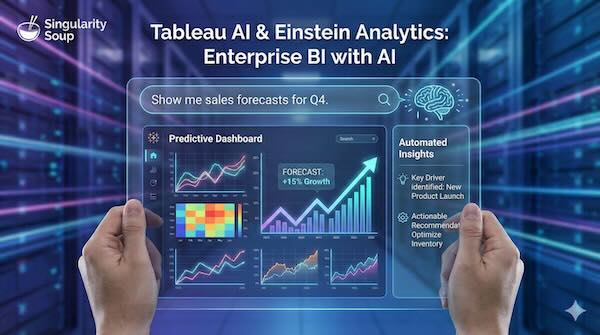
Salesforce has positioned itself at the forefront of AI-powered business intelligence by integrating artificial intelligence capabilities across its analytics portfolio. Tableau AI and Einstein Analytics represent the company's vision for making data analysis more accessible, predictive, and actionable for enterprise users.
What is Tableau AI?
Tableau AI refers to the suite of artificial intelligence and machine learning features embedded within Tableau's visualisation platform. Following Salesforce's acquisition of Tableau in 2019, the company has progressively woven Einstein AI capabilities throughout the product, creating a unified analytics experience.
The core promise is straightforward: reduce the technical barriers between business users and meaningful insights. Rather than requiring extensive SQL knowledge or statistical expertise, Tableau AI aims to let users ask questions in plain English and receive intelligent, contextual answers.
Key AI Features
Natural Language Queries with Ask Data
Ask Data allows users to type questions in conversational language and receive automatic visualisations. A marketing manager might type "show me sales by region for Q3" and instantly see an appropriate chart without manually configuring data sources or selecting chart types.
The system interprets intent, maps questions to available data fields, and selects suitable visualisation formats. Recent updates have improved the natural language processing to handle more complex queries and follow-up questions.
Explain Data for Automated Insights
When viewing a data point that seems unusual, users can click to have Tableau AI analyse potential explanations. The feature examines related data dimensions and statistical patterns to surface factors that might contribute to anomalies.
For example, if a particular store shows unexpectedly high sales, Explain Data might identify that a local competitor closed, a promotional campaign ran during that period, or seasonal factors align with the spike.
Einstein Discovery Predictions
Einstein Discovery brings predictive analytics to business users without requiring data science expertise. The tool analyses historical data to identify patterns and generate predictions about future outcomes.
Common applications include:
- Sales forecasting that accounts for pipeline data, historical trends, and external factors
- Customer churn prediction identifying accounts at risk of leaving
- Case resolution time estimates for customer service operations
- Lead scoring to prioritise sales efforts
Predictions come with explanations showing which factors most influence the outcome, making the AI's reasoning transparent rather than presenting black-box results.
Tableau Pulse and Metrics Layer
Tableau Pulse represents a newer addition, providing personalised, AI-generated insights delivered proactively. Rather than requiring users to build dashboards and check them regularly, Pulse monitors key metrics and alerts users when something notable occurs.
The system learns which metrics matter to each user based on their role and past interactions, then surfaces relevant changes through email digests or in-app notifications.
Enterprise Use Cases
Sales Operations
Sales teams use Einstein Analytics to monitor pipeline health, identify deals at risk, and forecast revenue. AI-powered recommendations suggest next best actions for sales representatives, such as which accounts to prioritise or when to escalate a stalled opportunity.
Customer Service
Service cloud analytics combines case data with Einstein predictions to route cases intelligently, estimate resolution times, and identify systemic issues before they escalate. Supervisors receive automated alerts when metrics deviate from normal patterns.
Marketing Analytics
Marketing teams leverage AI to analyse campaign performance, predict customer lifetime value, and optimise channel spend. Natural language queries allow marketers to explore data without waiting for analyst support.
Financial Planning
Finance departments use predictive models for budget forecasting, expense anomaly detection, and cash flow projections. The combination of historical pattern recognition and current pipeline data improves forecast accuracy.
Integration with the Salesforce Ecosystem
One significant advantage for existing Salesforce customers is native integration. Einstein Analytics connects directly to Sales Cloud, Service Cloud, and Marketing Cloud data without complex ETL processes. This tight integration enables:
- Real-time analytics on operational data
- Embedded visualisations within Salesforce workflows
- Actions triggered directly from insights, such as creating tasks or updating records
- Unified security and governance through the Salesforce platform
The recently introduced Tableau GPT and Einstein Copilot features further extend these capabilities, allowing conversational interactions with data across the entire Salesforce platform.
Considerations for Adoption
Data Quality Requirements
AI features are only as good as the underlying data. Organisations need clean, consistent data to generate reliable predictions and insights. Poor data quality leads to misleading recommendations that can erode user trust.
Training and Change Management
While these tools reduce technical barriers, users still need training to ask effective questions and interpret results appropriately. Successful implementations invest in change management alongside technology deployment.
Licensing Complexity
Tableau and Einstein Analytics have distinct licensing models, and AI features often require additional licences beyond base subscriptions. Organisations should carefully evaluate which capabilities they need and understand the associated costs.
Governance and Trust
Predictive models require ongoing monitoring to ensure they remain accurate and unbiased. Enterprises need governance frameworks for AI-generated insights, particularly when they inform significant business decisions.
The Competitive Landscape
Tableau AI and Einstein Analytics compete with other enterprise BI platforms that have added AI capabilities, including Microsoft Power BI with Copilot, Google Looker with Gemini integration, and various specialist analytics tools. The primary differentiator remains deep Salesforce integration, which provides substantial value for organisations already invested in that ecosystem.
For enterprises evaluating AI-powered analytics, the choice often depends less on which platform has superior AI and more on existing technology investments, data architecture, and specific use case requirements.