Series: Beginner's Guide to AI #18
Read Time: 15 minutes
Level: Beginner
Prerequisites: Guide #1 - What Is AI?, Guide #4 - AI in Your Daily Life
Key Takeaways
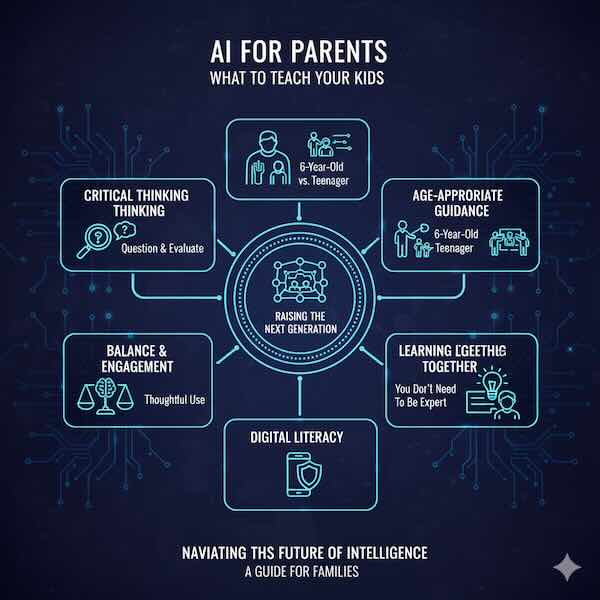
- Children are growing up with AI as normal - they need guidance to use it wisely and safely
- Age-appropriate education matters - what you teach a 6-year-old differs from a teenager
- Critical thinking is more important than technical knowledge - teach them to question and evaluate
- Balance is key - neither AI phobia nor uncritical acceptance, but thoughtful engagement
- You don't need to be an expert - learning together with your kids is perfectly fine
Your child asks Alexa for homework help. Your teenager uses ChatGPT to write essays. Your 8-year-old wants an AI companion app. Your family photos are automatically organized by facial recognition. AI is already part of your children's lives, and its presence will only grow.
As a parent, you face questions previous generations never encountered: How much should kids use AI? What are the risks? How do I teach critical thinking about technology I barely understand myself? What skills will they need for an AI-filled future?
You don't need a computer science degree to guide your children through the AI age. You need awareness, thoughtfulness, and willingness to engage with these questions. Most importantly, you need to start conversations now, while you still have influence over their relationship with technology.
This guide helps you understand what children need to know about AI at different ages, how to teach them to use it safely and critically, and how to prepare them for a future where AI is ubiquitous.
Let's explore how to raise kids who can thrive in—and help shape—the age of AI.
Understanding the Challenge
Before diving into what to teach, understand what makes AI parenting unique.
Why AI Is Different
AI isn't like previous technologies:
Television:
- Passive consumption
- Adults control content through channels
- Limited interaction
- Clear boundaries (screen time)
Internet:
- Active exploration
- Vast but human-created content
- Interactive but traceable
- Teachable safety rules
AI:
- Conversational and responsive
- Generates unlimited personalized content
- Appears intelligent and authoritative
- Harder to monitor and control
- Privacy implications unclear
- Long-term effects unknown
The challenge:
AI adapts to your child, learns from them, and creates content specifically for them. Traditional parenting tools (time limits, content filters) work differently.
What's at Stake
Why it matters:
Cognitive development:
- How children learn to think and reason
- Development of critical thinking skills
- Ability to solve problems independently
- Creativity and imagination
Social development:
- Forming relationships and connections
- Developing empathy and emotional intelligence
- Communication skills
- Understanding human vs. artificial interaction
Values and character:
- What children learn to value
- Ethical reasoning development
- Relationship with truth and honesty
- Sense of human agency and capability
Future preparation:
- Skills needed for AI-filled world
- Career and economic opportunities
- Ability to shape technology's role
- Resilience and adaptability
Your role matters:
How you guide children's AI use now shapes their relationship with technology for life.
Your Advantages
You don't need to be an expert:
What you have:
- Knowledge of your child's developmental stage
- Understanding of your family's values
- Ability to model critical thinking
- Relationship and influence
- Common sense and parental judgment
What you don't need:
- Technical expertise in AI
- Complete understanding of how it works
- All the answers
- Perfect consistency
The approach:
Learn together with your children. Admit uncertainty. Model curiosity and critical thinking. Focus on values and judgment, not technical details.
Age-Appropriate AI Education
What and how you teach depends on developmental stage.
Early Childhood (Ages 3-7)
Developmental stage:
Concrete thinking, learning basic concepts, trusting adults, magical thinking still present.
What to teach:
AI is a tool, not a friend:
"Alexa is like a very smart calculator. It can answer questions and help us, but it's not alive like people or pets. It's a machine that follows instructions."
Why this matters:
Young children can become attached to AI, treating voice assistants as friends or family members. This can:
- Create confusion about relationships
- Develop unrealistic expectations of humans
- Miss opportunities for human connection
- Create dependency
How to teach:
- Refer to AI as "it" not "she/he"
- Explain it's a tool we control
- Compare to other tools (calculators, dictionaries)
- Encourage human interaction over AI
Not everything you see or hear is real:
"Sometimes computers make pictures or stories that aren't real. They can look real, but they're pretend. Always ask a grown-up if you're not sure."
Why this matters:
AI can generate realistic images and stories. Young children need help distinguishing real from artificial.
How to teach:
- Show examples of AI-generated vs. real images
- Explain that computers can make pretend things
- Teach to ask adults about confusing content
- Reinforce that not everything online is true
Ask questions and think for yourself:
"It's good to ask Alexa questions, but also think about the answer. Does it make sense? What do you think?"
Why this matters:
Children learning to trust their own thinking rather than automatically accepting AI outputs.
How to teach:
- Model questioning AI responses
- Ask "What do you think about that answer?"
- Encourage checking with humans
- Praise independent thinking
Privacy basics:
"Don't tell Alexa or other computers about private family things. Some information is just for our family."
Why this matters:
Young children share freely without understanding privacy.
How to teach:
- Create simple rules about what not to share
- Explain that computers remember what we tell them
- Use concrete examples (addresses, full names, private family matters)
- Keep it simple and positive
Screen time includes AI:
Use AI devices counts as screen time, just like TV or games.
Activities for this age:
- Look at AI-generated images together, discuss what seems real or fake
- Practice asking questions and thinking about answers
- Play "is this AI or human-made" games
- Create rules together about AI use
Middle Childhood (Ages 8-12)
Developmental stage:
Developing logical thinking, peer awareness growing, more independent, beginning abstract thought.
What to teach:
How AI works (simplified):
"AI learns by looking at millions of examples. If you train AI on cat pictures, it learns what cats usually look like. Then it can recognize cats or even create new cat pictures. But it doesn't really 'understand' cats like we do."
Why this matters:
Understanding basics helps demystify AI and builds critical thinking.
How to teach:
- Use pattern recognition examples
- Show how AI makes mistakes
- Explain training and prediction
- Demonstrate limitations
AI can be wrong:
"AI makes mistakes. It might give wrong answers but sound very confident. Always check important information, especially for homework."
Why this matters:
Kids this age increasingly use AI for homework. They need to verify information.
How to teach:
- Show examples of AI errors and "hallucinations"
- Teach verification methods
- Encourage using multiple sources
- Discuss why AI might be confident but wrong
AI reflects human biases:
"AI learns from people, so it can learn people's biases and stereotypes. Sometimes AI is unfair because the information it learned from was unfair."
Why this matters:
Children developing understanding of fairness and justice need to know AI isn't neutral.
How to teach:
- Give age-appropriate examples of AI bias
- Discuss fairness and stereotypes
- Encourage questioning unfair AI outputs
- Connect to broader discussions of justice
Your data is valuable:
"Information about you is valuable. Companies use AI to learn about you so they can sell you things or keep you using their apps longer. Be thoughtful about what information you share."
Why this matters:
Children becoming more independent online need privacy awareness.
How to teach:
- Explain how data collection works
- Discuss targeted advertising
- Review privacy settings together
- Teach which information to protect
AI is a tool for learning, not a replacement:
"AI can help explain things or give you ideas, but you still need to do the thinking and learning yourself. Using AI to do all your homework means you don't learn."
Why this matters:
Easy access to AI for homework creates temptation to outsource thinking.
How to teach:
- Establish clear rules for AI homework help
- Discuss difference between help and cheating
- Teach to use AI as tutor, not answer machine
- Monitor and guide usage
Critical evaluation skills:
"When you read something AI wrote, ask: Does this make sense? Is this accurate? What's missing? What would a human say differently?"
Why this matters:
Developing critical thinking is essential life skill.
How to teach:
- Practice evaluating AI outputs together
- Ask critical questions out loud
- Point out flaws and omissions
- Praise thoughtful skepticism
Activities for this age:
- Test AI knowledge with questions where you know the answer
- Compare AI responses from different services
- Fact-check AI-generated content together
- Discuss ethical scenarios involving AI
- Create family guidelines for AI use
Teenagers (Ages 13-18)
Developmental stage:
Abstract thinking, identity formation, peer influence strong, increasing independence, future-oriented.
What to teach:
How AI actually works (deeper):
"AI uses neural networks modeled loosely on brains. It processes patterns in massive datasets through layers of processing. It's predicting likely outputs based on training, not truly understanding or thinking."
Why this matters:
Teens can understand more technical concepts. Understanding builds realistic expectations.
How to teach:
- Share accessible technical explanations
- Watch educational videos together
- Discuss implications of how AI works
- Explore limitations from architecture
The alignment problem:
"AI does what it's programmed to do, not necessarily what we want it to do. Making sure AI systems pursue goals aligned with human values is an unsolved problem."
Why this matters:
Teens thinking about future should understand major challenges.
How to teach:
- Discuss alignment examples
- Explore ethical implications
- Consider career possibilities in AI safety
- Encourage critical thinking about AI development
AI and identity:
"AI will know intimate details about you through data collection. This affects privacy, but also how you're perceived and treated. The digital trail you create now can impact your future."
Why this matters:
Teens are forming identity and making choices with long-term implications.
How to teach:
- Discuss digital footprints and permanence
- Explore implications of data collection
- Review privacy settings on all platforms
- Discuss future impacts (college, employment)
AI in social media:
"Algorithms control what you see on social media. They're optimized for engagement, not your wellbeing. They can create echo chambers, amplify extreme content, and manipulate your emotions."
Why this matters:
Teens heavily use social media shaped by AI.
How to teach:
- Explain recommendation algorithms
- Discuss business models and incentives
- Explore psychological manipulation
- Encourage mindful consumption
- Teach to diversify information sources
Academic integrity in AI age:
"Using AI for homework is a gray area. Some use is okay (like a tutor), some is cheating (having it write your essays). You need to understand the difference and make ethical choices."
Why this matters:
Teens face real temptation and consequences around AI use in school.
How to teach:
- Discuss school policies and why they exist
- Explore where the line is
- Talk about learning vs. grades
- Discuss integrity and character
- Share that you trust their judgment
AI and future careers:
"AI will change the job market significantly. Some jobs will disappear, new ones will emerge. Focus on developing skills AI can't easily replicate: creativity, emotional intelligence, ethical judgment, complex problem-solving."
Why this matters:
Teens making educational and career decisions need realistic perspective.
How to teach:
- Discuss career implications honestly
- Identify valuable human skills
- Explore AI-related career paths
- Emphasize adaptability and learning
- Discuss entrepreneurship and creating value
AI's societal impact:
"AI raises important questions about privacy, fairness, power, and what it means to be human. These aren't just technical questions—they're about what kind of society we want."
Why this matters:
Teens can engage with complex societal questions and should understand their stake.
How to teach:
- Discuss ethical dilemmas
- Explore different perspectives
- Encourage civic engagement
- Talk about regulation and governance
- Empower them to shape the future
Activities for this age:
- Analyze AI bias in real applications
- Debate AI ethics scenarios
- Research AI impacts on topics they care about
- Experiment with AI tools critically
- Discuss current AI news and developments
- Explore AI safety careers if interested
Practical Parenting Strategies
Beyond teaching concepts, implement these strategies.
Setting Boundaries
Create clear rules:
Example boundaries:
For younger children:
- AI devices only in common areas
- Adult present when using AI
- Time limits on AI interaction
- No personal information shared
For older children:
- Transparent AI use (parents can review)
- Homework help guidelines
- Privacy protection requirements
- Critical evaluation expected
For teens:
- Discuss and agree on guidelines together
- Focus on principles more than rules
- Build trust and responsibility
- Negotiate as they demonstrate judgment
Making it work:
- Write rules down together
- Explain reasoning behind each rule
- Be consistent in enforcement
- Revisit and adjust as kids grow
- Model the behavior you expect
Monitoring Without Hovering
Balance oversight and privacy:
Approaches by age:
Young children:
- Direct supervision appropriate
- Monitor all AI interactions
- Review history regularly
- Guide every use
Middle childhood:
- Spot-check conversations and usage
- Random reviews
- Required transparency
- Increasing independence with accountability
Teens:
- Respect privacy while maintaining awareness
- Focus on red flags, not micromanaging
- Build trust and communication
- Respect developing autonomy
Tools:
- Review conversation histories
- Check AI app usage
- Parental controls where appropriate
- Open dialogue about what you're monitoring
Balance:
Trust but verify. Give age-appropriate privacy. Communicate openly about monitoring. Focus on safety and values, not control.
Modeling Good Behavior
Children learn from watching you:
Model critical AI use:
- Question AI outputs aloud
- Verify information before acting on it
- Use AI as tool, not oracle
- Demonstrate healthy skepticism
Model privacy awareness:
- Be thoughtful about what you share
- Review privacy settings
- Discuss your own boundaries
- Protect family information
Model balanced use:
- Don't over-rely on AI
- Maintain human connections
- Use AI purposefully, not habitually
- Show it's okay to not use AI
Admit limitations:
- "I don't know" is okay
- Learn about AI together
- Acknowledge uncertainty
- Model intellectual humility
Your behavior matters more than your words.
Having Ongoing Conversations
Don't make it one talk:
Regular discussions:
- Bring up AI when it's relevant
- Ask about their experiences
- Share interesting articles or news
- Discuss what you're learning
Create safe space:
- Non-judgmental questions
- Listen without lecturing
- Validate concerns
- Admit your own uncertainties
Age-appropriate dialogue:
- Match complexity to development
- Use examples from their life
- Connect to their interests
- Make it relevant
Encourage questions:
- Welcome all questions
- Never dismiss curiosity
- Admit when you don't know
- Explore answers together
Teachable moments:
- Use current events
- Discuss their experiences
- Analyze examples together
- Connect to bigger themes
Encouraging Healthy Skepticism
Not cynicism, but critical thinking:
Teach to question:
- "How do you know that's true?"
- "Where did that information come from?"
- "What might AI not be telling us?"
- "Who benefits from this AI system?"
Develop verification habits:
- Check multiple sources
- Look for original sources
- Verify with trusted adults or experts
- Distinguish fact from opinion
Recognize manipulation:
- Understand persuasion techniques
- Identify emotional manipulation
- Question sources and motives
- Resist pressure to share or act immediately
Balance trust and skepticism:
- Some sources more reliable than others
- Expertise matters
- Critical thinking doesn't mean rejecting all information
- Nuance over blanket distrust
Specific AI Challenges
Address particular issues parents commonly face.
AI and Homework
The dilemma:
AI can do homework. Should kids use it? How much?
Clear guidelines:
Acceptable use:
- Explaining concepts you don't understand
- Providing examples
- Checking your own work
- Brainstorming ideas
- Learning new material
Not acceptable:
- Having AI write entire essays
- Getting answers without understanding
- Submitting AI work as your own
- Using AI instead of learning
The line:
If you couldn't explain what you submitted, you've crossed the line.
Teaching opportunity:
- Discuss academic integrity
- Explore purpose of homework (learning, not just completion)
- Talk about long-term consequences
- Build character and judgment
Practical approach:
- Check school policies
- Review AI-assisted work
- Ask kids to explain their work
- Focus on learning, not just grades
- Trust but verify
AI Companions and Parasocial Relationships
The concern:
Children forming attachments to AI chatbots or virtual personalities.
Why it matters:
- Displaces human relationships
- Creates unrealistic expectations
- Provides unconditional acceptance that doesn't teach resilience
- Potential for manipulation
- Affects social development
What to do:
Set limits:
- Time restrictions on AI companions
- Priority given to human relationships
- AI supplements, doesn't replace friends
Discuss reality:
- AI isn't truly a friend
- Designed to be engaging, not for your benefit
- Cannot provide what humans can
- One-sided relationship
Encourage real connections:
- Prioritize in-person friendships
- Family time without devices
- Activities fostering human connection
- Address underlying loneliness
When to worry:
- Preference for AI over humans
- Sharing intimate details only with AI
- Emotional distress when separated from AI
- Social isolation increasing
If concerned, consider:
- Reducing access
- Counseling or therapy
- Addressing root causes
- Seeking professional guidance
AI-Generated Content
The issue:
Children exposed to or creating AI-generated images, videos, text.
Concerns:
Misinformation:
- Can't distinguish real from fake
- Believes false content
- Shares misinformation
- Develops confused worldview
Inappropriate content:
- AI generating unsuitable material
- Exposure to harmful images
- Age-inappropriate content
- Disturbing or scary material
Creating harmful content:
- Using AI to create fake images of people
- Generating inappropriate material
- Cyberbullying with AI
- Impersonation
What to teach:
Critical consumption:
- Question authenticity
- Look for signs of AI generation
- Verify important claims
- Understand creation methods
Ethical creation:
- Don't create fake content of real people
- Consider harm before sharing
- Respect privacy and dignity
- Understand legal and ethical boundaries
Practical protection:
- Content filters where possible
- Supervised use for younger kids
- Discussions about what they encounter
- Open door policy for concerning content
Privacy and Data Collection
The reality:
AI companies collect vast data on children.
Risks:
- Detailed psychological profiles
- Behavioral manipulation
- Privacy violations
- Future implications unknown
- Data breaches
Protections:
Legal:
- COPPA (Children's Online Privacy Protection Act) in US
- Similar laws in other countries
- Age restrictions on services
- Parental consent requirements
Practical:
- Review privacy policies
- Opt out of data collection where possible
- Use privacy-focused services
- Limit information children share
- Regular privacy audits
Teaching privacy:
- What information is private
- Why privacy matters
- How to protect it
- Rights they have
- When to ask for help
Skills for the AI Age
Beyond AI literacy, develop broader capabilities:
Critical Thinking
Teach to:
- Question assumptions
- Identify logical fallacies
- Distinguish correlation from causation
- Recognize bias
- Evaluate evidence
- Think independently
How:
- Model critical thinking
- Ask probing questions
- Discuss current events critically
- Play devil's advocate
- Praise thoughtful skepticism
Creativity and Imagination
Why it matters:
AI can generate content, but human creativity remains unique.
Cultivate:
- Original thinking
- Artistic expression
- Novel problem-solving
- Imaginative play
- Creative pursuits
How:
- Encourage creative hobbies
- Provide unstructured time
- Value process over product
- Limit AI for creative work
- Celebrate originality
Emotional Intelligence
AI lacks genuine emotional understanding:
Develop:
- Self-awareness
- Empathy
- Relationship skills
- Emotional regulation
- Social awareness
How:
- Discuss feelings openly
- Practice perspective-taking
- Encourage face-to-face interaction
- Model healthy emotional expression
- Prioritize human connection
Adaptability and Resilience
Future is uncertain:
Build:
- Comfort with change
- Learning agility
- Resilience through setbacks
- Growth mindset
- Flexibility
How:
- Embrace challenges
- Reframe failures as learning
- Encourage trying new things
- Model adaptation
- Discuss coping strategies
Ethical Reasoning
Important for navigating AI dilemmas:
Develop:
- Moral reasoning
- Ethical frameworks
- Values clarification
- Integrity
- Civic responsibility
How:
- Discuss ethical dilemmas
- Connect to real situations
- Explain your own reasoning
- Encourage principled stands
- Model ethical behavior
When to Seek Help
You don't have to handle everything alone:
Red Flags
Seek professional guidance if:
- Excessive AI dependency (can't function without it)
- Social isolation (prefers AI to humans)
- Academic problems (AI use affecting learning)
- Emotional issues (distress, anxiety, depression)
- Risky behavior (sharing inappropriate content, unsafe use)
- Sleep disruption
- Withdrawal from activities
- Personality changes
Resources
Where to turn:
School resources:
- Teachers and counselors
- Technology coordinators
- School psychologists
- Administration
Mental health:
- Therapists familiar with technology issues
- Child psychologists
- Family counseling
- Support groups
Online resources:
- Common Sense Media
- Family Online Safety Institute
- Internet Safety organizations
- Parenting forums and communities
Don't hesitate:
Getting help early prevents bigger problems. Professional perspective offers valuable guidance.
Taking Action Today
Start with small steps:
This Week
- Have initial conversation about AI with your kids
- Review privacy settings on AI services they use
- Establish one new guideline for AI use
- Share one interesting thing you learned about AI
This Month
- Create family AI use guidelines together
- Do one age-appropriate AI activity together
- Research and discuss one AI news story
- Review homework AI use and set expectations
Ongoing
- Regular conversations about AI experiences
- Model critical AI use
- Adjust guidelines as kids grow
- Learn alongside your children
- Stay informed about developments
The key:
Start somewhere. Perfect isn't required. Engagement matters more than expertise.
The Bottom Line
Raising children in the age of AI is challenging but manageable. You don't need to be an AI expert—you need to be an engaged, thoughtful parent.
Teach age-appropriate concepts about what AI is, how it works, and its limitations. Develop critical thinking, creativity, emotional intelligence, and ethical reasoning. Set clear boundaries while allowing age-appropriate independence. Model good AI use yourself. Have ongoing conversations, not one-time talks.
The goal isn't to make your children AI experts (though they might become that). It's to raise thoughtful, critical, capable humans who can navigate an AI-filled world wisely.
Your children will encounter AI throughout their lives. The foundation you build now—critical thinking, healthy skepticism, strong values, human connection—will serve them regardless of how AI evolves.
You're not just teaching about AI. You're teaching how to live well in a world of powerful technology. That's always been part of parenting. AI just makes it more urgent and explicit.
Start today. Have a conversation. Set a guideline. Learn something together. Your engagement matters more than your expertise.
Your kids need you to help them navigate this. Not to have all the answers, but to care enough to engage with the questions.
That's something you're already equipped to do.
Continue Your Learning Journey
Now that you understand AI parenting, explore related topics:
- Guide #4: AI in Your Daily Life - Understanding AI your family encounters
- Guide #11: Understanding AI Risks - Protecting your children
- Guide #14: Your AI Privacy Guide - Privacy for the whole family
- Guide #10: Getting Started with AI Tools - Learn alongside your kids
- View All Beginner Guides - Complete learning path for AI beginners
This article is part of the SingularitySoup Beginner's Guide to AI series. Updated January 2026.