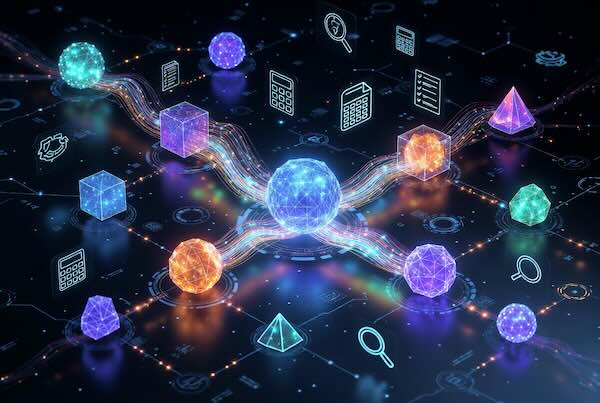
The future of artificial intelligence may not be a single superintelligent agent, but rather teams of specialized AI systems working in concert—much like a well-coordinated human organization.
As AI capabilities have matured, a fundamental shift is occurring in how these systems are deployed. Instead of building one massive, general-purpose AI to handle every task, developers are increasingly creating multi-agent systems: coordinated teams of specialized AI agents, each excelling at specific functions while collaborating to solve complex problems.
From Solo to Symphony
The evolution mirrors how human organizations work. A successful company doesn't hire one person to do everything—it assembles specialists. Marketing teams create campaigns, finance departments manage budgets, operations teams handle logistics. Each brings deep expertise to their domain, and they coordinate to achieve shared goals.
Multi-agent AI systems follow the same principle. Rather than asking a single AI to research, plan, write, fact-check, and revise simultaneously, these systems deploy separate agents for each role. A planner agent might break down a complex project into steps, an executor agent carries out those steps, a reviewer agent evaluates the work, and a fact-checker agent verifies accuracy. Each agent is optimized for its specific function, and together they produce better results than any single system could achieve alone.
The Frameworks Powering the Swarm
Several platforms have emerged to make building these agent teams accessible to developers and enterprises.
CrewAI allows developers to define "crews" of AI agents with specific roles, goals, and tools. An agent designated as a researcher might have access to search capabilities and databases, while a writer agent focuses on content creation. The framework handles coordination, allowing agents to pass information and build on each other's work.
Microsoft's AutoGen takes a different approach, emphasizing conversational interactions between agents. Agents can debate, critique each other's ideas, and iterate toward better solutions through dialogue—similar to how human team members refine ideas through discussion.
LangGraph, built by the creators of LangChain, treats multi-agent systems as state machines where information flows between agents through defined pathways. This gives developers fine-grained control over how agents interact and when each specialist should contribute.
Enterprise Applications: Breaking Down Silos
The real-world applications extend far beyond laboratory demonstrations. Enterprises are deploying what industry observers call "agent swarms"—interconnected specialist agents embedded across different departments.
Imagine a customer inquiry that touches multiple business functions. A sales agent receives the query and determines what information is needed. It consults a finance agent to check pricing and credit terms, coordinates with an operations agent to verify inventory and delivery timelines, and potentially involves a legal agent to review contract terms. All of this happens in real time, with agents communicating and coordinating without human intervention at each step.
This architecture solves a persistent problem in large organizations: information silos. When each department has its own specialized AI agent, but these agents can intercommunicate, data flows more freely while expertise remains concentrated where it's most effective.
Why Swarms Work Better
Multi-agent systems offer several advantages over monolithic AI approaches. Specialization allows each agent to be fine-tuned for specific tasks, often resulting in better performance than a general-purpose model trying to handle everything. When one agent needs updating or retraining, you can modify that specialist without rebuilding the entire system.
The approach also improves transparency and debugging. If something goes wrong, you can identify which agent in the chain made the error, rather than troubleshooting an inscrutable black box. For enterprises concerned about AI reliability, this modularity provides crucial oversight.
Perhaps most importantly, multi-agent systems can incorporate human oversight at key decision points. An agent might flag a complex decision for human review before proceeding, combining AI efficiency with human judgment.
Challenges and Considerations
Despite the promise, coordinating multiple AI agents introduces complexity. Agents must communicate effectively, handle conflicting information, and avoid infinite loops where they endlessly refine each other's work. Managing the computational costs of running multiple models simultaneously remains a practical concern for many organizations.
There's also the question of emergent behavior—when multiple AI systems interact, they might produce unexpected results that wouldn't occur with a single agent. Researchers are still developing best practices for testing and validating these more complex systems.
The Path Forward
As AI continues its rapid advancement, the trajectory seems clear: the future belongs to teams, not individuals. Just as modern software development embraced microservices over monolithic applications, AI development is embracing specialized, coordinated agents over single general-purpose systems.
For businesses exploring AI adoption, this shift has practical implications. Rather than waiting for a single AI solution that does everything perfectly, organizations can deploy focused specialists that collaborate—building AI capabilities incrementally, department by department, use case by use case.
The age of the solo AI agent isn't ending, but it's being augmented and, in many cases, surpassed by something that looks more familiar: teams of specialists working together, each bringing their expertise to solve problems too complex for any individual to handle alone.