Series: Beginner's Guide to AI #14
Read Time: 14 minutes
Level: Beginner
Prerequisites: Guide #1 - What Is AI?, Guide #11 - Understanding AI Risks
Key Takeaways
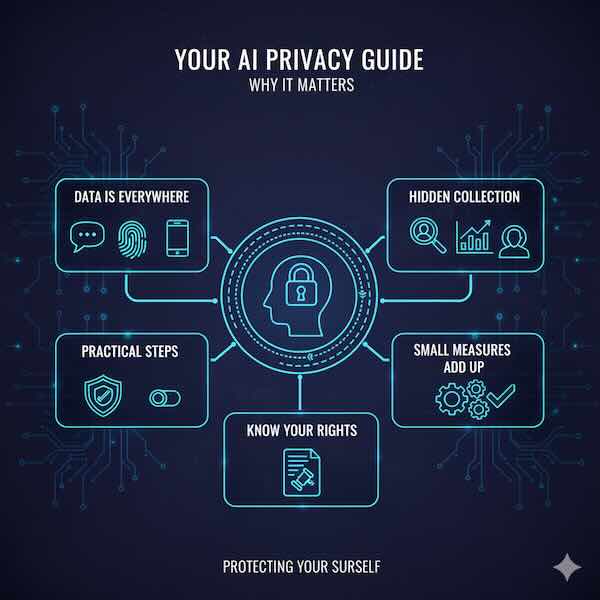
- Every AI interaction involves data - your inputs, patterns, and personal information
- AI companies collect far more than you realize and use it in ways you might not expect
- You can significantly reduce privacy risks through simple, practical steps
- Privacy isn't all-or-nothing - small protective measures add up
- Understanding your rights helps you make informed choices about AI use
You ask ChatGPT to help write a sensitive work email. You use an AI voice assistant to set reminders about medical appointments. You upload family photos to an AI-powered organizing app. Each interaction feels private, but is it?
The uncomfortable truth: Most AI services collect, store, and analyze everything you share. Your conversations train future models. Your photos are analyzed for patterns. Your voice recordings are reviewed by human workers. Your data might be retained indefinitely, shared with third parties, or accessed in data breaches.
This isn't paranoia—it's how AI systems work. They need data to function, and that data is valuable to companies developing them.
But you're not powerless. Understanding what data AI collects, how it's used, and what protective measures exist helps you use AI while maintaining reasonable privacy. This guide shows you how.
Let's explore the privacy landscape of AI and give you practical tools to protect yourself.
What Data Does AI Collect?
Understanding what's being collected is the first step toward protecting it.
Direct Inputs
Everything you type, speak, or upload:
Text-Based AI (ChatGPT, Claude, etc.):
- Every question you ask
- All conversations and context
- Topics you're interested in
- How you phrase requests
- When and how often you use the service
- What kind of tasks you're doing
Voice Assistants (Alexa, Siri, Google):
- Voice recordings of everything you say
- Background conversations (sometimes accidentally)
- Your voice patterns and characteristics
- Accents, speech patterns, emotional tone
- Who else is speaking in your home
- Ambient sounds in your environment
Image AI (Photo apps, generators):
- Every photo you upload
- Faces and who appears with whom
- Locations where photos were taken
- What's in your home, car, office
- Your lifestyle and activities
- People in your social circle
The surprising part: Even deleted conversations may be retained. "Deleting" often just hides content from you, not from company servers.
Derived Data and Inferences
What AI learns about you:
From patterns:
- Your schedule and routines
- Your location patterns
- Your relationships and social connections
- Your health concerns (from searches and questions)
- Your financial situation (from shopping and questions)
- Your political views and beliefs
- Your psychological state and vulnerabilities
The process:
You don't explicitly share this information, but AI infers it from:
- Topics you ask about repeatedly
- Time patterns of usage
- Combinations of questions
- Metadata and context
- Correlations with other users
Example:
You never tell an AI you're pregnant, but it might infer this from:
- Questions about morning sickness remedies
- Searches for baby products
- Changes in dietary questions
- Timing of doctor appointment reminders
- Correlation with known pregnancy-related patterns
Metadata
The data about your data:
- IP address and location
- Device type and characteristics
- Browser and operating system
- Time and duration of each session
- Sequence of actions
- Links you click
- How long you spend on responses
- Whether you copy, edit, or regenerate
Why metadata matters:
Even without seeing content, metadata reveals:
- Your daily routines
- Where you live and work
- Your social network
- Behavioral patterns
- Potentially sensitive activities
Court cases have established: Metadata alone can reveal intimate details of someone's life.
Training Data
The permanent record:
Unless you specifically opt out:
- Your conversations may train future AI models
- Your photos improve image recognition
- Your voice refines speech systems
- Your corrections teach better responses
The implications:
- Your data becomes part of AI's "knowledge"
- Potentially accessible to millions of future users
- Can't be fully removed once incorporated
- Used to profit companies indefinitely
How Is Your Data Used?
Understanding usage helps you assess risk and make informed choices.
Improving AI Systems
The stated purpose:
Most AI companies claim data is used primarily to improve services.
What this means:
Model Training:
- Your inputs become training examples
- AI learns from your corrections and preferences
- Your usage patterns shape future behavior
Quality Control:
- Human reviewers read conversations to assess quality
- Your photos are labeled and categorized
- Your voice is transcribed and analyzed
Bug Detection:
- Unusual inputs help identify problems
- Edge cases improve robustness
- Errors teach better error handling
Personalization:
- Your history shapes recommendations
- Preferences customize responses
- Patterns predict what you'll want
Commercial Purposes
The profit motive:
Your data is valuable. Companies monetize it.
How:
Advertising:
- Build detailed profile of interests and behaviors
- Target ads based on AI-learned preferences
- Sell access to advertisers
- Predict what you'll buy
Product Development:
- Identify market opportunities from questions people ask
- Understand user needs and pain points
- Develop new features based on usage patterns
- Competitive intelligence
Data Sales:
- Aggregated data sold to third parties
- "Anonymized" data (often not truly anonymous)
- Insights about user populations
- Market research and trends
The claim: Data is anonymized and aggregated.
The reality: Re-identification is often possible. Combining multiple data sources can reveal identity.
Research and Analysis
Academic and internal research:
- Understanding human behavior
- Social science research
- Psychological studies
- Language and culture analysis
You might not have consented to being a research subject, but many terms of service allow it.
Sharing with Third Parties
Who gets your data:
Business Partners:
- Integration partners
- Service providers
- Analytics companies
- Cloud infrastructure providers
Legal Requirements:
- Law enforcement requests
- Court orders
- Government surveillance
- National security demands
Corporate Transactions:
- Mergers and acquisitions
- Bankruptcy proceedings
- Asset sales
- Corporate restructuring
Your data can change hands without your knowledge or consent.
Unexpected Uses
Examples that surprised users:
OpenAI's ChatGPT:
- Initially used all conversations for training (now opt-out available)
- Human reviewers read conversations for quality control
- Bug exposed some users' conversation titles to others
Google Assistant:
- Contractors listened to voice recordings (including private conversations)
- Recordings stored indefinitely unless manually deleted
- Used to improve services but also accessed by employees
Photo Apps:
- Facial recognition trained on uploaded photos
- Location data mapped patterns of life
- Photos sometimes kept after account deletion
- Accessed for law enforcement purposes
Privacy Risks You Should Know
Understanding risks helps you make informed decisions.
Data Breaches
The reality:
Every company storing data can be hacked. AI companies are no exception.
What's at risk:
- Personal conversations (potentially embarrassing or damaging)
- Health information you discussed
- Financial details mentioned
- Work-related confidential information
- Relationship and personal problems
- Political views and sensitive topics
Recent examples:
- Major AI companies have experienced security incidents
- User data exposed through bugs and vulnerabilities
- Employee access abuse
- Third-party vendor breaches
The problem: Once data is breached, you can't get it back. It may circulate indefinitely.
Government Surveillance
Legal access:
In many jurisdictions:
- Government can request user data
- AI companies must comply with court orders
- National security requests may be secret
- Mass surveillance programs exist
What this means:
Content you share with AI services may be accessible to:
- Law enforcement
- Intelligence agencies
- Foreign governments (depending on where servers are located)
- Court proceedings
Cross-border data:
If AI company is multinational:
- Your data may be stored in multiple countries
- Subject to multiple jurisdictions' laws
- Potentially accessible by foreign governments
- Different privacy protections apply
Profiling and Discrimination
The risk:
Detailed profiles enable discrimination.
Scenarios:
Employment:
- Employers might access your AI usage
- Inferences about health, political views, personality
- Questions you've asked reveal concerns or weaknesses
- Pattern analysis suggests character traits
Insurance:
- Health insurers might want access to health-related AI queries
- Life insurance companies assess risk through behavior patterns
- Auto insurance could use data about your habits
- Denied coverage based on inferred risks
Financial Services:
- Credit decisions influenced by AI interaction patterns
- Loan applications affected by inferred financial stress
- Banking access based on predicted reliability
- Investment opportunities limited by profiling
Legal Proceedings:
- Divorce cases: AI conversations as evidence
- Custody battles: parenting questions examined
- Criminal cases: searches and questions scrutinized
- Civil litigation: communications subpoenaed
Manipulation and Targeting
The concern:
Detailed knowledge enables manipulation.
How it works:
Psychological Profiling:
- AI learns your vulnerabilities
- Identifies what persuades you
- Detects emotional states
- Maps decision-making patterns
Targeted Influence:
- Personalized advertising exploiting weaknesses
- Political messaging customized to your psychology
- Financial products targeting your insecurities
- Content designed to manipulate behavior
Real examples:
- Cambridge Analytica used psychological profiles for political targeting
- Social media algorithms exploit emotional triggers
- AI-powered ads target vulnerable moments
- Personalized scams using learned information
Identity Theft and Fraud
The danger:
Sufficient personal information enables impersonation.
What criminals can do:
Voice Cloning:
- AI needs just seconds of your voice
- Clone voice to impersonate you
- Call family members requesting money
- Authorize financial transactions
- Bypass voice authentication
Deepfakes:
- Create fake images or videos of you
- Fabricate compromising situations
- Damage reputation
- Blackmail and extortion
Identity Theft:
- Combine data from multiple sources
- Build complete profile
- Access accounts
- Commit fraud in your name
Protection is harder when so much personal data is already in AI systems.
Your Privacy Rights
Know what rights you have—they vary by location.
Rights Under GDPR (European Union)
If you're in EU or company operates there:
Right to Access:
- Request all data company has about you
- See how it's being used
- Understand who it's shared with
Right to Deletion ("Right to be Forgotten"):
- Request deletion of your data
- Companies must comply unless legal reason to retain
- Limited exceptions for legitimate interests
Right to Rectification:
- Correct inaccurate data
- Update incomplete information
Right to Data Portability:
- Receive your data in usable format
- Transfer to another service
Right to Object:
- Object to certain data processing
- Opt out of profiling and automated decisions
- Refuse marketing uses
Right to Explanation:
- Understand automated decisions affecting you
- Challenge algorithmic decisions
Rights Under CCPA (California)
If you're in California:
Right to Know:
- What personal information is collected
- How it's used and shared
- Categories of third parties receiving data
Right to Delete:
- Request deletion of personal information
- Exceptions for necessary business purposes
Right to Opt-Out:
- Opt out of sale of personal information
- Businesses must respect opt-out
Right to Non-Discrimination:
- Can't be treated differently for exercising rights
- Can't be denied services or charged more
Limited Rights Elsewhere
In many other jurisdictions:
Rights are weaker or non-existent:
- No guaranteed right to deletion
- Limited transparency requirements
- No opt-out from data sales
- Minimal enforcement
Check your local laws to understand what protections you have.
Practical Privacy Protection Steps
You can't achieve perfect privacy while using AI, but you can significantly reduce risks.
Immediate Actions (Do These Now)
1. Review Privacy Settings
For each AI service you use:
- Go to privacy/settings menu
- Opt out of data training if option exists
- Disable conversation history
- Turn off personalization features
- Limit data sharing
Specific examples:
ChatGPT:
- Settings → Data Controls → Opt out of training
- Delete conversation history regularly
- Use temporary chat mode
Google Assistant:
- Manage voice recordings
- Set auto-delete to 3 months
- Limit personalized ads
2. Delete Old Data
Clear what's already there:
- Delete conversation histories
- Remove uploaded photos and files
- Clear voice recordings
- Revoke app permissions
Make it routine:
- Monthly deletion of AI conversations
- Regular cleanup of voice data
- Periodic photo library reviews
3. Use Incognito/Temporary Modes
Many AI services offer:
- Temporary chats (not saved to history)
- Guest mode
- Incognito browsing
- Ephemeral sessions
Use these for:
- Sensitive topics
- Personal questions
- Confidential work matters
- Anything you don't want recorded
4. Read Privacy Policies
Sounds tedious, but:
- Use AI to summarize policies for you
- Focus on key sections: data collection, sharing, retention
- Understand what you're agreeing to
- Make informed decisions
Ask AI: "Summarize this privacy policy, focusing on what data is collected, how it's used, and who it's shared with."
Medium-Term Changes (Plan and Implement)
1. Minimize Sensitive Information
Never share with AI:
- Social security numbers
- Credit card details
- Passwords or security codes
- Medical records or diagnoses
- Legal case details
- Confidential business information
- Intimate personal details
Be vague when possible:
- "A friend has a health concern" instead of "I have diabetes"
- "Someone I know" instead of names
- Generic locations instead of specific addresses
2. Use Multiple Accounts
Compartmentalize usage:
- Personal account for casual use
- Professional account for work (if allowed)
- Throwaway accounts for testing or sensitive queries
Benefits:
- Limits profiling across contexts
- Reduces comprehensive data collection
- Minimizes impact of breaches
3. Choose Privacy-Focused Services
Some AI services prioritize privacy:
Better options:
- Local AI models (run on your computer)
- End-to-end encrypted services
- Services with strong privacy policies
- Companies with privacy-first business models
Research before choosing:
- Compare privacy policies
- Check data retention periods
- Look for independent audits
- Read user reviews about privacy
4. Use VPNs and Privacy Tools
Additional protection:
VPN (Virtual Private Network):
- Hides your IP address and location
- Encrypts internet traffic
- Makes tracking harder
Privacy-focused browsers:
- Brave, Firefox with privacy extensions
- Block trackers and ads
- Prevent fingerprinting
Ad blockers:
- Reduce tracking
- Limit data collection
- Improve security
Advanced Protection (For High Privacy Needs)
1. Run AI Locally
Most private option:
Local AI models:
- Stable Diffusion for image generation (runs on your computer)
- Local language models (if you have powerful hardware)
- Offline voice assistants
Benefits:
- No data sent to companies
- Complete control over data
- No internet required
- Maximum privacy
Limitations:
- Requires technical knowledge
- Needs powerful computer
- Less capable than cloud AI
- More setup and maintenance
2. Use Privacy-Preserving AI Services
Emerging options:
Federated Learning:
- AI trains on your device
- Only shares model updates, not data
- Privacy-preserving by design
Differential Privacy:
- Mathematical guarantees of privacy
- Data aggregated with noise added
- Individual data can't be extracted
Homomorphic Encryption:
- AI processes encrypted data
- Never sees unencrypted information
- Still experimental for most uses
Look for services advertising these technologies.
3. Limit Smart Device Usage
Smart devices are surveillance devices:
Minimize:
- Smart speakers in bedrooms, bathrooms
- Always-on microphones
- Cameras in private spaces
- Location tracking when unnecessary
Configure:
- Disable voice activation
- Mute microphones when not in use
- Cover cameras
- Turn off location services
Consider: Whether convenience is worth privacy trade-off for each device.
Special Situations
Some contexts require extra privacy care.
Work and Professional Use
Risks:
- Confidential business information in AI
- Proprietary data exposed
- Client information shared
- Competitive intelligence leaked
Protection:
Check company policy:
- Is AI use allowed?
- Which services are approved?
- What data can you share?
- What are consequences of violations?
Use work-approved tools:
- Enterprise versions with business agreements
- On-premises AI solutions
- Company-managed services
Never share:
- Trade secrets
- Client confidential information
- Proprietary code or data
- Unreleased product details
- Strategic plans
Assume everything is logged and potentially reviewed by employer.
Healthcare and Medical
Extra sensitivity:
Medical information is especially private and protected by laws like HIPAA (US), but AI services typically aren't HIPAA-compliant.
Risks:
- Medical AI services not legally protected
- Insurance companies might access data
- Employers could learn health conditions
- Data breaches expose medical history
Protection:
For medical questions:
- Use only HIPAA-compliant services (rare)
- Avoid specific diagnoses or conditions
- Speak to actual healthcare providers for real advice
- Don't upload medical records or test results
Be extremely vague:
- "General question about a common condition"
- "Hypothetical medical scenario"
- "Friend asking about symptoms"
Better: Don't use consumer AI for medical matters at all.
Legal Matters
High risk:
Legal information can be used against you.
Risks:
- AI conversations subpoenaed in court
- Admissions or statements used as evidence
- Legal strategy revealed to opponents
- Attorney-client privilege doesn't apply to AI
Protection:
Don't use AI for:
- Active legal cases
- Anything in litigation
- Criminal matters
- Divorce or custody issues
Use lawyers instead:
- Actual attorney-client privilege
- Professional confidentiality
- Legal protections
If you must use AI:
- Be extremely general
- Don't include specifics
- Assume it could be read in court
- Consult real attorney for anything important
Children and Family
Special concerns:
Children's privacy requires extra protection.
Risks:
- Children don't understand privacy implications
- Data collected follows them into adulthood
- Facial recognition on children's photos
- Inferences about children's health, development, behavior
Protection:
Teach children:
- Don't share personal information with AI
- Explain privacy risks age-appropriately
- Set boundaries on AI use
- Monitor their AI interactions
For parents:
- Don't upload children's photos to AI services
- Don't use AI for parenting questions that reveal too much
- Use child-specific protections where available
- Consider long-term implications of data collection
Family members:
- Get consent before uploading photos of others
- Don't share others' information with AI
- Respect family members' privacy preferences
Privacy-Friendly Alternatives
If privacy is paramount, consider alternatives to mainstream AI.
Text AI Alternatives
Privacy-focused options:
DuckDuckGo AI Chat:
- Doesn't store conversations
- No user profiling
- Anonymous queries
HuggingChat:
- Open-source models
- Less data collection
- More transparency
Local LLMs:
- Run on your computer
- Complete privacy
- No internet needed
Trade-offs: Less capable than ChatGPT, but more private.
Image AI Alternatives
Private options:
Stable Diffusion (local):
- Runs on your computer
- No data sent anywhere
- Full control
Self-hosted services:
- Your own server
- Complete control
- Technical expertise required
Voice Assistant Alternatives
More private options:
Mycroft:
- Open-source
- Privacy-respecting
- Local processing options
Home Assistant:
- Self-hosted
- No cloud required
- More setup involved
Alternative: Just use your phone or computer directly instead of voice assistant.
Balancing Privacy and Utility
Perfect privacy means no AI use. That's impractical for most people.
The Trade-Off
More privacy = Less convenience and capability
Questions to ask:
For each AI service:
- What value does it provide?
- What data am I sharing?
- What are risks if that data is exposed or misused?
- Are there more private alternatives?
- Can I limit data shared while keeping useful features?
Risk-Based Approach
Categorize your AI use:
High Privacy (use most protection):
- Health questions
- Legal matters
- Financial planning
- Relationship issues
- Work confidential matters
Medium Privacy (reasonable protection):
- Personal projects
- Learning and education
- Casual writing
- General questions
Low Privacy (minimal concerns):
- Public information requests
- General knowledge questions
- Non-sensitive tasks
Match protection level to sensitivity.
Periodic Review
Privacy isn't one-time:
Quarterly review:
- Check new privacy settings
- Delete old data
- Review what you've shared
- Update protection measures
- Reassess which services you use
Stay informed:
- Privacy policy changes
- New service features
- Data breach news
- Evolving best practices
The Future of AI Privacy
Understanding trends helps you prepare.
Emerging Protections
Positive developments:
Regulation:
- More countries passing privacy laws
- Stronger enforcement
- Higher penalties for violations
- Greater transparency requirements
Technology:
- Privacy-preserving AI techniques
- Better encryption
- Federated learning adoption
- User-controlled data
Awareness:
- Public demanding privacy
- Privacy becoming competitive advantage
- Media coverage of issues
- Education improving
Growing Challenges
Concerning trends:
More Data Collection:
- AI requires more data for improvement
- New sensors and devices
- Pervasive surveillance
- Harder to avoid
Sophisticated Inference:
- AI gets better at deriving information
- Anonymization becomes less effective
- Combination of data sources more powerful
- Re-identification easier
Centralization:
- Few companies control most AI
- Concentration of data
- Less competition
- Greater power imbalance
Your Action Plan
Protect yourself starting today.
This Week
- Opt out of data training for AI services you use
- Delete old conversations and data
- Review privacy settings on main AI services
- Set up auto-delete where available
This Month
- Read privacy policies for services you use regularly
- Delete accounts for AI services you don't need
- Set up VPN if you don't have one
- Create separate accounts for different uses
Ongoing
- Use temporary modes for sensitive topics
- Minimize personal information shared
- Regularly delete old data
- Stay informed about privacy developments
- Teach others about AI privacy
The Bottom Line
AI services collect vast amounts of data—your conversations, voice, photos, patterns, and inferences about your life. This data is used to improve services, target ads, build profiles, and generate profit. It can be accessed by governments, stolen in breaches, or misused by bad actors.
You can't achieve perfect privacy while using AI, but you don't have to choose between privacy and functionality. Understanding what data is collected, how it's used, what rights you have, and what protective measures exist allows you to make informed choices.
Simple steps—opting out of training, deleting data regularly, using temporary modes, minimizing sensitive information—significantly reduce privacy risks. Advanced measures like local AI, VPNs, and privacy-focused services provide additional protection.
Privacy isn't all-or-nothing. It's a spectrum. You choose where you want to be based on your needs, risks, and values. The key is making conscious choices rather than unknowingly surrendering privacy.
Your data is valuable. Companies know this—they built multi-billion dollar businesses on it. You should know it too, and protect it accordingly.
AI technology will continue evolving. Privacy challenges will grow. But so will protections, regulations, and tools. Staying informed and taking reasonable precautions positions you to benefit from AI while maintaining control over your personal information.
The choice isn't whether to use AI or preserve privacy. It's how to use AI thoughtfully while protecting what matters to you. This guide gives you the knowledge to make that choice wisely.
Continue Your Learning Journey
Now that you understand AI privacy, explore related topics:
- Guide #11: Understanding AI Risks - Broader context of AI dangers
- Guide #10: Getting Started with AI Tools - Use AI safely from the beginning
- Guide #12: AI Ethics 101 - Ethical questions including privacy
- View All Beginner Guides - See the complete learning path for AI beginners
This article is part of the SingularitySoup Beginner's Guide to AI series. Updated January 2026.