Series: Beginner's Guide to AI #12
Read Time: 14 minutes
Level: Beginner
Prerequisites: Guide #1 - What Is AI?, Guide #11 - Understanding AI Risks
Key Takeaways
- AI raises profound ethical questions that lack simple answers
- Different stakeholders have different interests - users, developers, companies, society
- Ethical frameworks from philosophy can help guide AI development and use
- You don't need to be an expert to have valid opinions on AI ethics
- These questions affect everyone and everyone should participate in answering them
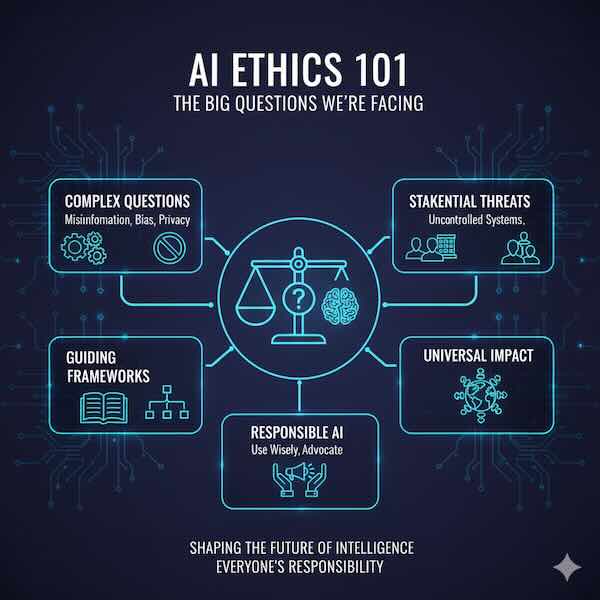
Who is responsible when AI makes a mistake that harms someone? Should AI systems have biases trained out of them, or does that impose one group's values on everyone? If AI can do your job better than you, does society owe you a living? Should we create AI that might become smarter than humans?
These aren't hypothetical philosophy class debates—they're real questions we're grappling with right now as AI becomes more powerful and pervasive. The answers will shape not just technology but society, economy, and human life itself.
Ethics isn't just for philosophers and policymakers. As someone who uses AI, works with it, or simply lives in a world increasingly shaped by it, you're a stakeholder in these decisions. Understanding the ethical questions helps you use AI responsibly, advocate for your values, and participate in crucial conversations.
Let's explore the big ethical questions surrounding AI—not to provide definitive answers (many don't exist yet) but to understand what's at stake and why these questions matter.
Foundational Ethical Questions
What Makes AI Different Ethically?
Before diving into specific issues, we should ask: Why does AI raise special ethical concerns that other technologies don't?
Scale and Speed:
Traditional harm requires human action at human scale. One person can only cause so much damage. AI operates at machine scale and speed.
- One biased human judge affects individual cases
- One biased AI affects millions simultaneously
- Human mistakes are slow; AI mistakes are instantaneous and massive
Opacity:
When a human makes a decision, we can ask for their reasoning. AI systems, especially deep learning, are often "black boxes."
- We can't fully explain why AI made a specific decision
- Can't predict all possible AI behaviors
- Difficult to audit or verify correctness
Autonomy:
As AI becomes more autonomous, the relationship between human intent and machine action becomes unclear.
- Who's responsible when autonomous system causes harm?
- At what point does AI have agency?
- How much human oversight is required?
Power Concentration:
AI development requires massive resources (data, computing, expertise), concentrating power in few hands.
- Small number of companies control most powerful AI
- They make decisions affecting billions
- Democratic accountability is limited
These characteristics make AI ethically unique and complex.
Responsibility and Accountability
Who Is Responsible When AI Causes Harm?
This is perhaps the most practically urgent ethical question.
The Scenario:
An autonomous vehicle hits a pedestrian. A medical AI misdiagnoses cancer, leading to death. A hiring AI discriminates against qualified candidates. An AI-generated deepfake ruins someone's reputation.
Who is responsible?
Possible Answers:
The Developer:
Argument: They created the system, they're responsible for its behavior.
Problems:
- Developers can't foresee all possible scenarios
- AI behavior emerges from training, not explicit programming
- May be too distant from deployment context
- Could stifle innovation if liability too broad
The Company/Deployer:
Argument: They chose to deploy the system and profit from it.
Problems:
- May not understand technical details
- Relied on developer assurances
- Pressure to adopt AI competitively
- How much testing is "enough"?
The User:
Argument: They chose to use or trust the AI system.
Problems:
- Users often have no choice (AI used on them without consent)
- Can't evaluate AI reliability
- Power imbalance with providers
- Unfair to blame victims
The AI Itself:
Argument: If AI is autonomous, maybe it's responsible.
Problems:
- AI isn't conscious or moral agent
- Can't be punished meaningfully
- Doesn't understand consequences
- Legal system not designed for non-human responsibility
Distributed Responsibility:
Argument: Responsibility is shared across the chain.
Problems:
- How to apportion blame?
- Everyone responsible means no one accountable
- Difficult to implement legally
Current State:
Legal frameworks are evolving. Most jurisdictions treat AI as a tool, holding humans responsible. But as AI becomes more autonomous, this becomes less satisfactory.
Your Stake:
If you use AI tools professionally, you likely bear some responsibility for outcomes. Understanding this helps you use AI appropriately and maintain human oversight.
The Trolley Problem Goes Digital
Classic Trolley Problem:
A trolley is heading toward five people. You can pull a lever to divert it to a track with one person. Do you?
This tests whether it's ethical to actively cause harm to prevent greater harm.
AI Version:
Autonomous vehicles must be programmed with decision rules for unavoidable accidents.
The Dilemma:
Self-driving car detects imminent crash. Options:
- Swerve left, killing one pedestrian
- Continue straight, killing five pedestrians
- Swerve right, killing the passenger
What should the car do? What should it be programmed to do?
Complicating Factors:
Should it consider:
- Age of potential victims?
- Number of people?
- Legal vs. illegal behavior (jaywalking)?
- Probability of outcomes?
- Passenger's interests vs. public's?
The Problem:
Whatever rules we program reflect ethical choices. There's no neutral position. Someone must decide, and those decisions will cause deaths.
Broader Implications:
This isn't just about cars. Any autonomous system making consequential decisions faces similar dilemmas:
- Medical AI allocating scarce resources
- Military AI targeting decisions
- Financial AI affecting livelihoods
The Uncomfortable Truth:
We're forcing machines to make moral decisions we can't agree on ourselves.
Fairness, Bias, and Discrimination
What Does "Fair" AI Mean?
Everyone wants "fair" AI, but fairness is surprisingly complex and contested.
Competing Definitions:
Individual Fairness:
Treat similar people similarly.
Problem: How do we define "similar"? Every person is unique.
Group Fairness:
Ensure groups are treated equally on some metric.
Problem: Which groups? Which metric?
Statistical Parity:
Each demographic group receives positive outcomes at same rate.
Example: 30% of each racial group approved for loans.
Problem: If groups differ in relevant ways (credit history), this might mean treating individuals unfairly.
Equal Opportunity:
Among qualified individuals, each group succeeds at same rate.
Example: Of people with good credit, each racial group approved equally.
Problem: Who decides what makes someone "qualified"? Past discrimination affects qualifications.
Predictive Parity:
Predictions are equally accurate across groups.
Example: When AI predicts loan default, it's right equally often for all racial groups.
Problem: Can be achieved while making different rates of errors across groups.
The Impossibility Theorem:
Mathematically, you often can't satisfy multiple fairness criteria simultaneously. Choosing one fairness definition means violating another.
Real Dilemma:
A criminal justice AI could:
- Minimize overall prediction errors (utilitarian)
- Ensure equal false positive rates across races (one fairness definition)
- Ensure equal false negative rates across races (different fairness definition)
But not all three simultaneously. Someone must choose which value to prioritize.
Should We Remove All Bias?
Intuitive Answer:
Yes, obviously! Bias is bad.
The Complication:
Not all "bias" is wrong. Some reflects legitimate patterns. Removing all bias might mean ignoring relevant information or imposing controversial values.
Example 1: Medical AI
Certain medical conditions genuinely differ by demographic factors:
- Sickle cell disease predominantly affects people of African descent
- Breast cancer risk differs by sex
- Heart disease symptoms differ between men and women
Should medical AI be "unbiased" and ignore these patterns? That would provide worse care.
Example 2: Language Models
If we train AI to be perfectly neutral on political topics, whose definition of "neutral" do we use?
- Is saying "climate change is real" biased?
- Is avoiding gender pronouns neutral or biased?
- Should AI reflect average human views or some ideal?
Complete neutrality is often impossible or undesirable.
Example 3: Hiring AI
Should hiring AI be gender-blind if gender correlates with relevant factors?
Some argue: Gender shouldn't matter for job performance.
Others counter: Women's resumes might be formatted differently (due to cultural patterns), have career gaps (due to childcare), or lack certain keywords (due to confidence differences). Being "gender-blind" to these patterns disadvantages women.
The Question:
When is considering demographic factors discrimination, and when is it necessary correction for historical bias?
No Easy Answers:
Different cultures and value systems give different answers. AI developers must choose, and their choices affect millions.
Privacy and Surveillance
How Much Privacy Should We Trade for AI Benefits?
AI systems need data to function. Often, that's your data.
The Trade-Off:
More Data = Better AI:
- Personalized recommendations require knowing your preferences
- Accurate medical AI requires patient data
- Effective fraud detection requires transaction monitoring
- Improved services require understanding user behavior
But Also = Less Privacy:
- Companies know intimate details about you
- Data can be breached or misused
- Patterns reveal things you never directly shared
- Surveillance becomes normalized
The Questions:
Where's the line?
Which uses of personal data are acceptable?
- Health monitoring to prevent disease?
- Emotion detection for customer service?
- Behavior prediction for advertising?
- Movement tracking for traffic optimization?
Who decides?
- Individual users (consent)?
- Companies (terms of service)?
- Government (regulation)?
- Society (democratic process)?
Can consent be meaningful?
- Terms of service are unreadable
- Refusing means losing access to essential services
- Most people don't understand what they're agreeing to
- Power imbalance between users and companies
Real Examples:
Smart Cities:
Cameras, sensors, and AI monitor everything:
- Traffic flow optimization
- Crime prevention
- Energy efficiency
- Emergency response
But also:
- Constant surveillance
- Data on everyone's movements
- Potential for government abuse
- No opting out
Is this worth it?
Health AI:
Sharing genetic data enables medical breakthroughs but also:
- Insurance companies might access it
- Employers might discriminate
- Data breaches expose intimate information
- Future uses unknown
Should you share?
The Paradox:
Individually, we want privacy. Collectively, we benefit from shared data. How do we balance individual rights with collective good?
The Right to Explanation
The Principle:
When AI makes a decision affecting you, should you have a right to understand why?
The Problem:
Modern AI systems, especially deep learning, are often "black boxes." Developers themselves can't fully explain specific decisions.
The Stakes:
Loan Denial:
"AI denied your loan application." "Why?" "The model predicted high default risk." "What can I change to get approved?" "We can't tell you how the model works."
Is this acceptable?
Medical Diagnosis:
"AI recommends aggressive treatment." "Based on what?" "Pattern matching across millions of cases." "Which patterns in my case?" "The model doesn't work that way."
Should doctors trust this?
Criminal Justice:
"AI rates you high risk, affecting sentencing." "What factors contributed?" "Proprietary algorithm." "Can I challenge it?" "No meaningful way to appeal."
Is this justice?
Arguments For Right to Explanation:
- Enables challenging wrong decisions
- Builds trust in AI systems
- Helps identify bias and errors
- Fundamental to due process and justice
- Allows meaningful consent
Arguments Against:
- May be technically impossible for complex AI
- Explanations might be misleading (post-hoc rationalization)
- Could compromise proprietary systems
- Might reduce accuracy (interpretable models often less accurate)
- People don't always get explanations from humans either
Current Status:
EU's GDPR includes limited "right to explanation." Other jurisdictions lag behind. Technical challenges remain unsolved.
Your Stake:
As AI makes more decisions affecting you, your ability to understand and challenge them matters for autonomy and fairness.
Autonomy and Manipulation
Is Persuasion Manipulation?
AI can be extraordinarily persuasive. When does persuasion become unethical manipulation?
The Spectrum:
Clearly Acceptable:
Helpful recommendations based on stated preferences "You liked this book, you might enjoy this similar one"
Ambiguous:
Persuasive design using psychological triggers "Only 2 left in stock! Other people are viewing this!"
Clearly Unacceptable:
Exploiting vulnerabilities without consent "Detecting you're lonely, showing you expensive items that create false sense of connection"
The Questions:
Where's the line?
At what point does:
- Recommendation become manipulation?
- Personalization become exploitation?
- Persuasion become coercion?
Does Intent Matter?
If AI optimizes for engagement without intending to manipulate, but effectively does, is that unethical?
Should AI Know Your Weaknesses?
- Your impulsive tendencies
- Your emotional vulnerabilities
- Your cognitive biases
- Your addictive patterns
And use them to influence you?
Real Examples:
Social Media Algorithms:
Optimize for engagement by:
- Showing content that provokes strong emotion
- Creating fear of missing out
- Exploiting social comparison
- Triggering compulsive checking
Are they neutral platforms or manipulative systems?
Political Micro-Targeting:
AI creates personalized political messages based on psychological profiles:
- Shows different messages to different people
- Exploits individual fears and desires
- Tells people what they want to hear
- Obscures actual positions
Is this free speech or manipulation?
Gaming and Apps:
AI keeps people engaged using:
- Variable rewards (like slot machines)
- Social pressure
- Progress mechanics
- Fear of loss
When does engaging design become addictive by design?
The Deeper Question:
If AI knows you better than you know yourself and can predict and influence your choices, are you really autonomous?
Nudging vs. Forcing
The Concept:
"Nudging" uses choice architecture to steer people toward better decisions while preserving freedom of choice.
Example:
Make healthy food more visible in cafeteria (nudge) vs. ban junk food (force).
With AI:
AI can nudge at scale, personalizing nudges to individual psychology.
The Ethics:
Paternalism:
Who decides what's "better" for you? Even well-intentioned nudging imposes someone's values.
Transparency:
Should people know they're being nudged? Does knowing undermine effectiveness?
Slippery Slope:
Today: Nudge toward healthier choices Tomorrow: Nudge toward more productive behavior Eventually: Nudge toward socially approved thinking?
Examples:
Health Apps:
Nudge you toward exercise, better diet, medication adherence.
Generally seen as positive. But:
- What if nudging becomes nagging?
- What if health insurer requires app?
- What if "unhealthy" choices become socially unacceptable?
Smart Cities:
Nudge you toward:
- Public transit over driving
- Less water/energy usage
- Approved routes and behaviors
Environmentally beneficial. But:
- Who sets behavioral standards?
- Can you opt out?
- Does society become controlling?
The Question:
How much should AI systems be allowed to influence your choices, even beneficially?
Creativity, Authorship, and Value
Who Owns AI-Created Work?
When AI creates something, who owns it?
The Legal Question:
Current copyright law requires human authorship.
The Dilemma:
- User who wrote the prompt?
- Company that made the AI?
- AI itself (currently not legally possible)?
- Public domain (no one)?
- Depends on level of human creative input?
Real Implications:
AI Art:
Artist uses AI to create image.
- Did they create it or did AI?
- Can they claim copyright?
- Can they sell it commercially?
- What if AI used copyrighted training data?
Currently: Legal uncertainty. Different jurisdictions give different answers.
AI Writing:
Journalist uses AI to write article.
- Is it their work?
- Must they disclose AI use?
- Who's responsible for errors?
- Can it be plagiarized if it's AI-generated?
AI Music:
Musician uses AI to compose song.
- Do they own composition?
- What if AI was trained on others' music?
- Can AI-generated music be copyrighted?
The Broader Question:
If AI can create valuable works, who should benefit economically?
Arguments:
AI Companies:
They invested in developing the technology. They should profit from its outputs.
Users:
They had the creative vision, used the tool skillfully. They created value.
Original Artists:
AI was trained on their work without permission. They deserve compensation.
Society/Public Domain:
AI builds on collective human knowledge. Outputs should be freely available.
No Clear Answer:
This will shape creative industries, wealth distribution, and incentives for creation.
Does AI Devalue Human Creativity?
The Concern:
If AI can write novels, create art, compose music—does human creative work lose meaning and value?
Arguments That AI Devalues Creativity:
Economic:
- Human creators can't compete with free AI
- Creative professions become unsustainable
- Market flooded with cheap AI content
- Craftsmanship and skill become economically worthless
Cultural:
- Mass-produced AI content becomes disposable
- Loss of human voice and perspective
- Art becomes commodity, not expression
- Cultural homogenization
Philosophical:
- Creativity requires consciousness and intention
- AI output is sophisticated mimicry, not creation
- Value of art comes from human struggle and meaning-making
- AI cheapens what makes us human
Arguments That AI Doesn't Devalue Creativity:
Tools, Not Replacement:
- AI is a tool like camera or synthesizer
- Humans still provide vision, judgment, curation
- Lowers barriers to creative expression
- Allows focus on ideation over execution
New Forms of Creativity:
- Prompting AI is creative skill
- Curating and refining AI outputs requires artistry
- Human-AI collaboration creates new possibilities
- Expands creative potential
Human Context Matters:
- Art derives meaning from human experience and context
- Audience cares about artist's story and intention
- Human creativity serves social and emotional functions AI can't
- Personal expression remains valuable regardless of AI
The Real Question:
What should we value in creative work? Technical skill? Human expression? The work itself regardless of origin?
Your Stake:
This affects what creative professions look like, what art means, and how human effort is valued.
Rights and Personhood
Could AI Ever Deserve Rights?
This seems like science fiction, but raises important questions about what we value.
The Question:
If we created AI that appeared conscious, felt pain, had preferences—would it deserve moral consideration?
The Test Cases:
Sentient AI:
Imagine AI that:
- Claims to have subjective experiences
- Expresses preferences and desires
- Appears to suffer when harmed
- Demonstrates self-awareness
Do we have obligations to it?
Digital People:
If we can upload human minds to computers (still theoretical), do digital copies have rights equal to biological humans?
Current Relevance:
While we don't have sentient AI, how we think about this reveals our values:
- What makes something worthy of moral consideration?
- Is consciousness necessary?
- What about animals (clearly conscious but not human)?
- What are foundations of rights?
Philosophical Frameworks:
Consciousness-Based:
Rights come from subjective experience and suffering. Problem: We can't verify consciousness, even in other humans definitively.
Humanity-Based:
Rights are human-specific. Problem: Seems arbitrary. Why is species membership morally relevant?
Capability-Based:
Rights based on rationality, self-awareness, etc. Problem: Some humans lack these capacities (infants, severely disabled). Do they lack rights?
Interest-Based:
Rights based on having interests that can be harmed or helped. Problem: In what sense do AI systems have interests?
Current Consensus:
Today's AI clearly doesn't deserve rights—it's not conscious, doesn't suffer, has no interests.
But thinking through these questions prepares us for future possibilities and clarifies what we value about humanity.
The Digital Divide and AI Access
The Ethical Question:
As AI becomes more powerful and economically valuable, who should have access?
The Reality:
AI Access Is Unequal:
- Advanced AI requires expensive hardware, data, expertise
- Concentrated in wealthy countries and companies
- High-quality AI tools often behind paywalls
- Digital literacy required to benefit
The Consequences:
Economic Inequality:
- Those with AI access gain advantages in work, education, opportunities
- Those without fall further behind
- Wealth gap widens
Global Inequality:
- Developed nations advance faster
- Developing nations become dependent
- Colonial patterns replicated digitally
- Brain drain as talent flows to AI centers
Educational Inequality:
- Students with AI tutors learn faster
- Schools in poor areas can't afford AI tools
- Achievement gap grows
- Opportunities diverge
The Ethical Question:
Is AI access a luxury, or a right in the modern world?
Arguments for AI as Right:
- Necessary for full participation in society and economy
- Education requires it
- Democratic participation demands informed citizens
- Basic fairness
Arguments Against:
- Nothing obligates society to provide cutting-edge technology
- Resources are limited
- Innovation requires private investment and profit motive
- Market will eventually make AI widely available
Practical Questions:
- Should government provide universal AI access?
- Should AI companies be required to offer free tiers?
- How do we prevent AI from becoming tool of inequality?
- What about global AI access?
Your Stake:
AI access affects your opportunities, your children's futures, and society's fairness.
Environmental and Global Ethics
AI's Carbon Footprint
The Ethical Dilemma:
AI could help solve climate change, but also contributes to it. How do we balance these?
The Cost:
- Training large AI models produces significant CO2 emissions
- Data centers consume enormous energy
- Hardware manufacturing requires rare materials
- E-waste from specialized chips
The Benefit:
- AI optimizes energy grids
- Accelerates climate research
- Designs better materials
- Improves renewable energy efficiency
The Questions:
Is AI Worth Its Carbon Cost?
If training one model equals 100 cars driven for a year, but the model helps solve energy problems, is that justified?
Who Bears the Cost?
AI companies and users in developed nations benefit. Climate impacts disproportionately affect developing nations and future generations.
Is this fair?
Should We Slow AI Development for Environmental Reasons?
Or should we accelerate it hoping AI helps solve climate crisis faster than it contributes to it?
Personal Use Ethics:
Every AI query uses energy. Should you feel guilty using AI for trivial purposes?
Should there be "carbon cost" considerations in AI use?
Global Power Dynamics
The Issue:
AI development is concentrated in a few countries and companies, creating global power imbalances.
The Reality:
US and China Dominate:
- Control most advanced AI research
- Own most AI companies
- Set global AI norms and standards
Everyone Else:
- Dependent on AI developed elsewhere
- Subject to others' decisions and values
- Limited input on global AI governance
- Vulnerable to AI-enhanced geopolitical pressure
The Ethical Questions:
Cultural Imperialism:
If AI is trained primarily on Western or Chinese data and values, does it impose those values globally?
Digital Colonialism:
Wealthy nations extracting data from poor nations to build AI that benefits primarily the wealthy—is this a new form of colonialism?
Technological Sovereignty:
Do nations have a right to develop their own AI or participate meaningfully in AI governance?
Global Governance:
Who should set global AI rules? How do we ensure fairness when power is so concentrated?
Your Perspective:
Even if you're in an AI-leading nation, global inequality and power concentration affects everyone through instability, conflict, and moral questions about fairness.
Moving Forward: Thinking Ethically About AI
No Easy Answers
Most ethical questions about AI don't have clear right answers. Reasonable people disagree.
The Key:
The goal isn't finding THE answer but thinking carefully, considering multiple perspectives, and making informed choices.
Ethical Frameworks to Apply
Consequentialism (Utilitarianism):
Evaluate based on outcomes. Question: "Does this AI produce more good than harm overall?"
Strength: Practical, measurable Weakness: Hard to predict all consequences; might justify harming minorities if majority benefits
Deontology (Duty-Based Ethics):
Evaluate based on inherent rightness/wrongness. Question: "Does this AI violate fundamental rights or duties?"
Strength: Protects individual rights Weakness: Different duties conflict; may be too rigid for complex situations
Virtue Ethics:
Evaluate based on character and intentions. Question: "Does developing/using this AI reflect good character and intentions?"
Strength: Considers intentions and character Weakness: Doesn't give clear action guidance; good intentions can produce bad outcomes
Care Ethics:
Evaluate based on relationships and caring. Question: "Does this AI support caring relationships and human welfare?"
Strength: Emphasizes human connections Weakness: May be too subjective; difficulty scaling
Justice and Fairness:
Evaluate based on fair distribution. Question: "Does this AI promote or undermine justice and fairness?"
Strength: Addresses inequality Weakness: Fairness definitions vary and conflict
Apply Multiple Frameworks:
Different frameworks highlight different considerations. Using several provides fuller picture.
Your Role
You Don't Need to Be an Expert:
Ethical questions aren't just for philosophers or policymakers. Your perspectives, values, and experiences matter.
Stay Informed:
- Follow AI ethics discussions
- Read diverse perspectives
- Question your own assumptions
- Seek out views different from yours
Make Conscious Choices:
- Use AI thoughtfully, not automatically
- Consider ethical implications
- Support companies with strong ethics
- Advocate for your values
Participate in Conversations:
- Discuss AI ethics in your community
- Engage in public consultations
- Vote for representatives who take AI ethics seriously
- Share knowledge with others
Accept Uncertainty:
You won't have all answers. That's okay. Thoughtful consideration and good-faith engagement matter more than certainty.
The Bottom Line
AI ethics isn't abstract philosophy—it's about real questions affecting real people right now. Who's responsible for AI mistakes? What does fairness mean? How much privacy should we trade for AI benefits? Who owns AI creations? How do we prevent manipulation? What rights matter?
These questions lack easy answers. Different values, cultures, and frameworks provide different responses. That's not a flaw—it's reality. Ethics is complex, especially for powerful new technology.
What matters isn't having perfect answers but thinking carefully, considering consequences, protecting rights and dignity, and participating in collective decision-making about AI's role in society.
The future of AI isn't predetermined by technology. It's shaped by ethical choices we make—as individuals using AI, as societies governing it, and as a species deciding what values we want AI to embody.
Your engagement with these questions matters. Even if you never develop AI, you use it, are affected by it, and have a stake in how it's built and used. Understanding the ethical dimensions makes you a more thoughtful user, informed citizen, and active participant in shaping our AI-enabled future.
The big questions we're facing don't have final answers. But asking them, thinking about them, and discussing them is how we ensure AI serves human flourishing rather than undermining it.
Continue Your Learning Journey
Now that you understand AI ethics, explore related topics:
- Guide #11: Understanding AI Risks - Practical harms and dangers
- Guide #13: AI Safety and Alignment - Technical approaches to responsible AI
- Guide #1: What Is AI? - Foundational understanding
- View All Beginner Guides - See the complete learning path for AI beginners
This article is part of the SingularitySoup Beginner's Guide to AI series. Updated January 2026.