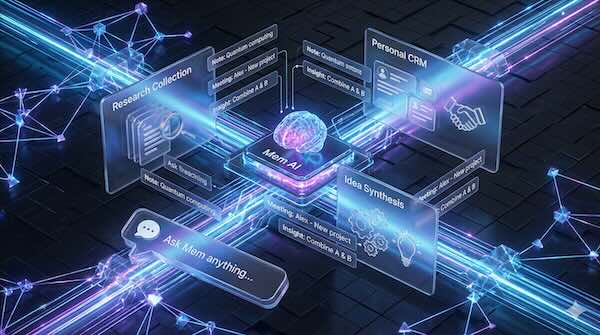
Note-taking apps have traditionally treated your information as something to store, file, and hopefully retrieve later. Mem takes a fundamentally different approach: it uses artificial intelligence to automatically organize your thoughts, surface relevant connections, and transform scattered notes into a dynamic knowledge system that works alongside you.
What Makes Mem Different
Most productivity tools demand upfront organization—folders to create, tags to apply, structures to maintain. Mem eliminates this overhead entirely. You capture ideas, meeting notes, research snippets, and random thoughts however they occur to you. The AI handles categorization, connection, and retrieval automatically.
The platform positions itself as an "AI Thought Partner" rather than a simple notes repository. When you start drafting a project proposal, Mem proactively surfaces related notes from past meetings, relevant research you collected months ago, and connected ideas you might have forgotten. This contextual awareness transforms note-taking from passive storage into active collaboration with your own knowledge base.
Core Features
Mem Chat functions as a conversational interface to your entire note library. You can ask questions like "What did we decide about the Q3 budget?" and receive answers drawn from your accumulated notes rather than generic web results. The system can summarize information across multiple notes, draft outlines based on your research, or help you build on half-finished thoughts.
Heads Up (previously called Copilot) automatically surfaces relevant notes while you work. Preparing for a meeting? It pulls up your history with that person. Working on a strategy document? It displays related brainstorms and research. The feature identifies connections you might miss through manual searching.
Deep Search understands natural language queries rather than requiring exact keyword matches. You describe what you're looking for conversationally, and Mem finds it based on meaning and context.
Voice Mode transforms spoken thoughts into organized, searchable notes. You can brain-dump ideas during a walk or let Mem record and transcribe meetings without requiring a separate meeting bot.
Collections provide lightweight organization without rigid folder structures, and the AI can suggest appropriate collections for new notes or reorganize existing content on request.
Practical Use Cases
Research Collection: Academics, journalists, and analysts can clip articles, paste excerpts, and capture source materials from across the web. Mem connects related research automatically, helping uncover patterns and relationships across diverse sources. Users can then chat with their collected materials to generate summaries with source citations.
Personal CRM: Mem works well for tracking relationships and conversations. You can log meeting notes, capture details about contacts, and let the system surface relevant history before your next interaction with someone. Sales professionals, consultants, and networkers use this to maintain relationship context without manual CRM entry.
Idea Synthesis: Writers, creators, and strategists benefit from Mem's ability to connect disparate thoughts. The platform acts as what one reviewer described as a "serendipity engine"—surfacing unexpected connections between notes that spark new insights. You can ask Mem Chat to draft outlines combining multiple ideas or to identify themes across your scattered notes.
Meeting Documentation: Beyond basic transcription, Mem helps extract action items, summarize key decisions, and connect meeting notes to relevant project documentation. The context flows both ways—pre-meeting, you see relevant history; post-meeting, the notes integrate with existing knowledge.
How It Works
Mem is available across Mac, Windows, iOS, and web browsers. A Chrome extension enables one-click saving of web content, and email integration lets you forward anything to a dedicated address for automatic capture.
The platform operates on a subscription model at approximately $15 monthly for individual users, with team pricing available for organizational use. There's no free tier, though the investment grants access to all AI features.
Offline support means you can access and edit notes without connectivity, with synchronization occurring when you reconnect. The AI processing capabilities work best with an internet connection.
Considerations
The approach requires a degree of commitment. Mem's value compounds as you add more content—the AI improves at understanding your thinking patterns and surfacing relevant material as your library grows. Users who capture extensively see the strongest benefits.
Import options remain somewhat limited compared to established competitors, though basic migration works smoothly. The folderless philosophy represents a genuine paradigm shift that may feel uncomfortable for users accustomed to traditional organization systems.
Privacy-conscious users should note that AI processing occurs on Mem's infrastructure. The platform emphasizes security, but your notes do leave your device for analysis.
The Broader Significance
Mem represents a growing category of AI tools designed to augment human cognition rather than replace it. Instead of asking you to adapt to software structures, it adapts to how you naturally think and work.
The "second brain" concept has existed in productivity circles for years, but implementations typically required significant manual effort. Mem attempts to deliver that promise through AI automation—you focus on capturing ideas, and the system handles making them findable and actionable.
For knowledge workers drowning in information, the appeal is clear: stop organizing and start creating, while the AI ensures nothing valuable gets lost.