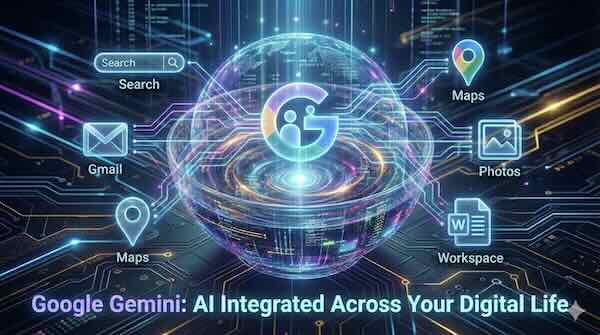
Google's Gemini has evolved from a standalone chatbot into a comprehensive AI layer woven throughout the company's ecosystem. With over 650 million monthly users in the Gemini app alone and 2 billion people encountering AI Overviews in Search each month, Gemini has become the connective tissue linking Gmail, Docs, Search, and Android into a unified, AI-enhanced experience.
Understanding Gemini's Architecture
Gemini operates as a family of multimodal models capable of processing text, images, audio, video, and documents through a unified interface. The current lineup includes Gemini 3 Pro for complex reasoning tasks, Gemini 3 Flash for speed-optimised responses, and specialised variants for real-time voice interaction and image generation.
What sets Gemini apart from earlier AI assistants is its native multimodal architecture. Rather than processing different input types through separate modules, Gemini was built from the ground up to handle mixed inputs naturally. You can upload a photograph alongside a text question, or combine audio with video in a single conversation, and the model processes everything as interconnected information rather than isolated data streams.
Gmail: Your AI-Powered Inbox
Gmail's January 2025 overhaul marked its most significant upgrade in years, transforming the email client into what Google calls an "AI Inbox." The integration touches nearly every aspect of email management.
AI Overviews in Email
Similar to how AI Overviews function in Search, Gemini now scans your messages and generates summaries in response to natural language questions. Instead of manually combing through a year of correspondence to find a specific detail, you can simply ask questions like "Who was the plumber that gave me a quote for the bathroom renovation last year?" The system pulls the relevant information and presents a concise answer.
Help Me Write and Suggested Replies
The Help Me Write feature, previously limited to paid subscribers, is now available to all Gmail users. It can draft emails from brief prompts or polish existing drafts for clarity and tone. According to Google's internal data, 70% of enterprise users who encounter Help Me Write suggestions in Gmail or Docs accept them.
What makes this particularly powerful is the personalisation layer. Gemini analyses your past emails to understand your writing style, typical greetings, sign-offs, and communication patterns. When it suggests a response, it attempts to match how you actually write rather than producing generic corporate-speak.
Practical example: You receive a lengthy email thread about a project deadline change. Rather than reading through 23 replies, you ask Gmail to summarise the key decisions. Gemini identifies that the deadline moved from March 15th to April 1st, that Sarah from marketing raised concerns about the launch timing, and that the budget was increased by £12,000 to accommodate the change.
Google Docs: Collaborative AI Writing
Gemini appears in Google Docs through a side panel that serves as an always-available writing assistant. The integration goes beyond simple grammar checking into genuine content collaboration.
Document Summarisation and Analysis
The side panel can summarise documents stored in your Drive, reference emails from Gmail, and pull insights across your connected Google services. If you're preparing a report and need to reference information scattered across multiple sources, you can ask Gemini to gather and synthesise relevant points without leaving your document.
Cross-Application Intelligence
Deep Research, one of Gemini's more advanced features, can now draw on context from Gmail, Drive, Docs, Sheets, Slides, and even Google Chat. This enables comprehensive report generation that combines web research with your organisation's internal documents, email discussions, and chat conversations.
Practical example: You're writing a competitive analysis and ask Gemini to "create a report comparing our product strategy with recent market developments, using the strategy document from last quarter's planning meeting and relevant industry news." The system pulls your internal document, searches for recent news, and produces a synthesised analysis with both internal and external perspectives.
Google Search: From Links to Answers
Search has undergone perhaps the most visible transformation, with AI Overviews and AI Mode fundamentally changing how information is presented.
AI Overviews
Now serving over a billion users, AI Overviews appear for queries where a synthesised answer proves more helpful than a list of links. The system uses a query fan-out technique, conducting multiple related searches simultaneously and bringing results together into coherent responses. For complex questions about comparing options or understanding nuanced topics, this approach often saves significant research time.
AI Mode
For users who want deeper exploration, AI Mode offers an explicitly AI-first search experience. Powered by Gemini 3, it can handle multi-part questions, follow-up queries, and reasoning across multiple information sources. The system now generates dynamic visual layouts with interactive elements tailored to specific queries.
Practical example: You search "what's the difference in sleep tracking features between a smart ring, smartwatch, and tracking mat." Rather than receiving a list of product reviews to read individually, AI Mode creates a comparison breakdown, identifies key differences, and lets you ask follow-up questions like "what happens to your heart rate during deep sleep" for immediate, contextual responses.
Android: Gemini as Your Mobile Assistant
On Android devices, Gemini serves as an increasingly capable personal assistant that understands your context and can take actions on your behalf.
Personal Intelligence
This feature connects Gemini to your Gmail, Photos, YouTube, and Search history to provide personalised assistance. The system can reason across these connected sources, retrieving specific details from emails or photos to answer questions.
Practical example: Standing in a car repair shop, you realise you don't know your vehicle's tyre size. Instead of searching through documentation, you ask Gemini, which locates a photo of your car's specifications in Google Photos or finds the information in an old email from your dealership.
Multimodal Understanding on Mobile
Gemini's multimodal capabilities shine on mobile, where camera access enables real-time visual understanding. You can photograph a diagram and ask for an explanation, capture a product and request price comparisons, or show Gemini a document and ask it to extract specific information.
The model excels at understanding complex layouts, including receipts, forms, and multi-column documents. This goes beyond simple optical character recognition into genuine comprehension of document structure and meaning.
Image Understanding and Generation
Gemini's visual capabilities extend in both directions: understanding images you provide and generating new ones on request.
Visual Analysis
Upload a photograph, and Gemini can identify objects, explain diagrams, read handwritten notes, or analyse data visualisations. The model handles mixed inputs naturally, so you can upload an image alongside a text question and receive a response that addresses both.
Nano Banana Image Generation
Google's image generation model, integrated into Gemini, creates visuals from text descriptions. Reviews have noted its strength in producing realistic, consistent imagery, particularly for architectural visualisation and creative projects.
Practical example: You photograph a complex flowchart from a whiteboard during a meeting. Later, you ask Gemini to explain the diagram's components and relationships, and it provides a text-based breakdown of what the flowchart represents without requiring you to recreate the information manually.
Privacy and Data Handling
Google has addressed privacy concerns by establishing clear boundaries around how Gemini uses personal data. Your interactions stay within your organisation when using Workspace. Content isn't shared externally without permission, isn't human-reviewed, and isn't used for training models outside your domain.
For Personal Intelligence features, users control exactly which apps to connect, and each connection can be individually enabled or disabled. The system references your data to deliver responses but doesn't directly train on your Gmail inbox or Photos library. Google trains on limited information like specific prompts and responses, with personal data filtered or obscured before model training occurs.
Pricing and Access
Gemini features are available across several tiers. Free users access basic capabilities including email summaries and Help Me Write. Google AI Pro subscribers (approximately £17 per month) gain access to more powerful models, higher usage limits, and features like Deep Research. Google AI Ultra provides the highest limits and earliest access to new capabilities.
Following the January 2025 announcement, many AI features previously limited to paid add-ons are now included in Google Workspace Business and Enterprise editions, making organisational deployment more straightforward.
What This Means for Daily Workflows
The cumulative effect of these integrations is a shift from using AI as an occasional tool to having AI assistance available throughout your digital activities. Email becomes less about inbox management and more about information retrieval. Document creation shifts from blank-page anxiety to collaborative drafting. Search evolves from link-hunting to conversation.
For users heavily invested in Google's ecosystem, Gemini creates genuine productivity gains by reducing the friction between having a question and finding an answer. The system's ability to reason across your personal data, combined with its access to web information, positions it as something closer to a knowledgeable assistant than a search engine or chatbot.
The integration depth also raises the stakes for users considering ecosystem changes. As Gemini accumulates context about your communication style, document history, and information needs, the switching costs increase. This represents both the promise of AI that truly understands your needs and the challenge of growing dependency on a single provider's interpretation of how AI should work.