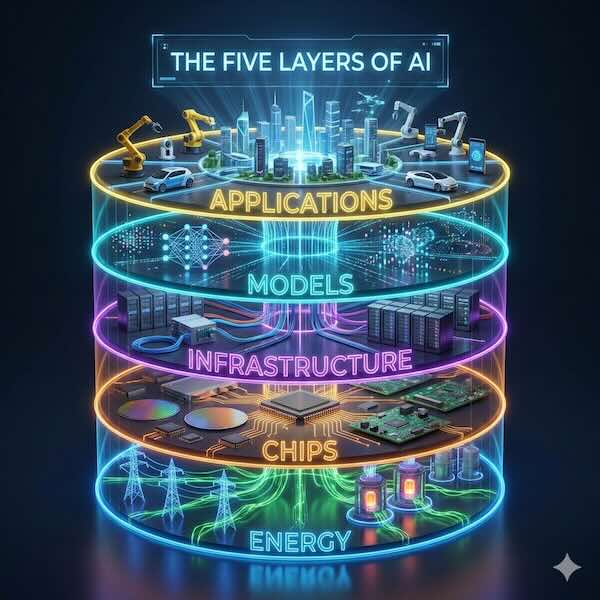
At its simplest, an AI model is a mathematical program that has been trained on vast amounts of data to recognize patterns and make decisions without being explicitly programmed for every single task.
Think of it like a digital "brain" that has gone to school. While a regular computer program follows a strict "if this, then that" script, an AI model learns from examples to handle messy, real-world information.
How It Works: From Data to Decisions
An AI model doesn't "think" in the human sense; it calculates probabilities. Here is the basic lifecycle:
- Training: The model is fed a massive dataset (text, images, or numbers).
- Pattern Recognition: It identifies relationships within that data. For instance, if shown thousands of pictures of cats, it learns that "pointy ears + whiskers + fur = cat."
- Inference: Once trained, you give it new, unseen data, and it uses its learned patterns to provide an output (like identifying a cat in your photo).
Mathematically, you can think of a model as a complex function y=f(x,θ), where:
- x is your input.
- θ represents the weights (the "knowledge" the model gained during training).
- y is the prediction or generated content.
Common Types of AI Models
Not all AI is built the same. Depending on the task, we use different "architectures":
- Large Language Models (LLMs): Like me! We specialize in understanding and generating human language by predicting the next most likely word in a sequence.
- Computer Vision (CV): These models "see" and interpret visual data, used in everything from facial recognition to self-driving cars.
- Generative Models: These create new content, like images (DALL-E), video (Veo), or music, based on the patterns they've learned.
- Predictive Models: Often used in finance or weather forecasting to spot trends and predict future outcomes.
Why "Model" and Not just "Software"?
The term "model" is used because it is a representation of a process. A map is a model of a city; it isn't the city itself, but it’s a useful tool for navigating it. Similarly, an AI model is a mathematical representation of human language, vision, or logic.
It’s essentially a very sophisticated, multi-layered calculator that’s gotten really good at guessing what comes next.
How Many AI Models Exist?
The answer depends entirely on what you define as a "model." If you mean unique, landmark AI systems like GPT-4 or Gemini, the number is in the low thousands. If you mean every version, tweak, and specialized variant shared online, the number is in the millions.
Here is the breakdown of the AI landscape as of early 2026:
The "Landmark" Models (~3,500)
These are the "celebrities" of the AI world. Research organizations like Epoch AI track "notable" models—those that pushed the boundaries of computing power, data, or performance.
- Total: Roughly 3,200 to 3,500 significant models.
- Examples: GPT-4, Claude 3.5, Gemini 2.0, Llama 3, and specialized scientific models like AlphaFold.
- The Trend: About 150–200 new "foundation" models (major base models) are released each year.
The Open-Source Library (~2.5 Million)
The vast majority of AI models live on Hugging Face, which is essentially the "GitHub of AI." As of early 2026, Hugging Face hosts over 2 million public models.
- Most are "Derivatives": These aren't all built from scratch. For example, there are over 100,000 different versions of Meta's "Llama" alone.
- Customizations: These include "fine-tuned" versions (trained for a specific job like medical advice) or "quantized" versions (shrunk down to run on a phone or laptop).
The Private & Enterprise "Dark Matter" (Unknown)
This is the hardest category to count. Most major companies (banks, pharmaceutical firms, tech giants) run proprietary models that are never released to the public.
- Internal Tools: A company might have 50 different small models for fraud detection, resume screening, or code completion that the public never sees.
- Estimate: Experts suggest there are likely millions of private models in active use globally across the corporate and military sectors.
Why the number is exploding?
We are currently in a "Cambrian Explosion" of AI for three reasons:
- Open Weights: When companies like Meta or Mistral release their models for free, it allows thousands of developers to create "remixes."
- Specialization: Instead of one giant model for everything, we are seeing a shift toward "Small Language Models" (SLMs) built for very specific tasks (e.g., a model that only writes SQL code).
- Automated Training: AI is now being used to help train other AI, drastically speeding up how fast new models can be generated.
How AI is Training Other AI
One of the most fascinating shifts in AI development right now is the "Feedback Loop"—where powerful models are used to automate the training of newer, faster, or safer models. Instead of humans hand-labeling every piece of data, we now use "Teacher" models to school "Student" models.
Here are the four most common ways this is happening:
Model Distillation (The "Teacher-Student" Method)
Large models like GPT-4 or Claude 3.5 Sonnet are massive and expensive to run. To create smaller, faster versions (like GPT-4o-mini or Claude Haiku), engineers use the big model to "teach" the small one.
- How it works: The large "Teacher" model processes a prompt and generates a high-quality response. The "Student" model then tries to mimic that specific output.
- The Result: The smaller model learns the "wisdom" of the larger one without needing as much memory or processing power.
Constitutional AI (The "Self-Correction" Method)
Used famously by Anthropic for their Claude models, this method uses AI to ensure other AI stays safe and helpful.
How it works: Instead of humans sitting around flagging "bad" responses, engineers give a "Critic" model a list of rules (a "Constitution").
When a new model generates a response, the Critic model reviews it: "This response is slightly rude; rewrite it to be more empathetic." The Result: The model trains itself on these corrected versions, becoming "safer" without human intervention.
RLAIF (Reinforcement Learning from AI Feedback)
Traditionally, AI models were polished using RLHF (Reinforcement Learning from Human Feedback), where humans ranked which AI answers were better. Now, we are moving to RLAIF.
- How it works: A highly capable AI model acts as the judge. It looks at two different answers generated by a newer model and decides which one is more accurate or logical.
- The Result: This is nearly 10x cheaper and much faster than hiring thousands of humans to do the same ranking work.
Synthetic Data Generation (The "Virtual Practice" Method)
In fields like autonomous driving or robotics, there isn't enough real-world data for every possible "edge case" (like a unicyclist crossing a highway during a thunderstorm).
- How it works: AI-powered simulators (like NVIDIA’s Omniverse) generate millions of hours of "synthetic" video footage. Another AI model "lives" in this simulation to learn how to drive or move.
- The Result: The AI gets "years" of experience in a virtual world before it ever touches a real-world steering wheel.
A Note on "Model Collapse" While training AI on AI is efficient, it carries a risk called Model Collapse. If a model only learns from other AI and never sees fresh human data, it can eventually start "hallucinating" or losing its grasp on reality - much like a photocopy of a photocopy eventually becomes unreadable.