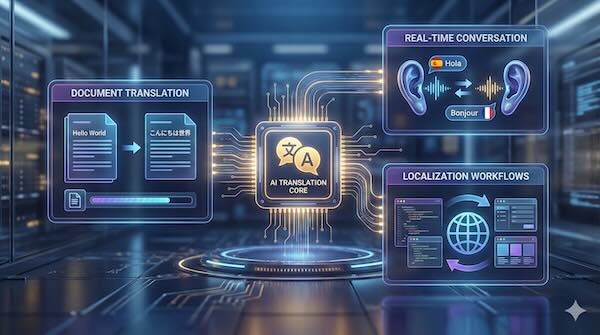
The landscape of AI-powered translation has evolved dramatically, with services now capable of handling everything from casual travel conversations to enterprise-scale localization workflows. Whether you need to translate a business document, communicate with someone in real-time, or localize an entire software platform, there's an AI translation tool designed for the task.
How Modern AI Translation Works
Today's leading translation services use neural machine translation (NMT) models trained on vast datasets of human-translated text. These systems analyze context, sentence structure, and linguistic nuance rather than simply swapping words between languages. The result is translations that read more naturally than the statistical models of the past.
Large language models have further refined this capability, with some platforms now offering users a choice between traditional NMT and generative AI translations depending on their needs. This hybrid approach lets businesses optimize for speed, accuracy, or natural tone depending on the content type.
DeepL: Quality Over Quantity
DeepL has built its reputation on producing translations that sound human, particularly for European language pairs. The German-based service supports around 36 languages with a strong focus on major European and select Asian languages including Japanese, Korean, Chinese, and Arabic.
Professional translators in blind tests have consistently rated DeepL's output higher than competitors for European languages. One benchmark found DeepL was the top-performing engine in 65% of language pairs tested, producing roughly 10 translation issues compared to 25 from Google Translate on the same content.
Best use cases for DeepL:
- Business documents, contracts, and formal correspondence
- Marketing copy where tone and brand voice matter
- Content requiring post-editing efficiency (less human cleanup needed)
- European language translations where nuance is critical
DeepL Pro offers several enterprise-friendly features including glossary support for consistent terminology, formality controls to match regional conventions, and document translation that preserves formatting in Word, PowerPoint, and PDF files. The platform also provides an API for integration into existing workflows, though it lacks built-in translation memory, meaning previously approved translations aren't automatically reused across projects.
Google Translate: Unmatched Reach
Google Translate remains the go-to choice for sheer language coverage, supporting over 249 languages and dialects. This includes numerous low-resource languages, African dialects, and Indigenous languages that other services simply don't offer.
Recent updates have significantly improved the platform's capabilities. The service now features live conversation translation in over 70 languages through the mobile app, with AI models that can identify conversational pauses, accents, and intonation to enable natural back-and-forth dialogue. This makes it particularly useful for travelers in busy environments like airports or cafes.
Best use cases for Google Translate:
- Quick translations for rare or low-resource languages
- Travel scenarios requiring camera or image translation
- Real-time conversations using the mobile app
- Situations requiring offline translation (59 languages available offline)
- Integration with Google Workspace products
For businesses, Google Cloud Translation API offers scalable translation at approximately $40 per million characters, making it an affordable option for high-volume needs. However, the output tends toward more literal translations that may require additional editing for customer-facing content.
Microsoft Translator: Enterprise Integration
Microsoft Translator distinguishes itself through deep integration with the Microsoft 365 ecosystem. The service supports over 100 languages and offers a generous free API tier of 2 million characters per month, with paid plans costing roughly half of Google's API pricing.
Microsoft Translator Pro, now generally available, provides enterprise-focused features including real-time speech-to-speech translation, on-device processing for offline scenarios, custom phrasebooks for organization-specific terminology, and noise cancellation for conversations in busy environments.
Best use cases for Microsoft Translator:
- Organizations already using Microsoft 365, Teams, or Office products
- Multi-person translated meetings (supports up to 500 participants)
- Healthcare and education settings requiring accessibility features
- Enterprise environments with strict security and compliance requirements
The Custom Translator feature allows businesses to train translation models on their own terminology and industry-specific language, improving accuracy for specialized content.
Apple Translate: Privacy-First Simplicity
Apple Translate prioritizes on-device processing, ensuring translations happen locally without data being sent to external servers. While supporting fewer languages (around 19 major languages), it offers seamless integration across iPhone, iPad, Mac, Apple Watch, and Vision Pro.
The latest iOS updates introduced Live Translation for phone calls, allowing real-time translated conversations where Apple Intelligence translates speech and plays it back in the other person's language. This feature works with AirPods Pro, making it feel like having a personal interpreter in your ear.
Best use cases for Apple Translate:
- Privacy-conscious users who want on-device processing
- Casual travel translation within supported languages
- Face-to-face conversations using the split-screen mode
- Integration with other Apple apps and services
Amazon Translate: Cloud-Scale Automation
Amazon Translate is designed for developers and enterprises needing to integrate translation into applications and workflows. The service supports over 50 languages with automatic language detection and integrates with other AWS services like S3, Lambda, and CloudWatch.
Best use cases for Amazon Translate:
- Batch translation of large document sets (Word, PowerPoint, HTML)
- Social media content moderation requiring multilingual text analysis
- Website and app localization at scale
- Organizations already invested in AWS infrastructure
Real-Time Conversation Tools
Beyond the major translation platforms, specialized tools have emerged for live meeting and event translation. Services like Wordly, KUDO, JotMe, and Talo integrate with video conferencing platforms including Zoom, Microsoft Teams, and Google Meet to provide real-time translation for remote meetings.
These tools offer features specifically designed for professional settings including simultaneous translation to multiple languages, meeting transcription alongside translation, glossary support for industry terminology, and enterprise security compliance (SOC 2, ISO 27001).
Wordly alone reports serving over 4 million users across 60 countries, demonstrating the growing demand for real-time multilingual communication in global business settings.
Localization Workflows: Translation at Scale
For organizations managing content across multiple languages and platforms, translation management systems (TMS) combine AI translation with workflow automation. Platforms like Lokalise, Smartling, XTM Cloud, and SimpleLocalize integrate with content management systems, code repositories, and development pipelines.
Modern localization workflows typically include translation memory that stores and reuses approved translations across projects, glossary enforcement for consistent brand and technical terminology, automated quality checks before content goes live, and multi-engine support that routes content to the best AI translation for each language pair.
Industry data shows that machine-assisted translation now powers approximately 70% of language workflows, with AI translation usage growing 533% in a single recent year. Research from Lokalise found that Claude 3.5 outperformed other language models across tested language pairs for translation accuracy, suggesting LLMs are becoming viable alternatives to traditional machine translation engines.
Choosing the Right Tool
The best translation tool depends entirely on your specific needs.
For everyday personal use, Google Translate's broad language support and free access make it the default choice. Apple Translate offers a cleaner experience for users already in the Apple ecosystem.
For business documents and professional content, DeepL's superior accuracy for European languages reduces editing time and maintains brand voice. The glossary and formality features add additional control.
For enterprise environments, Microsoft Translator's deep Office integration and Custom Translator capabilities make it ideal for organizations standardizing on Microsoft tools. Amazon Translate fits naturally into AWS-based infrastructure.
For real-time conversations, Google Translate's live conversation mode works well for casual travel, while dedicated tools like Talo or Wordly are better suited for professional meetings requiring multiple languages.
For localization workflows, a TMS platform that aggregates multiple translation engines and adds workflow automation will deliver better results than any single translation tool alone.
Many organizations find that a hybrid approach works best. Using DeepL for high-value customer-facing content, Google Translate for broad language coverage, and a TMS platform to orchestrate the entire process often produces better results than relying on any single service.
The Road Ahead
Translation technology continues to advance rapidly. Apple, Google, and Meta are all developing hardware features that bring real-time translation to earbuds and smart glasses, inching closer to the universal translator long imagined in science fiction. Voice translation that preserves the speaker's tone and inflection is becoming reality, with Google's Voice Translate already capable of maintaining a speaker's vocal characteristics in the translated output.
For businesses and individuals navigating a multilingual world, these tools are eliminating barriers that once required expensive human interpreters or extensive language training. The challenge now isn't whether AI can translate, but choosing the right combination of tools for each specific communication need.