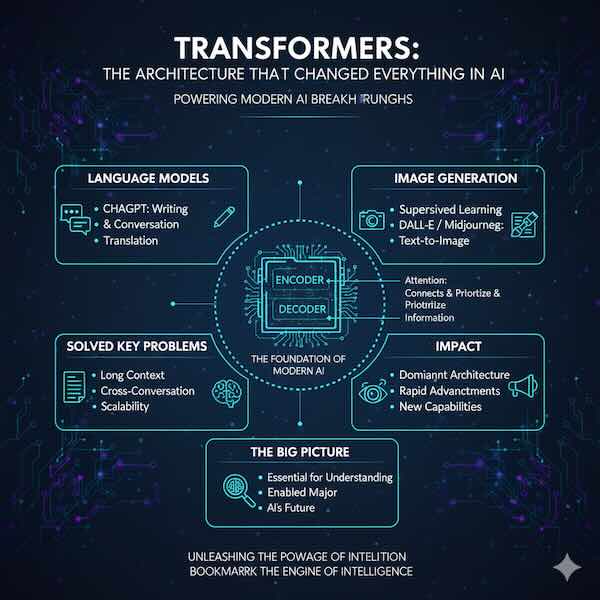
When you ask ChatGPT to write an email, use Google Translate to convert a paragraph into Japanese, or generate an image from a text prompt with DALL-E, you're relying on a neural network architecture called a transformer. Since its introduction in 2017, the transformer has become the dominant architecture in artificial intelligence, powering nearly every major breakthrough in language models, image generation, and beyond.
Before transformers, researchers struggled to build AI systems that could handle long documents, maintain context across conversations, or scale efficiently with more computing power. Transformers solved these problems so effectively that they've become the foundation on which modern AI is built. Understanding how they work is essential for anyone trying to make sense of where AI is heading.
The Problem Transformers Solved
To appreciate what transformers achieved, it helps to understand what came before them.
For most of the 2010s, the go-to architectures for processing sequences like text were recurrent neural networks (RNNs) and their more sophisticated cousins, long short-term memory networks (LSTMs). These models processed input one element at a time, passing information forward step by step. If you fed them a sentence, they would read it word by word, updating an internal state as they went.
This sequential approach had serious drawbacks. First, it created a bottleneck: since each step depended on the previous one, you couldn't easily parallelize the computation across multiple processors. Training was slow. Second, information had to travel through many steps to connect distant parts of a sequence. By the time the model reached the end of a long document, details from the beginning had often faded or been distorted. Capturing long-range dependencies was difficult.
Researchers tried various workarounds, but the fundamental limitation remained. The field needed a new approach.
The Core Innovation: Attention Is All You Need
In 2017, a team at Google published a paper with a memorable title: "Attention Is All You Need." The architecture they introduced, the transformer, abandoned recurrence entirely. Instead of processing sequences step by step, transformers process all elements simultaneously using a mechanism called self-attention.
The core idea is elegantly simple. For each element in a sequence, the model asks: how relevant is every other element to understanding this one? In a sentence like "The cat sat on the mat because it was tired," when processing the word "it," the model can directly attend to "cat" to determine what "it" refers to, without having to pass that information through a chain of intermediate steps.
Self-attention works through three learned transformations applied to each input element, producing what are called Query, Key, and Value vectors. Think of it like a retrieval system. The Query represents what an element is looking for. The Key represents what an element offers. The Value represents the actual information to be retrieved. By comparing Queries against Keys, the model computes attention weights that determine how much each element should influence each other element. These weights are then used to create weighted combinations of Values.
Transformers use multi-head attention, meaning they run several attention operations in parallel, each with different learned transformations. This allows the model to capture different types of relationships simultaneously. One attention head might focus on syntactic relationships while another captures semantic similarity.
Architecture Walkthrough
The original transformer used an encoder-decoder structure. The encoder processes the input sequence and builds a rich representation of it. The decoder then generates the output sequence, attending both to its own previous outputs and to the encoder's representation of the input. This design made sense for tasks like translation, where you need to fully understand the source sentence before producing the target.
Later work showed that you don't always need both components. Models like BERT use only the encoder, making them well-suited for tasks that require understanding text, such as classification or question answering. Models like GPT use only the decoder, optimizing them for generating text one token at a time.
Since transformers process all positions simultaneously, they have no inherent sense of order. The sentence "dog bites man" would look identical to "man bites dog" without some additional information. Positional encoding solves this by adding information about each element's position in the sequence. The original paper used fixed mathematical functions based on sine and cosine waves, though many later models learn these encodings during training.
Beyond attention, each transformer layer includes feed-forward networks that process each position independently, and layer normalization that stabilizes training. A typical transformer stacks many such layers, allowing it to build increasingly abstract representations as information flows upward through the network.
Why Transformers Scale So Well
One of the most consequential discoveries about transformers is how predictably they improve with scale. In 2020, researchers at OpenAI documented what they called scaling laws: given more parameters, more training data, and more compute, transformer performance improves in smooth, predictable ways.
This predictability changed the economics of AI research. Instead of searching for clever architectural innovations, labs could invest in bigger models with reasonable confidence that performance would improve. GPT-3 had 175 billion parameters. GPT-4 is rumored to be far larger still.
The parallelization advantage is crucial here. Because transformers process all positions simultaneously rather than sequentially, they can efficiently use modern GPU and TPU hardware designed for parallel computation. Training a massive transformer is expensive, but it's at least feasible. Training an equivalently large recurrent model would be impractical.
The Transformer Family Tree
The original transformer spawned a diverse family of descendants, each optimized for different purposes.
BERT (Bidirectional Encoder Representations from Transformers), released by Google in 2018, uses only the encoder portion. It's trained by masking out words in sentences and learning to predict them from context. This bidirectional training lets BERT build rich representations useful for understanding tasks. It dominated benchmarks for classification, question answering, and named entity recognition.
GPT (Generative Pre-trained Transformer), developed by OpenAI, uses only the decoder. It's trained to predict the next token in a sequence, making it naturally suited for text generation. Each successive version, from GPT-2 to GPT-3 to GPT-4, has demonstrated remarkable emergent capabilities as scale increased.
T5 and BART retain the full encoder-decoder structure and frame all tasks as text-to-text problems. Want to translate? Feed in the source text and generate the target. Want to summarize? Feed in the document and generate a summary.
Perhaps most surprisingly, transformers have proven effective far beyond language. Vision Transformers (ViT) treat images as sequences of patches and process them with standard transformer layers, matching or exceeding the performance of convolutional networks that had dominated computer vision for years. Transformers now power models for audio, video, protein structure prediction, robotics, and more.
Limitations and Open Challenges
Transformers aren't without problems.
The self-attention mechanism has quadratic complexity with respect to sequence length. If you double the length of your input, the computational cost roughly quadruples. This makes processing very long documents expensive and eventually infeasible. A lot of current research focuses on efficient attention variants that reduce this cost, through sparse attention patterns, linear approximations, or other techniques.
Closely related is the context window limitation. Models have a maximum sequence length they can handle, which constrains how much information they can consider at once. While context windows have grown dramatically, from hundreds of tokens to hundreds of thousands, fundamental limits remain.
The computational and energy costs of training and running large transformers are substantial. Training a frontier model can cost tens of millions of dollars and produce significant carbon emissions. This concentrates cutting-edge AI research in well-funded labs and raises questions about sustainability.
Finally, researchers are actively exploring alternative architectures. State space models like Mamba offer some of the benefits of transformers with better efficiency on long sequences. Mixture-of-experts approaches activate only a subset of parameters for each input, reducing computational costs. Whether these represent incremental improvements or the seeds of a post-transformer era remains to be seen.
Looking Ahead
For now, transformers remain the master architecture of modern AI. Their combination of expressiveness, parallelizability, and scalability has proven remarkably powerful. Nearly every major AI system in production today, whether it understands language, generates images, writes code, or predicts protein structures, is built on transformer foundations.
The question going forward is whether we'll see continued refinement of transformers or the emergence of a successor architecture. History suggests that paradigm shifts happen when limitations become acute and a compelling alternative appears. The quadratic scaling problem and the enormous resource requirements of current models create pressure for change. But transformers have also shown a remarkable ability to absorb improvements and continue advancing.
For anyone watching the AI field, understanding transformers isn't just about understanding the present. It's about having the context to recognize when the next revolution arrives.