Series: Beginner's Guide to AI #2
Read Time: 10 minutes
Level: Beginner
Prerequisites: Guide #1 - What Is AI?
Key Takeaways
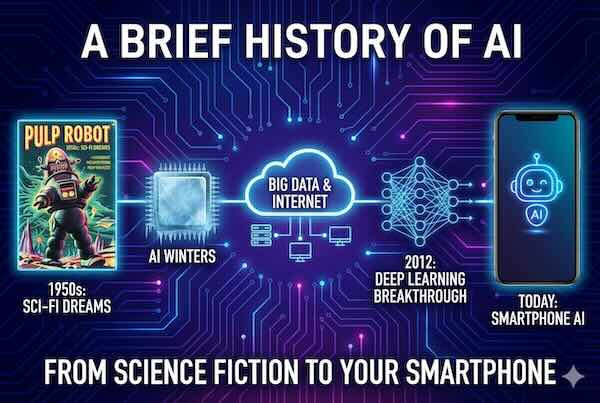
- AI began as a dream in the 1950s when scientists first imagined machines that could think
- AI has experienced multiple "winters" - periods where progress stalled and funding dried up
- The internet and big data transformed AI by providing the massive datasets needed for machine learning
- Deep learning breakthroughs in 2012 kicked off the modern AI revolution we're experiencing today
- Today's AI explosion is built on 70+ years of research, not overnight success
If you think artificial intelligence just appeared in the last few years with ChatGPT and image generators, you're not alone. But AI's story actually stretches back over seven decades, filled with ambitious dreams, crushing disappointments, and remarkable comebacks.
Understanding this history helps explain why AI suddenly seems to be everywhere, why it works the way it does, and where it might be heading next. Let's take a journey through time to see how we got from science fiction to the AI in your pocket.
The Birth of an Idea (1950s)
Alan Turing Asks a Revolutionary Question
The story really begins in 1950 when British mathematician Alan Turing published a paper asking "Can machines think?" This might not sound revolutionary today, but in 1950, computers were room-sized calculators used primarily for math. The idea that they could "think" was radical.
Turing proposed what's now called the "Turing Test": if a human can't tell whether they're talking to a machine or another human, then the machine can be considered intelligent. This question sparked decades of research and debate that continues today.
The Dartmouth Conference (1956): AI Gets Its Name
In the summer of 1956, a small group of scientists gathered at Dartmouth College for a workshop that would change computing forever. John McCarthy, Marvin Minsky, Claude Shannon, and others spent six weeks discussing whether machines could be made to simulate human intelligence.
It was here that the term "artificial intelligence" was coined. The researchers were wildly optimistic, believing they could create thinking machines within a generation. One famous prediction claimed that within 20 years, machines would be capable of doing any work a human could do.
They were wrong about the timeline, but they were right about the potential.
Early Optimism and Simple Successes
The late 1950s and early 1960s saw genuine excitement and progress:
- 1952: Arthur Samuel created a checkers program that could learn and improve its play
- 1957: Frank Rosenblatt invented the Perceptron, an early neural network
- 1961: The first industrial robot, Unimate, began working on a GM assembly line
- 1964: ELIZA, an early chatbot that could mimic a psychotherapist, convinced some users it was human
These early successes attracted significant government funding, especially from the U.S. military's DARPA (Defense Advanced Research Projects Agency). The future looked bright.
The First AI Winter (1974-1980)
Reality Hits Hard
By the mid-1970s, reality set in. The early AI systems were impressive demos, but they couldn't scale to real-world problems. Computers were still too slow and expensive. Memory was scarce. The mathematics and algorithms weren't sophisticated enough.
Most critically, researchers had underestimated how incredibly complex human intelligence really is. Tasks that seemed simple to humans—like recognizing a face or understanding casual speech—turned out to be extraordinarily difficult for computers.
Funding Dries Up
When AI failed to deliver on its ambitious promises, both governments and private investors lost faith. Research funding was slashed. The term "AI" became almost toxic in scientific circles. Many researchers abandoned the field or stopped calling their work "AI."
This period became known as the "AI Winter"—a frozen time when progress stalled and pessimism reigned.
The Expert Systems Era (1980s)
A Different Approach
AI bounced back in the 1980s with a more modest but practical approach: expert systems. Instead of trying to create general intelligence, these systems captured the knowledge of human experts in specific domains.
Real-World Example:
MYCIN, developed at Stanford, could diagnose blood infections and recommend antibiotics as well as human doctors. It worked by following complex rules: "If the patient has fever AND the infection site is blood AND the organism is gram-negative, THEN prescribe gentamicin."
Commercial Success... and Limitations
Companies invested billions in expert systems. Digital Equipment Corporation's XCON system, which configured computer orders, saved the company an estimated $40 million annually. Japan launched the ambitious "Fifth Generation Computer Project" to dominate AI.
But expert systems had serious limitations:
- They required human experts to manually encode every rule
- They couldn't learn or adapt to new situations
- They were brittle—failing completely when encountering unexpected scenarios
- Maintaining them was expensive and time-consuming
The Second AI Winter (Late 1980s-1990s)
Another Crash
By the late 1980s, the limitations of expert systems became clear. The specialized AI hardware companies had developed couldn't compete with increasingly powerful personal computers. Japan's Fifth Generation Project failed to meet its goals.
Once again, AI funding collapsed. The field entered its second winter. Researchers learned to avoid the term "AI," instead calling their work "informatics," "machine learning," or "neural networks."
Hidden Progress
Despite the funding drought, important work continued quietly:
- 1989: Yann LeCun demonstrated that neural networks could recognize handwritten digits—early work that would later revolutionize computer vision
- 1997: IBM's Deep Blue defeated world chess champion Garry Kasparov, proving AI could master complex strategic games
- Universities continued training new researchers who would lead the next AI revolution
The Internet Changes Everything (2000s)
The Data Gold Rush
The rise of the internet and digital devices created something AI had desperately needed: massive amounts of data. Billions of photos, websites, emails, social media posts, and search queries became available for training AI systems.
This data explosion solved one of AI's biggest problems. Machine learning algorithms need lots of examples to learn from, and suddenly those examples were everywhere.
Machine Learning Goes Mainstream
While the public wasn't paying attention, companies like Google, Amazon, and Facebook were quietly deploying AI at scale:
- 2006: Netflix launched its recommendation algorithm
- 2007: The iPhone introduced mainstream speech recognition with Siri (2011)
- 2008: Google introduced voice search
- 2009: ImageNet, a massive image database, was created to train computer vision systems
Tech companies realized that the combination of big data, cloud computing power, and improved machine learning algorithms was incredibly valuable. AI became profitable again, even if most people didn't call it "AI" yet.
The Deep Learning Revolution (2012-Present)
The Breakthrough Moment
In 2012, a team led by Geoffrey Hinton won the ImageNet competition by a huge margin using a deep neural network called AlexNet. The error rate dropped from 26% to 15% overnight—a shocking improvement that couldn't be ignored.
This moment marked the beginning of the modern AI era. Deep learning—neural networks with many layers—suddenly worked far better than anything before it, and everyone took notice.
Why Now? The Perfect Storm
Several factors converged to make deep learning practical:
More Data: The internet provided billions of training examples More Computing Power: Graphics Processing Units (GPUs), originally designed for gaming, turned out to be perfect for training neural networks Better Algorithms: Researchers solved key technical problems that had limited neural networks Cloud Computing: Companies could rent massive computing power instead of buying expensive hardware
The AI Explosion (2012-2020)
Progress accelerated dramatically:
- 2014: Google acquired DeepMind, which would create AlphaGo
- 2015: Microsoft's speech recognition matched human performance
- 2016: AlphaGo defeated world champion Go player Lee Sedol—a game many thought AI couldn't master for decades
- 2017: Transformers, a revolutionary neural network architecture, was invented (the foundation for modern AI)
- 2018: OpenAI created GPT, the first large language model
- 2020: GPT-3 demonstrated impressive language abilities with 175 billion parameters
By 2020, AI could generate realistic images, translate languages, recognize speech with near-human accuracy, drive cars, and beat humans at complex strategy games.
The ChatGPT Moment (2022-Present)
AI Goes Mainstream
When OpenAI released ChatGPT in November 2022, something unprecedented happened: AI became a household topic virtually overnight. Within two months, ChatGPT reached 100 million users—the fastest adoption of any consumer technology in history.
Why did ChatGPT capture public imagination when more advanced AI had existed for years?
- Accessible: Anyone could try it for free through a simple chat interface
- Impressive: It could write essays, explain complex topics, debug code, and even write poetry
- General Purpose: Unlike earlier AI focused on narrow tasks, ChatGPT seemed capable of almost anything language-related
- Human-like: Its conversational ability felt like talking to a knowledgeable person
The Current AI Race
ChatGPT's success triggered an AI arms race:
- 2023: Google released Bard (now Gemini), Microsoft integrated GPT-4 into Bing, Meta released Llama
- 2024: AI image generators like Midjourney, DALL-E, and Stable Diffusion became mainstream
- 2025: AI video generation, AI voice cloning, and multimodal AI (understanding text, images, and audio together) advanced rapidly
- 2026: AI is now integrated into most major software platforms and consumer devices
What Made the Difference?
Looking back, several key ingredients came together to create today's AI:
Scale: Modern AI models are trained on datasets containing trillions of words and billions of images—unimaginable in the early days
Computing Power: Today's supercomputers are millions of times more powerful than 1990s machines
Architecture Innovation: Transformers and attention mechanisms solved problems that stumped earlier neural networks
Transfer Learning: Models can now be pre-trained on general data, then fine-tuned for specific tasks
Investment: Tech companies now invest tens of billions of dollars annually in AI research
Open Research: The AI community shares discoveries rapidly through papers, conferences, and open-source code
Lessons from History
AI's long journey teaches us important lessons:
Progress Isn't Linear
AI advanced in fits and starts, not smooth progression. Breakthroughs often took decades to become practical. What seems impossible today might be commonplace in ten years—or might still be impossible in fifty years.
Hype Cycles Are Real
AI has experienced multiple boom-bust cycles. Today's excitement might lead to another disappointment if we overpromise. Or we might be at the start of genuine transformation. History suggests humility about predictions.
Fundamentals Matter
Many "new" AI breakthroughs are built on research from decades ago. Neural networks were invented in the 1950s. Backpropagation was developed in the 1980s. Sometimes old ideas just need new resources.
Unexpected Applications Drive Adoption
The internet wasn't created for AI, but it provided the data AI needed. Gaming GPUs weren't designed for neural networks, but they revolutionized AI training. Sometimes progress comes from unexpected directions.
Where Are We Now?
As of 2026, we're in an unprecedented moment. AI capabilities are advancing monthly, not yearly. Systems can now:
- Generate realistic images and videos from text descriptions
- Write code and debug programs
- Engage in extended conversations on complex topics
- Translate languages in real-time
- Create music and art
- Assist with scientific research and medical diagnosis
But we're still far from science fiction AI. Today's systems don't truly understand—they recognize patterns. They can't reason flexibly like humans. They make mistakes, show biases, and can be fooled. They excel at specific tasks but lack general intelligence.
Looking Forward
Understanding AI's history helps us navigate its future. We've learned that:
- Revolutionary capabilities often come from unexpected breakthroughs
- Progress requires sustained investment, even through setbacks
- Practical applications drive advancement more than theoretical achievements
- Hype and reality don't always align
- The gap between "impressive demo" and "reliable tool" can be enormous
The next chapters of AI's story are being written right now. We're the first generation to live alongside increasingly capable AI systems. Understanding how we got here helps us shape where we're going.
Continue Your Learning Journey
Now that you understand AI's history, explore how it actually works:
- Guide #3: How Does AI Actually Work? - Dive deeper into the mechanics of machine learning and neural networks
- Guide #1: What Is AI? - If you haven't already, start with the fundamentals
- Guide #4: AI in Your Daily Life - Discover all the ways you're already interacting with AI
- View All Beginner Guides - See the complete learning path for AI beginners
This article is part of the SingularitySoup Beginner's Guide to AI series. Updated January 2026.