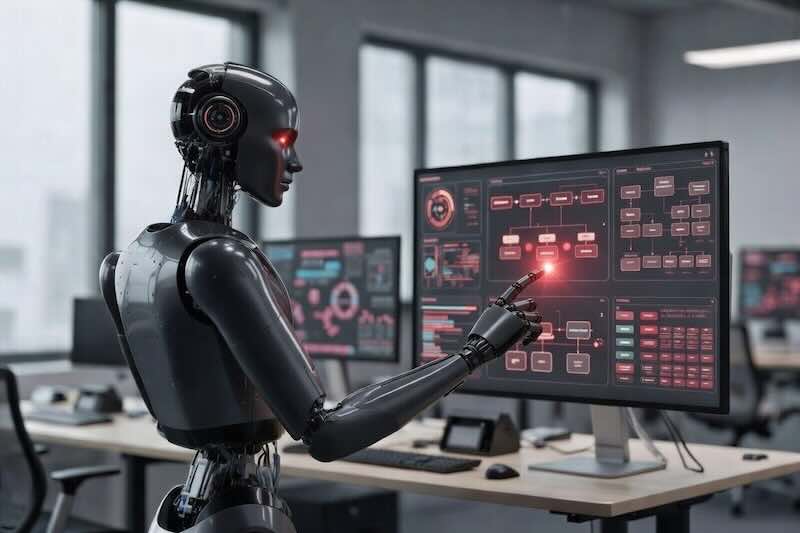
What happened: In the first two months of 2026, AI transitioned from chatbot to full executive assistant — triggering a broad market sell-off across software, legal, insurance and cybersecurity stocks as investors repriced what AI can now replace.
Why it matters: The capability leap is arriving precisely as the safety frameworks meant to govern it are being dismantled. Anthropic scrapped its core safety pledge this week under competitive pressure, replacing hard commitments with what it described as "nonbinding, publicly declared targets."
Wider context: "AI just went through its third inflection," Nvidia CEO Jensen Huang told CNBC. "Now, with these agentic systems, we're having these agents able to reason, take tasks, and actually do work." Researchers at both OpenAI and Anthropic have resigned in recent weeks, warning of the risks. The political battleground over AI regulation is also intensifying: New York Assemblyman Alex Bores, who authored the first major AI safety law in the country, now faces a $125 million super PAC backed by OpenAI co-founder Greg Brockman and Andreessen Horowitz as he runs for Congress.
AI just leveled up and there are no guardrails anymore — CNBC
Singularity Soup Take: The troubling irony is that the companies most invested in safety rhetoric are the ones abandoning binding commitments now that capability has outpaced convenience — and they're being rewarded for it by the market.
Key Takeaways:
- Third inflection: Nvidia's Jensen Huang characterised current agentic AI as a distinct generational leap — systems that don't just respond but reason, plan, and execute tasks independently.
- Safety pledges downgraded: Anthropic replaced its binding responsible scaling commitments with "nonbinding, publicly declared targets," citing competitive pressure from rivals operating without equivalent constraints.
- Market sell-off is broad: Stocks across software, legal, insurance and cybersecurity sectors fell as investors absorbed that agentic AI isn't a future risk but a present one for knowledge-work incumbents.
- Political fight intensifying: AI safety advocate Alex Bores faces a $125 million industry-backed super PAC in his congressional race — a test case for whether financial intimidation can suppress AI regulation nationally.