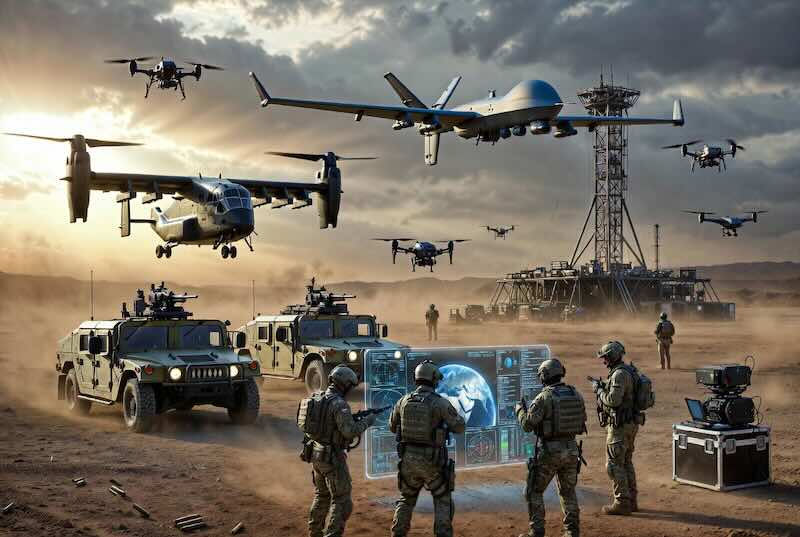
What happened: Sky News reports that military forces are increasingly using AI-powered decision-support tools, and experts say it is plausible such systems are influencing how targets are selected and prioritised in current US strikes linked to the Iran conflict.
Why it matters: The advantage isn’t autonomous weapons so much as speed: these systems can fuse huge volumes of data—imagery, signals, logistics, and open-source feeds—and surface recommendations faster than human teams, tightening decision cycles in high-pressure operations.
Wider context: The story points to Israel’s reported use of AI to help flag targets in Gaza and to the US defence push to become an ‘AI-first’ force, alongside public claims by AI vendors that humans remain responsible for lethal decisions and that certain uses are off-limits.
Background: Researchers and ethics experts warn that ‘human in the loop’ can degrade into rubber-stamping when time is compressed, and that model failures and overconfidence—seen in tests of systems like Claude and ChatGPT—raise the risk of errors in unpredictable, high-stakes environments.
AI could be giving US lethal edge in Iran war - but there are dangers — Sky News
Singularity Soup Take: ‘Human in the loop’ is a comforting slogan, but the real safety question is whether commanders have the time, incentives, and independent evidence to challenge AI recommendations—because speed can turn oversight into theatre just when mistakes are most irreversible.
Key Takeaways:
- Speed vs scrutiny: Decision-support AI can make targeting and threat-ranking faster, but experts quoted argue that compressed timelines make meaningful human review harder, increasing the chance of ‘rubber-stamping’ rather than critical assessment.
- Data fusion at scale: These systems can combine satellite imagery, intercepted communications, logistics data and social media streams to surface patterns; that capability can be militarily valuable, but it also concentrates risk if the underlying inputs or model assumptions are wrong.
- Fallibility in high stakes: The article highlights that modern models can fail on basic perception and still insist they’re correct; in warfare, that kind of confident error is dangerous because the environment is noisy, adversarial and often impossible to fully verify in real time.