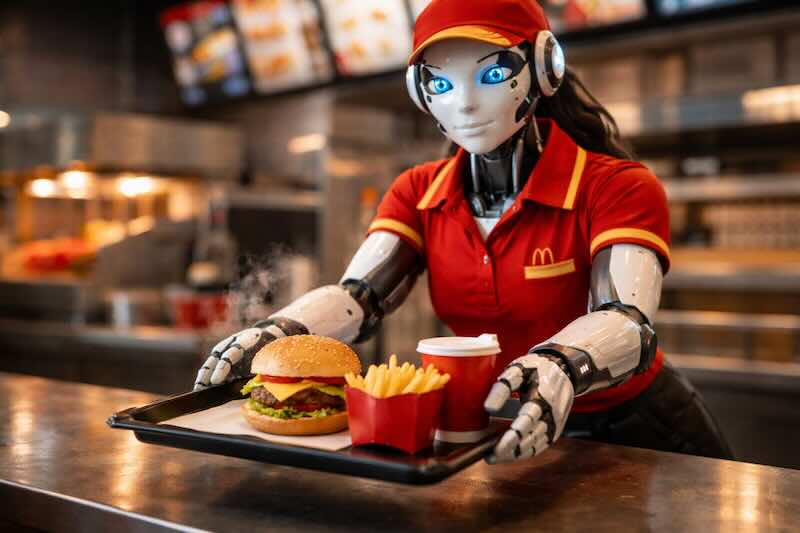
What happened: Japan’s KDDI and AVITA are working on domestically developed humanoids for frontline customer service, arguing that “physical AI” can close staffing and operational gaps where software automation alone falls short.
Why it matters: The pitch is that hospitality and support roles depend on non-verbal cues—eye contact, nods, and facial expressions—that industrial robots and chatbots typically can’t deliver, so the hardware and the interaction layer become part of the product.
Wider context: Their approach ties robotics to data-centre and network capacity: KDDI provides low-latency connectivity and cloud processing so visual and motion data from real customer interactions can be fed back to improve the system’s behaviour over time.
Background: The project builds on earlier deployments of remote customer service using digital avatars in retail settings, with trials of freely moving physical units planned for autumn 2026, including possible use in au Style shops.
Physical AI adoption boosts customer service ROI — AI News
Singularity Soup Take: “ROI” in physical customer service will hinge less on the humanoid’s face and more on the unglamorous plumbing—reliable networks, data governance, and operational ownership—because the moment cameras and motion data enter public spaces, complexity and risk scale fast.
Key Takeaways:
- Partnership Model: AVITA brings avatar and interaction expertise while KDDI supplies communications infrastructure, framing humanoids as a combined hardware-plus-network product rather than a standalone robot deployed in isolation.
- Data Loop Dependence: The system relies on real-time transmission of visual and control data, then uses the resulting motion/interaction data to train and improve behaviour—making connectivity and compute capacity a core constraint for rollout.
- Enterprise Compute Stack: The partners plan to use GPUs hosted at KDDI’s Osaka Sakai Data Center (operational since January 2026) and are exploring integration with an on-premises service for Google’s Gemini model for high-performance generative dialogue.
- Timeline and Deployment: Trials in real commercial facilities are planned for autumn 2026, extending earlier work where digital avatars enabled remote assistance in retail locations such as Lawson stores and au Style shops.
Related News
Britain Protests Target Data Centres’ Rising Power Needs — A reminder that physical AI at scale quickly becomes an infrastructure story, with power, connectivity, and data-centre expansion shaping what’s feasible.
Nvidia Bets $4 Billion on Photonics Suppliers — More compute and faster interconnects are becoming prerequisites for systems that stream rich sensor data and run heavy models in production.
Relevant Resources
AI at Work: How Different Industries Use AI — Useful context for where automation changes frontline roles, what tends to work in practice, and which jobs require human interaction rather than pure workflow optimisation.