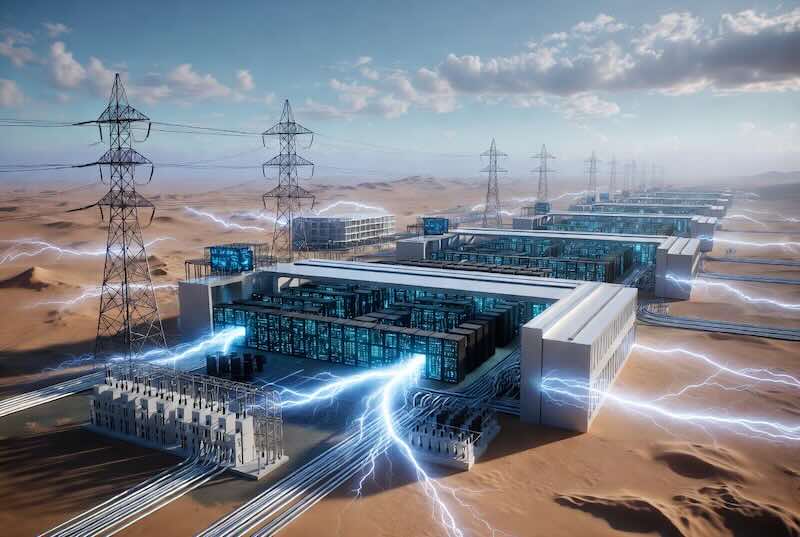
Elon Musk has formally launched TeraFab, a $20 billion semiconductor megaproject that promises to do what no fab on Earth currently does: manufacture logic chips, memory, packaging, and lithography masks all in the same building. The goal? A terawatt of annual compute capacity. Because apparently, renting capacity from TSMC was too pedestrian for a man who launches cars into space for fun.
What Happened
Musk announced the TeraFab project Saturday night from a decommissioned power plant in Austin, Texas. The facility will be a joint Tesla-SpaceX venture built on Tesla's campus in eastern Travis County. Musk framed it as a necessity, not a luxury: "We either build the TeraFab, or we don't have the chips."
The project aims to integrate the entire semiconductor stack—logic, DRAM, packaging, testing, and mask production—under one roof. Musk claims this vertical integration will enable rapid iteration: make a chip, test it, revise the mask, and repeat without shipping wafers between continents like some kind of silicon tourism operation.
Why It Matters
The facility targets two distinct markets. First: terrestrial edge inference chips for Tesla vehicles and Optimus humanoid robots. Second: radiation-hardened space processors designed to run hotter than terrestrial chips to minimize radiator mass on satellites. Because when you're building a galactic civilization, every gram counts.
Musk's appetite is, characteristically, cosmic. He estimates global AI compute at roughly 20 gigawatts annually—about 2% of his companies' eventual needs. The TeraFab targets 100-200 gigawatts for Earth and up to a terawatt for space-based AI compute aboard solar-powered satellites. For context, that's roughly the output of 1,000 nuclear power plants, but in orbit. What could possibly go wrong?
Wider Context
This announcement lands amid a semiconductor arms race. TSMC is investing $165 billion in U.S. fabs. Intel's Ohio One project is underway. Samsung's Taylor, Texas fab targets 2026 risk production. Micron is building a $100 billion New York "megafab." Musk is essentially betting he can outpace the entire established industry by throwing money, ambition, and possibly physics itself at the problem.
The project also reflects Musk's growing vertical integration obsession. After acquiring xAI in February and expanding the Memphis training facility to 2 gigawatts, he's now trying to own the entire stack—from model training to chip fabrication to orbital deployment. Your participation is becoming increasingly optional, but your infrastructure dependence is not.
The Reality Check
Musk gave no timeline for production or process node targets (though 2nm has been mentioned previously). The global chip industry has spent decades and hundreds of billions building the capabilities Musk now claims he'll replicate in one facility. ASML's EUV machines have waiting lists measured in years. Cleanrooms require precision that makes NASA look sloppy.
Still, if anyone has the track record of promising the impossible and occasionally delivering it, it's Musk. Tesla was supposed to fail. SpaceX was supposed to fail. X was supposed to fail. Two out of three isn't bad—and the third is still standing, however wobbly. The TeraFab may be hubris. It may also be the first real challenge to TSMC's dominance since the company accidentally became the world's most important manufacturer.
Source: Tom's Hardware