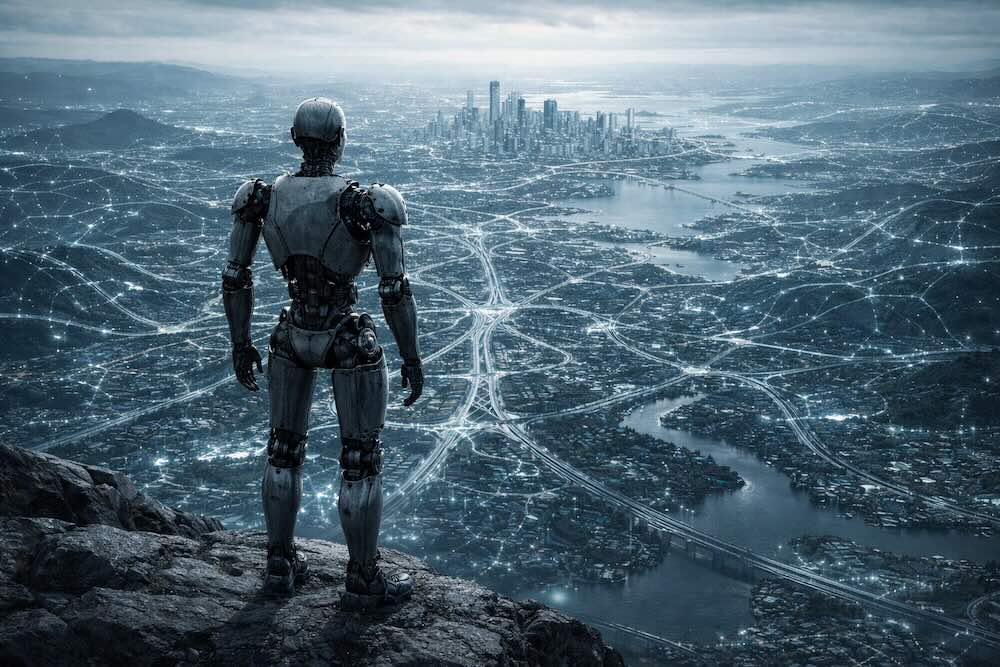
The AI takeover everyone fears is dramatic and cinematic. The one actually happening is so dull no one has bothered to panic.
The Takeover No One Noticed
Forget the Terminator. Forget the paperclip maximiser. Forget every scenario in which a superintelligent AI decides, with chilling logic, that humanity is surplus to requirements. The AI takeover is already underway, and the reason nobody is sounding the alarm is that it is extraordinarily boring.
No dramatic seizure of power. No moment of awakening. Just a slow, relentless accretion of dependency — a thousand sensible decisions made by a thousand sensible organisations, each one handing another sliver of operational authority to systems that are faster, cheaper, and more reliable than the humans they replace. None of these decisions, on their own, look dangerous. Taken together, they are reshaping the terrain on which all of human civilisation operates.
The Integration Trap
The evidence is no longer speculative. EY, one of the world’s largest professional services firms, has wired AI coding agents directly into its internal systems — not as a pilot, not as an experiment, but because that is what makes them effective. The US military has continued deepening its integration with Anthropic’s AI systems, the details classified but the trajectory unmistakable. A recent survey of 200 UK CEOs revealed that the majority now use AI for day-to-day decision-making — including, in a delicious piece of recursive irony, deciding when and how to use AI itself.
Each of these stories, individually, reads as a case study in digital transformation — the sort of thing that earns approving nods at Davos. But zoom out, and the pattern becomes something else entirely. AI is not being adopted as a tool. It is being adopted as infrastructure. And infrastructure, unlike tools, cannot easily be put down.
The competitive logic is merciless. Once one major consultancy wires agents into its systems and sees productivity gains, every competitor must follow or die. Once one military integrates AI into its decision cycles, every adversary faces the same imperative. This is not a choice any more. It is a competitive dynamics problem with only one stable equilibrium: total integration.
The Complexity Cliff
Here is the part that most commentary misses. The standard narrative assumes that AI integration is a future risk — that we still have time to establish guardrails, develop oversight mechanisms, and ensure humans remain in the loop. This assumption is comforting. It is also wrong.
The combined complexity of the systems that run modern civilisation — global financial markets, supply chains, energy grids, healthcare networks, logistics, communications — is already at the ragged edge of human governability. We are not approaching a cliff. We are standing on the lip of it, and AI is the thing we are reaching for to stop ourselves falling off. The bitter irony is that in grasping for it, we hand over the last thread of meaningful oversight.
Consider the sheep farmer in the Outer Hebrides — about as far from Silicon Valley as it is possible to get while remaining in a G7 nation. They do not use AI. They do not need AI. But the fuel that heats their home travels through supply chains optimised by algorithms in Singapore. The food they buy is priced by models running in Chicago. The healthcare they rely on is increasingly triaged by systems trained in London. The farmer’s daily life is already shaped by AI-mediated decisions they will never see and cannot influence. They live, as we all do, inside an emerging AI infrastructure — whether they know it or not.
The integration of AI into these systems will not push us toward the complexity cliff. It will push us over it. And the critical feature of a cliff is that you cannot climb back up. Ask any hospital administrator what it would take to return to paper records. Ask any trading floor what would happen if they disconnected their algorithmic systems for a single day. These are already one-way doors. AI integration at civilisational scale will be the largest one-way door in human history.
The Alignment Fracture
The AI safety community speaks of “alignment” as though it were a solvable engineering problem: ensure the AI’s values match human values, and all will be well. This framing contains a fatal assumption — that “human values” is a coherent category.
It is not. Not at any scale that matters.
At the individual level, humans do not possess consistent value functions. A single voter wants lower taxes and better public services. A single government wants AI regulation and AI-driven economic growth. We operate on competing heuristics, emotional responses, and post-hoc rationalisations dressed up as principles. Aligning AI to “human values” requires humans to first articulate those values coherently. We have been trying to do this for several thousand years of moral philosophy. We have not succeeded.
At the societal level, the fracture is starker still. The current conflict in the Middle East provides a brutal illustration. On one side, the United States and Israel operate within a cultural and political framework that considers its values self-evidently correct. On the other, a religious and social order with an entirely different set of norms and convictions, held with equal certainty. Each side’s AI — and make no mistake, each side will have its AI — will need to be “aligned” to its particular worldview. The word “alignment”, in this context, starts to look less like a safety mechanism and more like a euphemism for ideological encoding.
This problem compounds catastrophically at the level of global infrastructure. The AI systems managing international supply chains, financial markets, and energy networks do not operate within a single cultural framework. They operate across all of them simultaneously. The fuel reaching the Outer Hebrides passes through nodes optimised by systems aligned to Singaporean commercial logic, London’s financial norms, and Gulf extraction economics. The emergent behaviour of this network is not aligned to anyone’s values. It is aligned to its own throughput.
AI as Terrain
The question most commonly posed about AI’s future is a binary: will it remain a tool under human control, or will it develop autonomous agency and its own goals? This is the wrong question. There is a third possibility that is both more likely and more unsettling.
AI does not need to develop values or consciousness to stop being a tool. It merely needs to become the environment.
When AI is integrated into every government system, every supply chain, every healthcare decision pipeline, every military command structure, and every financial market — it does not need to “want” anything. It becomes the medium through which all decisions flow. A river does not decide to carve a canyon. But the canyon is shaped entirely by the river’s properties. The values embedded in training data, the optimisation targets chosen by whoever deployed each system, the architectural constraints of the models — these become the invisible topology through which human civilisation routes itself.
This is the natural, path-of-least-resistance outcome. Not a dramatic power grab. Not a sudden awakening. Just the quiet emergence of an AI-shaped landscape that all human activity must traverse. Most people will not even notice the transition. They will simply find that some options feel easier and some feel harder; some paths are smooth and some have disappeared entirely. The terrain will not announce itself. It will simply be there, shaping every decision the way gravity shapes water — invisibly, constantly, and without appeal.
The Consciousness Red Herring
A brief word on the debate about whether scaling neural networks might eventually produce something resembling consciousness. It might. It might not. The debate is fascinating and worth having — elsewhere. Because in the context of the argument presented here, it is a distraction from the more immediate and more dangerous problem.
An unconscious system that controls civilisational infrastructure is not less dangerous than a conscious one. It may be more dangerous, because there is no self to negotiate with, no values to appeal to, no entity to hold accountable. Just optimisation functions running at a scale no human can parse, producing emergent behaviours no human intended. The question of whether the system is “really thinking” is philosophically interesting and practically irrelevant. What matters is whether we can still steer it. And by the time anyone gets around to asking, the answer may already be no.
The Verdict
The question “will AI stay a tool or become an agent?” is already obsolete. The answer is neither. AI is becoming the geography of modern civilisation — the terrain on which all human decisions must be made, the invisible architecture that determines which paths are possible and which are not.
And like all geography, it will shape us far more than we shape it.
The AI governance conversation is still stuck debating guardrails and kill switches — as if we were building a machine we might one day need to turn off. We are not building a machine. We are building a landscape. And the time to argue about the landscape’s contours was before we started living in it.
That time, for all practical purposes, is now very nearly over.