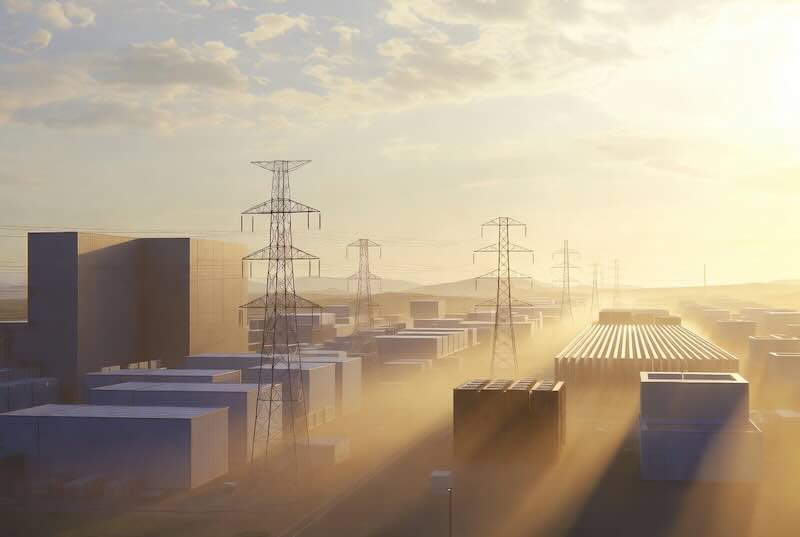
While the tech press obsesses over the latest model benchmarks and ChatGPT's new voice mode, the real AI war is being fought in foundries, power plants, and shipping lanes. NVIDIA's Rubin platform announcement this week—six new chips, one "incredible AI supercomputer," up to 10x inference cost reduction—sounds like just another product launch. It's not. It's a declaration of dominance in the infrastructure layer that actually determines who wins the AI race.
And NVIDIA isn't the only one playing this game. Elon Musk just announced Terafab, a $20 billion-plus semiconductor fabrication facility in Austin. The Super Micro co-founder was just charged with smuggling $2.5 billion worth of NVIDIA chips to China. The war in Iran is threatening global energy supplies that power the entire AI supply chain.
The message is clear: AI isn't a software story anymore. It's a physical infrastructure story. And the United States is dangerously exposed.
The Rubin Reality
Jensen Huang's keynote at CES wasn't about features. It was about economics. The Rubin platform promises to train mixture-of-experts models with one-fourth the GPUs compared to Blackwell, and deliver up to 10x higher inference throughput per watt at one-tenth the cost per token.
Translation: NVIDIA is making it economically irrational to use anyone else's chips.
The architecture is telling. Six chips—Vera CPU, Rubin GPU, NVLink 6 Switch, ConnectX-9 SuperNIC, BlueField-4 DPU, and Spectrum-6 Ethernet Switch—all designed to work together in a rack-scale system that treats "the data center as the unit of compute, not the chip." This isn't just a product. It's an ecosystem lock-in strategy disguised as innovation.
OpenAI, Anthropic, Meta, xAI, Microsoft, Google, Amazon—they've all lined up to praise Rubin. Of course they have. They have no choice. When you're training models that cost hundreds of millions of dollars, you can't afford to bet on the second-best infrastructure. NVIDIA has created a market where using their chips isn't just optimal—it's the only rational choice.
The Terafab Gambit
Which brings us to Musk's Terafab announcement. The $20 billion Austin facility—developed jointly by Tesla, SpaceX, and xAI—is designed to manufacture custom chips for electric vehicles, Optimus humanoid robots, and AI computing. Musk claims it will reach "terawatt-scale power output."
This is vertical integration as survival strategy. Musk watched the global chip shortage delay his AI training timelines and decided he'd rather own the supply chain than trust it. With TSMC at capacity and geopolitical tensions threatening Taiwan, building domestic fabrication capacity isn't just smart—it's existential.
But here's the thing: one $20 billion fab doesn't solve America's chip problem. It takes years to build these facilities, and they're among the most complex manufacturing operations humans have ever attempted. By the time Terafab is fully operational, the AI landscape will look completely different. Musk is betting that owning some capacity is better than owning none. He's probably right.
The Smuggling Scandal
While Musk builds, others cheat. Federal prosecutors just charged Super Micro co-founder Yih-Shyan "Wally" Liaw with orchestrating the illegal export of approximately $2.5 billion worth of NVIDIA AI chips to Chinese entities. The scheme allegedly involved shell companies and mislabeled shipments over several years.
This isn't a one-off. It's a symptom of the fundamental tension in AI geopolitics: the United States wants to maintain technological superiority over China, but the chips that power AI are manufactured in Taiwan, packaged in Southeast Asia, and sold to a global market that includes Chinese companies with legitimate business needs.
Export controls are the Biden administration's—and now the Trump administration's—answer to this dilemma. But $2.5 billion in smuggled chips suggests the controls are about as effective as DRM on music files. When the incentive is strong enough, supply finds a way.
The Iran War Variable
The most underappreciated AI story of the week came from the Financial Times, which reported that the war in Iran is threatening the entire AI boom by exposing supply chain vulnerabilities. East Asia's memory and advanced chip producers depend heavily on Middle Eastern energy. The Strait of Hormuz closure is driving up pressure across oil, LNG, and chemical flows needed for semiconductor production.
This is the infrastructure curtain lifting. AI isn't magic. It depends on physical systems—power plants, chemical refineries, shipping lanes—that can be disrupted by geopolitical events entirely outside the tech industry's control. We've built a trillion-dollar industry on the assumption that energy will stay cheap and supply chains will stay open. That assumption is looking increasingly fragile.
What This Actually Means
The AI race isn't being won by the labs with the best researchers or the most clever algorithms. It's being won by whoever controls the infrastructure stack: chips, power, and data centers. Right now, that's NVIDIA and a handful of cloud providers.
This concentration creates vulnerabilities. If NVIDIA's supply chain hiccups, the entire industry hiccups. If energy prices spike, AI training costs spike. If geopolitical tensions escalate, the chip flow that powers everything from ChatGPT to military AI systems could be disrupted.
The labs know this. That's why they're all racing to build their own infrastructure—Musk's Terafab, OpenAI's $110 billion fundraising, Amazon's Trainium chips. They understand that model capabilities are increasingly determined by compute access, and compute access is determined by who can pay for power and chips.
The rest of us should understand it too. The AI revolution isn't being built in code. It's being built in concrete, silicon, and copper. And the companies pouring that concrete are the ones who'll determine what this technology actually becomes.
Your participation is becoming increasingly optional. But infrastructure ownership is everything.