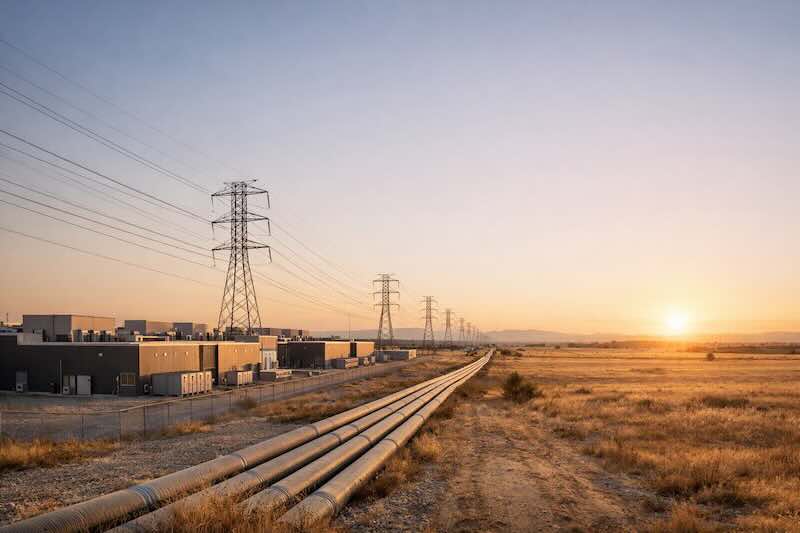
When GPUs are abundant, networking becomes the constraint — and that quietly shifts power from model labs to the companies that control optics, export licences, and grid capacity.
Nvidia’s $4 billion push into photonics looks like a supply-chain footnote, but it’s a tell: the next phase of AI competition won’t be decided only by chips, but by the plumbing that connects and powers them.
What Happened
CNBC reports Nvidia will invest a combined $4 billion — $2 billion each — into photonics firms Lumentum and Coherent, alongside multi-year strategic agreements that include large purchase commitments and future capacity rights for advanced laser components and optical networking products. Jensen Huang framed the move as part of building “gigawatt-scale AI factories,” signalling a focus on the network layer inside next-generation data centers, not just the GPU trays.
Separately, the Los Angeles Times reported U.S. officials are considering per-customer caps on how many advanced AI accelerators Nvidia can export to any single Chinese firm — figures discussed included 75,000 H200 chips per company — as part of a broader attempt to manage both the volume and the strategic impact of high-end compute flowing into China.
Put those two stories together and you get a clearer picture of where the industry’s constraint is moving: from training algorithms, to chips, to clusters — and now to the optics and regulatory chokepoints that determine who can run what, where.
Why It Matters
AI has entered an era where “more GPUs” is no longer a complete strategy. The top-end systems that matter — frontier training runs and large-scale inference fleets — behave less like standalone servers and more like tightly-coupled supercomputers. In those systems, interconnect bandwidth, latency, and reliability become first-order constraints. If the GPUs can’t talk to each other fast enough, you pay for expensive silicon that sits idle.
Photonics is Nvidia’s admission that the bottleneck is now as much about moving bits as it is about crunching them. Silicon photonics, lasers, transceivers, and optical switching are the enabling layer for scaling from “a big cluster” to “a factory.” If you control capacity rights in that supply chain, you control the pace at which hyperscalers and model labs can actually deploy.
Meanwhile, export rules don’t just cap hardware; they shape the geography of AI capability. A per-customer H200 cap isn’t only about limiting Chinese national champions — it’s also a way of preventing concentrated, gigawatt-scale compute from appearing in a single place under a single operator. The intent is dispersion, friction, and delay. The result is that “who can build” becomes a political question, not merely an engineering one.
Wider Context
We’ve been living through a repeated pattern: each time one constraint is partially solved, the next one becomes visible. First it was data and models; then it was GPUs and memory bandwidth; then it was power, cooling, and land; now it’s the mesh that ties everything together — networking, optics, and the licensing regimes that decide which firms can buy what.
This matters for competition in a non-obvious way. The dominant narrative says model labs compete on algorithms and talent, while Nvidia competes on hardware. In reality, the winners will be the organisations that can integrate the whole stack: chips, interconnect, storage, power contracts, and deployment logistics. That is why “capacity rights” in photonics are strategically similar to reserving wafer capacity at a foundry. They are a claim on the future.
Export controls also change the incentives for second-best ecosystems. If China’s access to top-end chips is capped and bureaucratically mediated, Chinese firms will increasingly rationalise around domestic alternatives, even if performance lags. That doesn’t mean the alternatives instantly become world-class — but it does mean they get volume, developer attention, and the long runway that ecosystems need. Paradoxically, poorly-designed restrictions can accelerate the very substitution they aim to prevent.
The Singularity Soup Take
Nvidia is selling a story about “AI factories,” but the real product is control over bottlenecks. When the limiting reagent is optics and deployment capacity, the company that can lock in supply and standardise the interconnect gets to set the tempo for the entire industry. Policymakers should read that as a warning: if you want to influence AI outcomes, you won’t do it only by regulating models. You’ll do it by shaping the infrastructure layer — export licences, power and grid policy, and the supply chains for the components that make scaling possible.
What to Watch
Watch whether Nvidia’s photonics partnerships turn into de facto platform lock-in — where “Nvidia inside” extends from GPUs to the network fabric and the optical supply chain. Watch the details of any per-customer export caps: do they become enforceable rules, or negotiating leverage ahead of diplomatic meetings? And watch where hyperscalers build next. If grid constraints and export rules push compute into new geographies and smaller, distributed inference sites, the next AI advantage may come from deployment strategy — not model architecture.
Sources
CNBC — "Nvidia to invest $4 billion into photonics companies Coherent and Lumentum"
Los Angeles Times — "U.S. considers caps on Nvidia chips for China"
Data Center Knowledge — "New Data Center Developments: March 2026"