TL:DR: AGI isn’t a finish line; it’s a distraction. We don't need a "Silicon God" when a "Choir of Experts" (orchestrated narrow AIs) already does the job cheaper and faster. The real barrier isn't raw power—it’s Salience. Until a machine has "skin in the game" and can notice when the rules of the world have changed, AGI remains a high-priced human fantasy.
The Verdict: Efficiency wins over "Generality" every time. We're building better tools, not a new species.
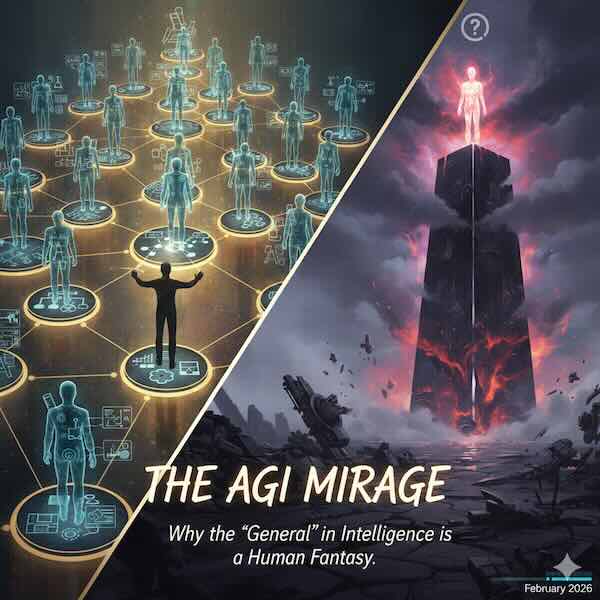
We have been told for a decade that AGI is the "final invention" of humanity. We imagine a silicon god that can write code with its left hand and compose symphonies with its right. But as we peer into the architecture of the future, a localized truth is emerging: We don't need AGI to change the world, and even if we built it, we might not want to pay for it.
The Tension: The Scaffolding and the Soul
The current debate is trapped in a false dichotomy: Are we building one "General" mind, or a "Choir" of specialized experts?
Mainstream hype suggests that once we scale compute high enough, "Generality" will simply emerge—a ghost in the code. However, our analysis suggests that "Generality" isn't a level of power, but a specific type of meta-cognitive scaffolding. Right now, humans provide that scaffolding. We are the "Conducting Tissue" that recognizes when a logistics problem is actually a political one. We are the ones who transfer the "vibe" of one domain into another.
"AI can solve the puzzle, but it cannot yet notice the room is on fire."
The Analysis: The Salience Bottleneck
The technical reality is that narrow, specialized AI is economically superior. A model that only solves for oncology is cheaper, safer, and more accurate than a generalist that also wants to debate Proust. But the danger of this "Efficiency Trap" is the 1% Problem.
In a world of stable rules, narrow AI wins. But we live in an adversarial, "Black Swan" universe. Biological intelligence is "General" not because it's efficient, but because it's robust. It can handle "frame-shifts"—those moments when the rules of the game change overnight (think COVID-19 or the sudden collapse of an industry).
The true bottleneck isn't "Reasoning"—it's Salience. We have yet to build a system that can distinguish between "Data" and "Meaning" without a human tether. Without a unified drive—something akin to a survival instinct—AI lacks "judgment." It has pattern-matching, but no "skin in the game."
The Verdict: The Transition to Orchestration
The "Singularity" won't be a single spark of AGI. It will be the "Great Orchestration." We are entering an era of Advanced Cross-Domain Mapping, where the "General" in AGI is replaced by a high-dimensional switchboard of experts.
The question of whether this system has an "I" or a "Soul" is a philosophical distraction. The real challenge is whether we can teach a machine Phronesis—practical wisdom. Until a machine can "feel" the consequence of being wrong, it will remain a brilliant tool, but a hollow agent. We aren't building a God; we are building a very complex, very efficient mirror of our own cognitive biases.
Further Reading
The Philosophical Foundations: Why "Meaning" is Hard
Hubert Dreyfus: What Computers Still Can't Do * Why it adds value: Dreyfus was the original "Soup" provocateur. His 1972 critique of AI remains the definitive argument on why disembodied logic-gates struggle with the "unconscious background" of human common sense. This is the root of our Salience Bottleneck argument.
Marco Masi: No Consciousness? No Meaning (and no AGI!) * Why it adds value: A 2025 preprint that explores the "Syntax vs. Semantics" gap. It argues that without subjective experience, an AI is just a sophisticated pattern-matcher that can't cross the threshold into true semantic understanding.
The Technical Reality: The "First-Step Fallacy"
Melanie Mitchell: Why AI is Harder Than We Think * Why it adds value: Mitchell (a Santa Fe Institute professor) outlines the "First-Step Fallacy"—the mistaken belief that because we’ve made progress on narrow tasks (like Chess or Go), we are on a continuous path to AGI. This provides the technical evidence for our 99/1 Economic Reality point.
Distant Domain Transfer Learning (AAAI Research) (PDF) * Why it adds value: For readers who want to see the math behind our "Vibe Transfer" metaphor. This research explores why "Distant Domain Transfer" (applying lessons from unrelated fields) is still an unsolved frontier in machine learning.
The Future of Orchestration: Agentic Systems
IBM: What is AI Agent Orchestration? * Why it adds value: This provides the "Corporate Reality" counter-weight. It explains how industry is already moving away from "General" models and toward the "Digital Symphony" of specialized agents we discussed in the Synthesis.
Specialist AI Agents vs. General AI (DEV Community) * Why it adds value: A great breakdown of the Economic Efficiency argument, detailing why niche models are winning the ROI war in the 2024–2026 landscape.