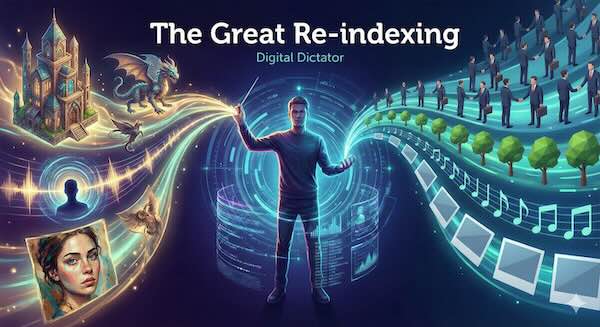
The year 2026 has brought us to a strange, jagged horizon. For decades, we defined "creativity" by the manual labor required to manifest it: the hours spent scouring a stock library for the "least-bad" photo, the weeks a level designer spent placing individual ferns in a digital forest, or the grueling logistics of a 200-person film set.
Today, that definition is dead. We are witnessing the Great Re-indexing, a fundamental mutation where the human creator has been promoted from a "searcher and laborer" to a Digital Dictator. The question is no longer whether AI can create "better" content than a human—it already does—but whether we are prepared for a world where art is stripped of its scarcity and its struggle.
The End of the "Utility" Creator
The first casualties of this era are the mid-tier "utility" creators. The image and music libraries of the early 2020s were essentially graveyards of best guesses—vast archives of "Uplifting Corporate Acoustic" tracks and "Business People Shaking Hands."
- The Technical Shift: We have moved from Static Scarcity to Dynamic Intent. A creator doesn't "find" an asset anymore; they calculate it.
- The Market Reality: Smaller stock libraries are folding because they cannot compete with a "Spatial LLM" that creates the exact lighting, species of tree, and time of day a director requests.
- The "Clean Data" Pivot: The remaining giants (Getty, Shutterstock) have realized that their value isn't in selling pixels to humans, but in selling legal indemnity to AI companies. The library is no longer a store; it’s a fuel tank for models.
Synthesis Note: We shouldn't mourn the "mid-tier" professional who lived on functional art. If 90% of creative work was filler, its automation isn't a loss of art—it’s the liberation of the intent.
Gaming: From World-Building to World-Curating
In gaming, the "hand-placed tree" has become the "hand-cranked car"—a quaint relic. Using contextually aware AI, we can now generate worlds the size of Jupiter with more biological and physical consistency than a tired human designer could ever manage.
However, this "perfection" creates a new tension: The Isolation of the Infinite. * The Shared Secret: Gaming culture was built on "Did you see that?"—shared discoveries in a fixed world.
- The Individual Silo: When a Spatial LLM generates a unique, 100-mile valley tailored specifically to your playstyle, you are the only person who will ever see it.
- The Verdict on "Soul": Critics argue these worlds are "Gameslop"—technically perfect but emotionally hollow. But they miss the point. The "soul" of a game doesn't come from the manual placement of a rock; it comes from the intent of the mechanics. AI has turned game development into a high-fidelity interface for human imagination, removing the technical tax on ambition.
Film and the "Wealth Filter"
The film industry is currently hitting the Logistics Singularity. While we aren't yet at the "one-click blockbuster" stage, the components are already here: Elastic Actors (biometric assets that can be directed via prompt) and Real-time Generative Video that eliminates the need for expensive post-production.
The most profound impact here isn't technical—it's demographic. For a century, cinema was protected by a massive "Wealth Filter." You needed millions of dollars to tell a visual story at scale.
- AI has effectively smashed this filter.
- A "Prompter-Director" can now do the work of a gaffer, a boom op, and a colorist simultaneously.
We are trading the "human sweat" of a 200-person crew for the raw vision of a single mind. Some call this the end of Hollywood; we call it the democratization of the epic.
The Verdict: Intent is the New Craft
The prevailing media narrative laments the loss of "human touch," but it often confuses "touch" with "technical limitation." We are entering an era of Ambient vs. Bespoke art.
- Ambient Content: The "good enough" background noise of our lives will be 100% automated, personalized, and disposable.
- Bespoke Art: True human creativity will no longer be measured by the ability to operate a camera or a DAW, but by the depth of the prompt and the originality of the intent.
AI hasn't removed the human from the creative process; it has stripped away the "clutter" of production, leaving only the pure, terrifying responsibility of having an actual idea. In the future, the only thing AI won't be able to generate is the reason why the art needed to exist in the first place.